


India II. Part 2
Description
This section is from the book "India - John L. Stoddard's Lectures", by John L. Stoddard. Also available from Amazon: John L. Stoddard's Lectures 13 Volume Set.
India II. Part 2
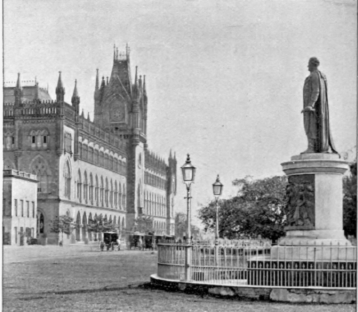
Anglicized Calcutta.
Occasional statues of distinguished Englishmen then seem to be its only occupants. But when the solar shafts fall on this promenade obliquely, and pierce with difficulty, if at all, the drooping fringes of the palms, the British colony appears as if by magic, invading the vast area from all directions, much as the chorus of an opera troupe pours in upon an empty stage. Between five and seven o'clock the spectacle here displayed is rarely, if ever, equaled in the world. While military music stirs the balmy air, one sees along these avenues the most astonishing varieties of costumes and complexions. Even the simplest carriage of an English family will have its native coachman robed in white from head to foot and a dark groom resplendent in huge colored turban and gold-embroidered jacket; and these, with Indian princes, wealthy Parsees, and rich Hindus, give to the scene a touch of Oriental splendor.

A Calcutta Street.
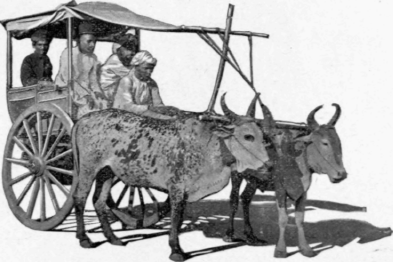
A Calcutta "Herdic".
But, while the English in India are prudent enough to avoid the parks in the middle of the day, they have decided, absurdly enough, that the fashionable time for making calls shall be from twelve to two. One wretched victim of this social tyranny recently defined these Indian morning-calls as "The destruction that wasteth at noonday."
We could not wonder that the English who reside in India look on Calcutta in the winter as an Eastern Paradise. It is, indeed, the centre of the Government, and here the Governor-general of India holds a court, said to surpass in brilliancy that of most European sovereigns. At Christmas time, especially, the town is thronged with officers of the army and navy and all the notable men in England's Indian service.
Then, also, hundreds of visitors from Europe, America, and Australia constitute a most distinguished and enjoyable society. But this is only one side of Calcutta. The native side is very different. The former is, of course, more agreeable to the English, and is the one more frequently described by travelers. But we all know what Europeans are like. The question is, what do the natives resemble? For, in India, where the foreigners number about one hundred thousand, the natives reach a population of three hundred millions. They are very easily studied at Calcutta, for at almost any point a short walk brings one from public buildings and spacious thoroughfares to the disgusting filth and poverty of the common Hindus. Most of the native streets are dirty alleys; most of their dwellings, hovels made of sun-dried mud or of bamboo poles covered with coarse matting. The occupants, in many instances, have their well-nigh naked bodies greased with rancid butter (which they consume internally as well), and even their hair is smeared with the same mixture. The pungent odor of this lubricant, combined with the smoke of burned manure, which is the fuel of India, gave to the atmosphere a peculiar quality which I shall always associate with Hindustan.
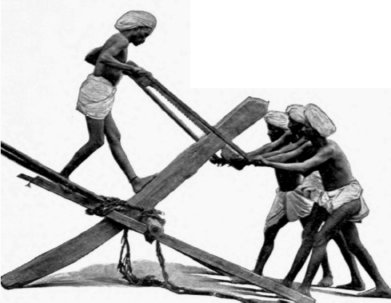
Dressed For Work.
Some of the natives - tailors and cobblers - we found hard at work, seated in holes in a plastered wall, like dogs in their kennels. Even the splendor of the Mogul palaces which we afterward beheld could not make me forget this misery and degradation. India is a land of terrible extremes. Whatever is good there is superlatively good, and what is bad can hardly be imagined worse. Thus, in the matter of hotels, the very best in Calcutta is the Great Eastern; but it is my deliberate conviction, based upon an experience of many never-to-be-forgotten days and nights, that, whereas, all the hotels in India are bad, those of Calcutta are worse than those of any city of its size and prominence in any country of the civilized world. It is true, the Great Eastern is well situated, and covers a great area; but in this case, "O, what a goodly outside falsehood hath!"
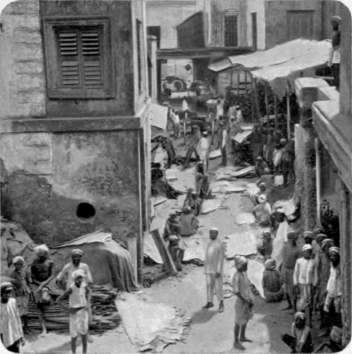
The Native Quarter.
My traveling companion and myself, having telegraphed in advance, were assigned to a room on the best floor of the hotel. We reached it by a long, dark corridor about four feet wide. This space was made still smaller by a line of Hindu servants who were lying on the floor - one in front of each door. Through these we picked our way to room number "54." I give the number, not that the reader may specially avoid it when he goes there (since most of the other rooms are equally bad), but that, on seeing it, he may remember me and murmur: "There was a man who told the truth." The walls of this room did not come within two feet of the ceiling, and, as most of the other apartments were equally well ventilated, we assisted by day at half a dozen family quarrels, and at night could hear the whole brigade of Hindus snoring in the corridor. The Oriental way of calling servants is by clapping the hands. This is occasionally inconvenient; for in a room next to mine was a refractory child, and every time his mother spanked him all the servants in the entry responded to the call.
Continue to:


My Books

