


India II. Part 18
Description
This section is from the book "India - John L. Stoddard's Lectures", by John L. Stoddard. Also available from Amazon: John L. Stoddard's Lectures 13 Volume Set.
India II. Part 18

Looking Toward The Taj.

A Mountain Of Alabaster.
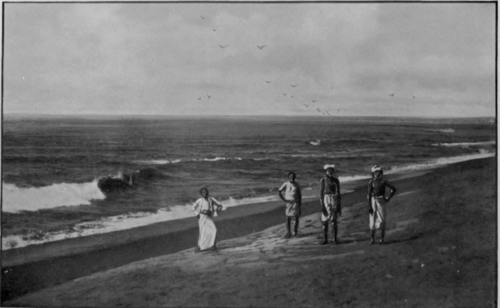
India's Coral Strand.
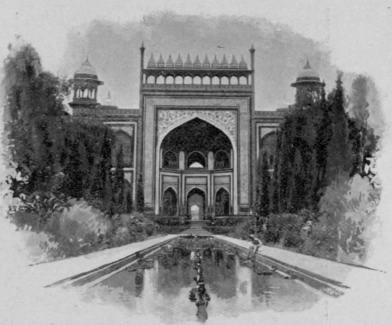
Gateway Seen From The Garden.

Lacework In Marble.
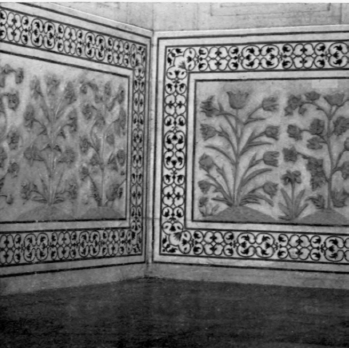
A Section Of The Taj.
Our admiration of the Taj was still further increased, when we examined its marvelous decorations. Around each archway, inlaid in black marble, are delicate arabesques and countless verses from the Koran, - the graceful Oriental characters mingling and intertwining like the finest scroll-work or the slender stems and tendrils of a creeping vine. The walls appear almost as massive as the eternal hills, yet on their milk-white surface thousands of roses, tulips, hyacinths, and daisies are sculptured in relief, as though real garlands had been hung here once with such consummate skill that some delighted genie of the Arabian Nights had, by a stroke of the enchanter's wand, transformed them into stone. As I surveyed them with delight, I caught my breath to think of all the labor represented here, and of the patient fingers (long since turned to dust), which planted all these jeweled flowers in their snow-white beds, and made them bloom unchanged from century to century. The Taj, which was begun in the year 1630, is said to have occupied twenty thousand men for twenty years. All India furnished its materials. The marble came from one province, the sandstone from another. The Punjab sent it jasper; Ceylon gave sapphires and lapis-lazuli; and agate, onyx, turquoises, and carnelians came from Thibet, Persia, and Arabia. A twilight gloom pervades the interior of this wonderful mausoleum; but if electric light could suddenly be introduced here, one could believe himself within Aladdin's cave. For then the walls would show with dazzling effect their inlaid agate, jasper, bloodstone, and carnelian. It seems as if the emperor, in madness at his loss, and counting earthly wealth as nothing, had thrust his arms repeatedly into the glittering coffers of the Mogul treasury, and, drawing forth great handfuls of rare gems, had scattered them upon this tomb, as ordinary men would lay upon a grave bouquets of flowers. In the very centre of the mausoleum I saw what seemed to be a circular frame of lace suspended from the roof by unseen cords. It is, in reality, a screen of alabaster, six feet in height and sixty in circumference. Each panel is a single piece of alabaster several inches thick, yet carved with so much elegance and skill that one must touch it to believe it stone. Within this exquisite enclosure are two marble cenotaphs, completely covered with mosaic-work in precious stones, one hundred being sometimes used to represent a single flower; and through this mass of floral decorations runs a delicate Persian script, telling the story of these royal lovers in lines of which each letter is a gem.
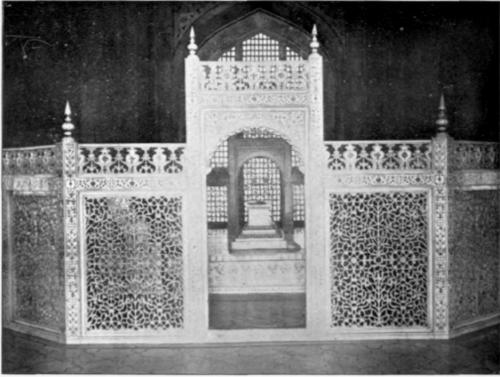
The Screen Of Alabaster.
Continue to:


My Books

