


India II. Part 16
Description
This section is from the book "India - John L. Stoddard's Lectures", by John L. Stoddard. Also available from Amazon: John L. Stoddard's Lectures 13 Volume Set.
India II. Part 16
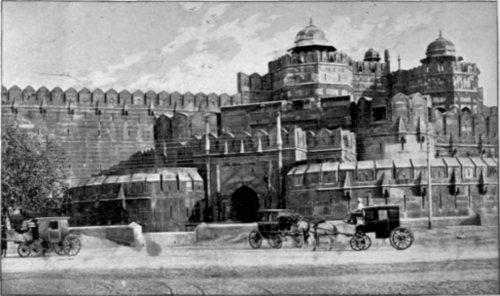
The Fort At Agra.
"A palace lifting to eternal summer Its marble halls from out a glossy bower Of coolest foliage, musical with birds."

Group Of Female Teachers.
In Agra as in Delhi, stands a mighty fortress, built by Akbar. I could not think of this as a mere citadel. It seemed rather a city in itself; for it is nearly two miles in circumference, and is entirely enclosed by ramparts seventy feet in height. Around it winds a moat a hundred feet in breadth, from which at frequent intervals rise massive towers, like mediaeval castles on the Rhine. The color of this belt of masonry is a deep red, which in the glow of sunset is suggestive of the sanguinary scenes it has so often looked upon. At such a time one easily fancies that the moat itself is filled with blood, whose horrible reflection paints itself upon the stone.
Its massive gateway, guarded constantly by sentinels, is a reminder that the primary object of this structure is defense. At all events, a large amount of arms and ammunition is now stored within its walls; and in the event of another mutiny, this would become invaluable as a place of refuge. In the days of the Mogul emperors this fortress was a kind of strong box, containing the palace and the sacred treasures of the empire. To some extent it is so still. For, though the throne of the Moguls has fallen, and their resplendent diadems and diamond-hilted swords have all passed into other hands, yet even now this beautifully sculptured casket holds some architectural jewels that have few equals in the world.
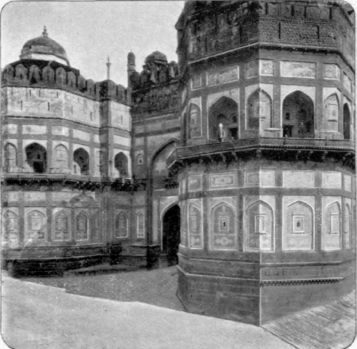
The Gateway.
The first of these to greet the tourist as soon as he has passed the portal, is called the Pearl Mosque, and from its spotless purity and beauty it deserves the name; for everywhere in its enclosure, - roof, columns, walls, and pavement are as white as alabaster. No other sanctuary on earth exhibits such simplicity and purity. Here are no images or paintings, or even gilding; one is surrounded only by the chaste white marble, with vines and flowers carved upon it in relief. Oh, the immeasurable superiority of this immaculate pearl of Oriental architecture over the sickening idolatry and filth of Hinduism! No furniture, not even a rug, profanes this beautiful expanse; but the marble pavement is carefully divided by the sculptor's chisel into rectangular spaces, on each of which a follower of Mahomet may kneel in prayer. What an example is this of the restraining power of the Mohammedan religion! For, more than twelve hundred years ago, the Koran forbade the followers of the Prophet to make any likeness of animal life, lest it should lead to idolatry; and during all these centuries that rule has been obeyed. The Moslems, it is true, have thus been kept from cultivating painting and sculpture, but what have they not accomplished in architecture, from Granada to Damascus, and from these Mogul palaces to the Taj Mahal!
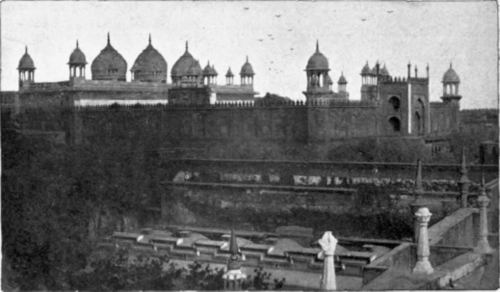
A Corner Of The Fort, Agra.

Exterior Of The Pearl Mosque.
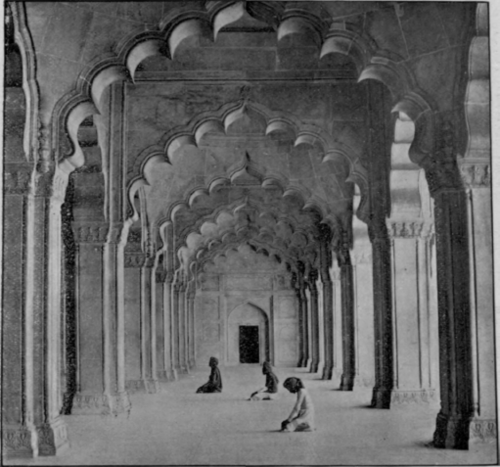
The Pearl Mosque.
At a little distance from this mosque, but still within the fort, stands the palace in which the Mogul emperors resided when at Agra. It seems as if the inmates of such glorious halls should have led lives as full of joy as their apartments were of beauty. Yet sculptured stone, however exquisite, can never satisfy the heart, and even jeweled walls cannot atone for loss of liberty. So it was here. Its builder was the lavish Shah Jehan, who also built the equally magnificent palace at Delhi and the incomparable Taj Mahal. And yet he spent the last seven years of his life here, a hopeless captive, imprisoned by his rebellious son ; experiencing thus that bitterest of sorrows, - ill-treatment and ingratitude from a heartless child. One thing, however, gave Shah Jehan some consolation; for, when all others had abandoned him, his faithful daughter would not leave him. She voluntarily shared his long imprisonment, striving to make her love atone for all that he had lost. Her very name, "Jehanara," was but the softened echo of his own, and it was in giving birth to this child that the Emperor's idolized wife had died. Renowned for wit and beauty, she might have held a brilliant place at her brother's court; but she preferred the prison of her father, displaying thus the noble traits of character that have immortalized her memory.
Continue to:


My Books

