


India II. Part 14
Description
This section is from the book "India - John L. Stoddard's Lectures", by John L. Stoddard. Also available from Amazon: John L. Stoddard's Lectures 13 Volume Set.
India II. Part 14

An English Regiment.
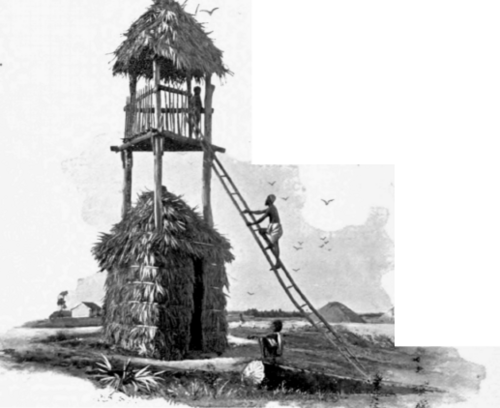
The dwellings of the common peasants on the plains of India sug-gested to my mind feathered dog-houses, sometimes surmounted by a second story, where the inmates keep a look-out for crows. One readily sees that the vast majority of these people do not understand the character and customs of the men who govern them. The Hindus, for example, living on a little rice, and thinking it an atrocious crime to kill an animal, regard with horror and contempt the godless foreigners who gorge themselves with beef and mutton; and the Mohammedans, who are forbidden by the Koran to touch intoxicating drinks, shudder to see Europeans consume astonishing quantities of brandy, whisky, and champagne. A story is told of a Hindu servant who was devotedly attached to his English master. When the latter died, the native desired to carry out the Oriental custom of comforting the spirit of the deceased by bringing to his tomb a sample of the food of which, in life, he had been especially fond. Accordingly, he knelt beside his master's grave, and, with tears streaming down his cheeks, poured out to the dead Englishman a copious libation of - brandy and soda.
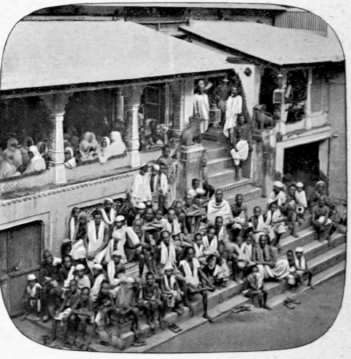
Some Subjects Of Great Britain.
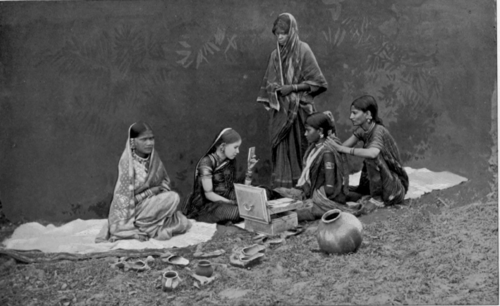
An Open-Air Boudoir.
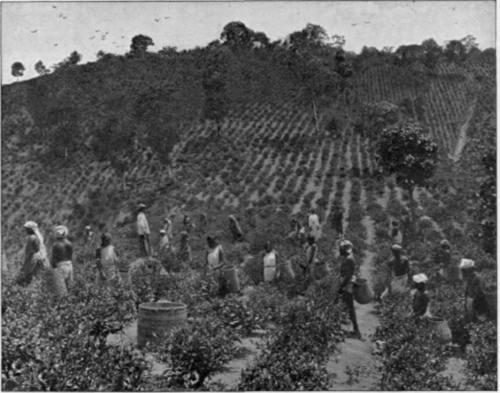
Tea Picking In India.
When one occasionally gains a glimpse of one of the Indian princes whom England has deposed, he naturally asks (as they themselves no doubt, have often done), "What right have the English in India, anyway?" About the same right they have in Burma and a score of other places; the same right that the French possess in Siam, or that various nations now have in the continent of Africa. The recent history of Oriental politics is, after all, a simple one. Stripped of all glittering rhetoric, the situation is just this: Europe desires to control the trade of a certain country, and sends out merchants to obtain it. If the unfortunate country does not wish to trade, Europe bombards her till she yields and business is established. Of course, complications soon arise. The Orient is always in the wrong. A war ensues. The Orient is defeated and must pay indemnity. In order to collect it, European officers are appointed, and the unhappy country is taken under European "protection," which means, eventually, not only annexation, but the appropriation of much private property. There have been writers, even among the English, bold enough to declare that England had no more right to the private jewels of one of the kings whom she dethroned in India than to the crown diamonds of Russia.
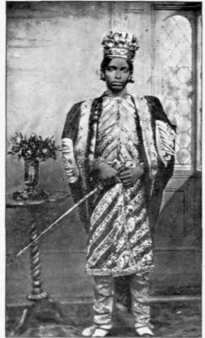
An Indian Prince.
Yet, in justice to England, it should be remembered that, although other European nations feign to regard such conduct with the utmost horror, they are all watching for a chance to do the same thing. The principal difficulty seems to be that England has appropriated almost everything in sight. The other nations, therefore, are in the position of the smaller lions, represented in the picture of Daniel in the lion's den, of which a Sunday-school boy once said to his teacher: "Please, ma'am, those little lions in the corner are n't going to get any Daniel at all!" It should be said, however, that England succeeds in her colonization where other nations often fail; for she invariably sends the trader first, and then the soldier. France, on the contrary, usually sends the soldier first, and hence the trader sometimes does not come at all.
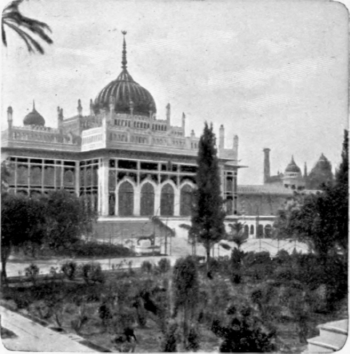
Palace Of A Dethroned Prince.
An incident in my experience well illustrates these different modes of colonization. In sailing down the coast of China, from Hong-Kong to India, we stopped at the French settlement of Saigon. To our surprise, we were there able to attend an opera given by a company brought direct from Paris. The French Government, at an expense of twenty-five thousand dollars, had sent it out there for the season, to keep the colonists from being so homesick that they would return to France. "Great Heavens!" cried one of our English passengers, "I wish Gladstone would do that for us. But in our colonies life 'means business' from the start. We young men come out here to succeed, or to go to the wall. It is a case of the survival of the fittest. The mother country practically says to every one of us, as she casts us into the world, 'Root, hog, or die.'
Continue to:


My Books

