


India II. Part 10
Description
This section is from the book "India - John L. Stoddard's Lectures", by John L. Stoddard. Also available from Amazon: John L. Stoddard's Lectures 13 Volume Set.
India II. Part 10
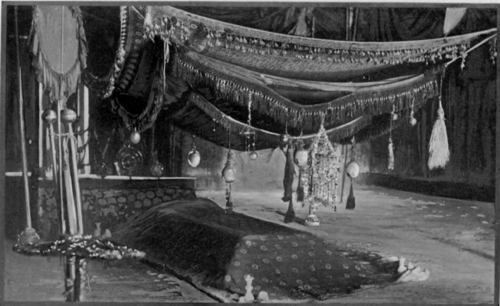
Sarcophagus Of A Native Ruler.
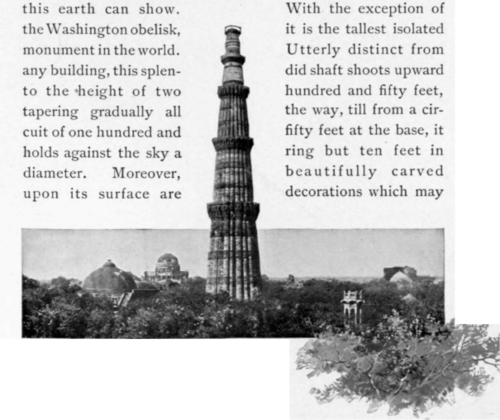
The Kutub M1Nar.

European Residences.
By night the plain surrounding Delhi presents a scene of singular desolation. Upon a site once swarming with tumultuous life, a few poor hovels are the only human habitations. Yet everywhere, like wreckage floating on the sea, lie the memorials of former greatness. Dilapidated walls, deserted fortresses, ruined mosques, solitary gateways, and crumbling towers are constantly in sight, some still retaining vestiges of strength, oth-ers longsince re-duced to masses of debris. One of these structures is of extraordinary beauty. It is the oldest Moslem tomb known to exist in India, and certainly there are few so richly decorated. The roof, indeed, is gone, and the sarcophagus of alabaster which it protected is now unsheltered from the sun and rain; but the old walls remain intact, and in their frost-like tracery in stone remind one of the enchanting work of the Alhambra. Similar tombs are scattered broadcast on this plain; yet what do we really know of any of the kings and warriors buried in them? A feeling of profound sadness took possession of me here, and I recalled the appropriate verses of the Persian poet, Omar Khayyam, written a hundred years before the Kutub Minar arose above this plain.

One Of The Kutub Minar's Rings.
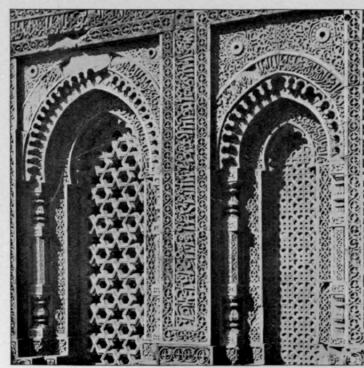
Exqusite Stone Tracery Near Delhi.

Traveling With Elephants.
"Strange, is it not? that of the myriads who Before us pass'd the door of Darkness through,
Not one returns to tell us of the Road, Which to discover we must travel too.
" Think, in this batter'd Caravanserai Whose Portals are alternate Night and Day,
How Sultan after Sultan with his Pomp Abode his destin'd Hour, and went his way.
" When You and I behind the Veil are past, Oh, but the long, long while the World shall last,
Which of our Coming and Departure heeds As the Sea's self should heed a pebble-cast.
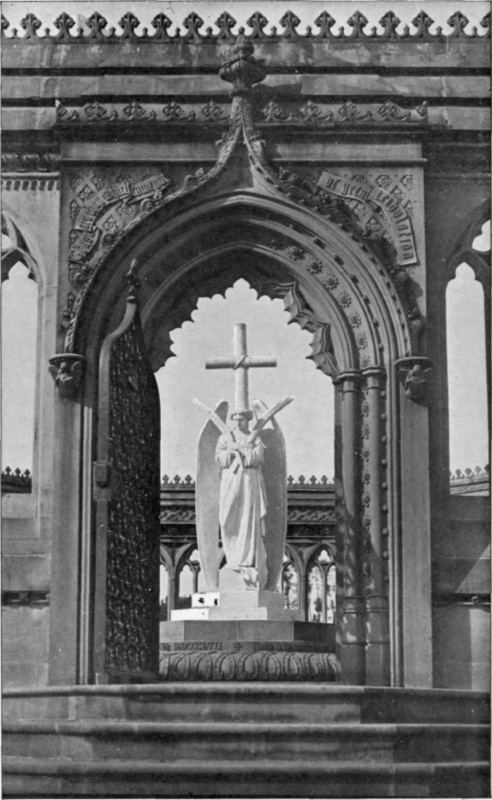
Monument At Cawnpore.
" Ah, my Beloved, fill the Cup that clears To-day of past Regret and future Fears:
To-morrow! - Why To-morrow I may be Myself with Yesterday's Sev'n thousand Years.
" Yet Ah, that Spring should vanish with the Rose! That Youth's sweet-scented manuscript should close!
The Nightingale that in the branches sang, Ah whence, and whither flown again, who knows ! "
The name of Delhi is forever associated with the great Indian mutiny in 1857, when England was suddenly confronted by a revolt of more than one hundred thousand trained Sepoys, or native soldiers, whom she had enrolled, as she supposed, for her defense. A spirit of discontent and hatred of the English had long been latent throughout India, but the immediate cause of the uprising was, as usual in all Indian troubles, a religious one. Cartridges had been given to the troops, and these, it was reported, were greased with lard or tallow, to bite into which (as soldiers were then obliged to do) was to the Hindus a contamination worse than death. The rumor of this sacrilege spread like wild-fire, and regiment after regiment murdered its English officers and turned against the Europeans the weapons they had been force of only seven thousand men, led by the gallant Nicholson, resolved to dislodge them. To do this it was necessary to make an entrance through a structure called the Cashmere Gate. This Nicholson ordered to be blown up. It was a desperate undertaking, for it was then surrounded with a moat; but four intrepid heroes volunteered to attempt it. With heavy bags of powder on their heads, they dashed across the moat. The foremost was shot dead; the second fell to rise no more; the third reached the gate and laid the powder, but was wounded; the fourth, however, lighted the train and sprang into the ditch. A moment later there was a fearful explosion, the ponderous gate was shattered, and the English troops rushed in to victory and - in the case of Nicholson - to death. This memorial of British valor was still fresh in our minds when, shortly after leaving Delhi, we reached Lucknow and stood within its former Residency. It is now a ruin, deeply scarred by shot and shell; but vines and flowers do their best to hide the ravages of cruelty and strife, and its old walls possess a serene and melancholy beauty peculiarly their own. Here, at the time of the mutiny, the position was exactly the reverse of that at Delhi. In this case, the English were the besieged. Scantily protected by these walls, through five long months of Indian summer heat, a force of about sixteen hundred fighting men, encumbered by five hundred women and children, heroically kept at bay no less than fifty thousand natives, who were not ignorant savages with uncouth instruments of war, but well-armed native soldiers, trained by British officers.
Continue to:


My Books

