


How Fossils Were Embedded In The Rocks. Continued
Description
This section is from the book "An Introduction To Geology", by William B. Scott. Also available from Amazon: An Introduction to Geology.
How Fossils Were Embedded In The Rocks. Continued
It is on the sea-bed that the conditions are most favourable to the preservation of the greatest number and variety of fossils. Among the littoral deposits ground by the ceaseless action of the surf, fossils are not likely to be abundant or well-preserved, but in quieter and deeper waters vast numbers of dead shells and the like accumulate and are buried in sediments. The fossils are not, however, uniformly distributed over the sea-bottom; in some places they are crowded together in multitudes, while large areas will be almost devoid of them. The differences are due to variations in temperature, in the character of the bottom, in food supply, and other conditions. Even under the most favourable circumstances, the fossils can never represent more than a fraction of the life of their times. Indeed, the wonder is that so much of the life systems of past ages has been preserved, rather than that so large a part has been irretrievably lost.
The ways in which fossils are preserved vary much, but three groups include all the principal kinds.
(1) Preservation Of More Or Less Of The Original Substance
In certain rare instances an organism may be preserved intact, as have been the carcasses of the extinct species of elephant and rhinoceros in the frozen gravels of Siberia. Much more common is the decomposition of the soft structures and the preservation of the hard parts, - bones, shells, etc. Most of the shells and bones found in the rocks of later geological date are composed of the material originally belonging to them, though they have suffered much loss of substance.
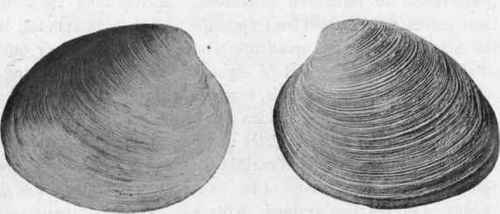
Fig. 252. - Artificial external mould of clam shell (on left) and original shell (on right).
(2) Entire Loss Of Substance And Retention Of Form
In this class of fossils all the original material of the organism has been lost, and no trace of its internal structure is retained, but only the external form has been reproduced in some different material.
Under this class we may distinguish two principal varieties: (a) Moulds and (b) Casts. A mould is formed when the fossil is embedded in sediments, which accurately reproduce its external form, and harden so as not to collapse when the fossil is removed. Percolating waters then dissolve away the organism entirely, leaving only a cavity, which is the mould. Impressions of footprints, which may be placed in the same category as moulds, have already been explained (see pp. 206-7).
Casts are formed when the mould is filled by some solid substance deposited from percolating waters, thus reproducing the form of the fossil, as is done artificially with plaster or gutta-percha. If the fossil were hollow, like a shell, we frequently find a combination of internal cast with an external mould in the same specimen. At the time the fossil is embedded its interior is filled with the same sediment which hardens and forms an internal cast, exactly reproducing the form of the interior. The shell itself is then dissolved away, leaving a space between the outer mould and the inner cast. Moulds and casts are commonest in rocks which permit percolating waters to traverse them freely, such as sandstones and coarse-grained limestones.

Fig. 253. - Artificial internal cast of clam shell (on left) and inner view of original shell (on right).
(3) Loss Of Substance With Reproduction Of Form And Structure
Fossils of this class are also called petrifactions and pseudomorphs (the latter a term borrowed from mineralogy). Here the original material of the organism has been more or less completely removed, and other material substituted for it; but the substitution has been so gradual, molecule by molecule, that not only the external form but also the microscopic structure has been perfectly reproduced. Several scantily soluble substances act as petrifying materials, the most perfect results being given by silica. A silici-fied bone, or tooth, or bit .of wood, differs from the original only in weight, colour, and hardness, and when a thin section is examined under the microscope, the minutest details of structure may be made out as perfectly as from the unaltered original. CaC03 is a very common petrifying agent, but it often obliterates structure by crystallizing after deposition; less usual are pyrite and siderite.
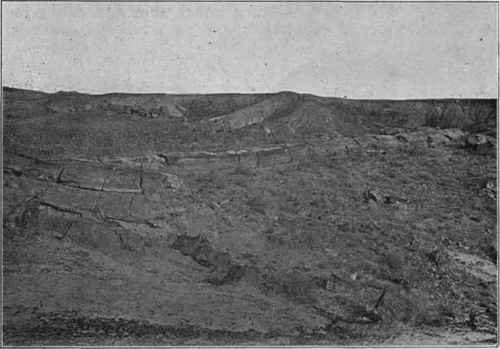
Fig. 254. - Petrified logs, exposed by weathering of tuffs, Arizona. (Photograph by Sinclair).
Continue to:


My Books

