


Tables of Weights, Measures, etc. Part 20
Description
This section is from the "Encyclopedia Of Practical Receipts And Processes" book, by William B. Dick. Also available from Amazon: Dick's encyclopedia of practical receipts and processes.
Tables of Weights, Measures, etc. Part 20
6011. Nautical Time
6011. Nautical Time. The hour of the day or night is noted on board a ship by 1, 2, 3, etc., up to 8 bells. The 12 hours between midnight and noon, or noon and midnight, are divided into 3 portions of 8 bells each, the duration of time between bells being half an hour. During the course of each 12 hours, the same number of strokes of the bell will necessarily be used to denote three different hours or periods of time.
Bell. | Clock-Time. Clock-Time. Clock-Time. | |||
1 denotes 12.30 | 4.30 | 8.30 | ||
2 | 1. | 5. | 9. | |
3 | 1.30 | 5.30 | 9.30 | |
4 | 2. | 6. | 10. | |
5 | 2.30 | 6.30 | 10.30 | |
6 | 3. | 7. | 11.. | |
7 | 3.30 | 7.30 | 11.30 | |
8 | 4. | 8. | 12. | |
The right hand column shows the number of gallons contained in 10 inches of depth. By this standard you may easily increase or diminish the capacity at pleasure. Thus, if you wish the above cistern to hold 97 gallons more, make it 10 inches deeper; or 194 gallons more, 20 inches deeper.
6012. Capacity of Cisterns, etc.
6012. Capacity of Cisterns, etc..
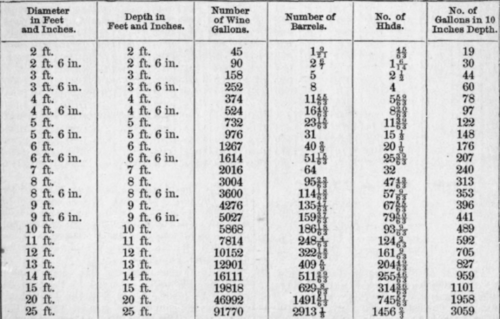
Example: Suppose you desire to ascertain the capacity of a cistern 4 feet 6 inches in diameter and 4 feet 6 inches in depth. Find the diameter in the left hand column, and directly opposite you will see that the cistern will hold 524 gallons of 231 cubic inches each, equal to 16 40/63 barrels, or 8 20/63 hogsheads.
The geographical or nautical mile, according to Brande, is equivalent to 1.153 statute miles; this would give 2029.3 yards to the nautical mile, 69.18 statute miles to the degree, and about 24.905 miles for the earth's equatorial circumference. According to one of the very best authorities, Chambers' Encyclopaedia, the nautical mile contains 2029 yards; on this basis, a degree would measure about 69.17 statute miles, and the earth's circumference about 24.901 statute miles. A great circle of the earth is an imaginary line or belt so drawn round the earth as to divide it into two equal parts or hemispheres; the equator and the ecliptic are great circles. In navigation, sailors measure depth of soundings and short distances by the fathom of 6 feet, and the cable-length of 120 fathoms.
The Greek prefix Deka means 10 units
" " Hecto " 100 "
Kilo " 1000 "
" " Myria " 10000 "
The Latin prefix Deci " 1/10 of a unit
" " Centi " 1/100
Milli " 1/1000 "
Continue to:


My Books

