


Galvanism, Or Voltaic Electricity. Part 9
Description
This section is from "The American Cyclopaedia", by George Ripley And Charles A. Dana. Also available from Amazon: The New American Cyclopædia. 16 volumes complete..
Galvanism, Or Voltaic Electricity. Part 9
To measure the resistance of any conductor, the rheostat and sine galvanometer may be used in the following manner: In fig. 22, let m be a conductor whose resistance is to be measured or compared. One end of it is dipped in a cup of mercury, b, which is also connected with one pole of a battery, T. The other end of m dips into a second cup of mercury, a, which is connected with one of the binding screws of the rheostat. A wire attached to the other binding screw is connected with one end of the wire which passes around the vertical circle of the galvanometer, the other end of which connects with the other pole of the battery. The rheostat wire is all wound on the metal cylinder, and the circuit being closed, the deflection of the galvanometer may be noted. Then the conductor m is removed from the circuit, and the two wires at a and za are joined. Enough of the rheostat wire is now wound on the non-conducting cylinder to cause the same deflection in the needle as before. That portion of the rheostat wire through which the current passes will have the same resistance as that of the conductor m, whose amount is therefore found by comparison.
The results obtained from numerous experiments upon the conductivities of various metals show that silver, gold, and copper are the three best conductors, and that impurities greatly increase resistance, as will also an increase of temperature. It has been shown by Forbes that metals have proportional conductivities for heat and for electricity, and that impurities also proportionately increase the resistance for each. The following table gives E. Becquerel's determinations of specific electrical resistances at 15° 0., regarding that of silver at 0° as 100:

Fig. 16.-Coupling for Intensity.
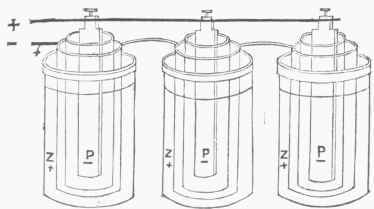
Fig. 17.-Coupling for Quantity.
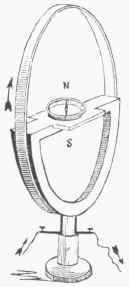
Fig. I8.-Tanpent Galvanometer.
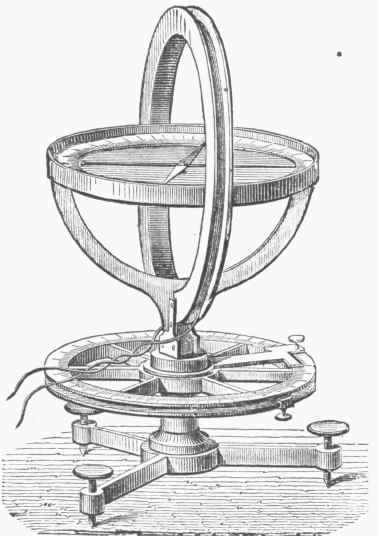
Fig. 19.-Sine Galvanometer.

Fig. 20.-Sir William Thomson's Mirror Galvanometer.

Fig. 21.-Rheostat.

Fig. 22.
Silver.................. | 107 |
Copper.................. | 112 |
Gold................... | 155 |
Cadmium..................... | 407 |
Zinc.................... | 414 |
Tin................... | 734 |
Iron.......... | 825 |
Lead.................. | 1213 |
Platinum......... | 1243 |
Mercury.......... | 5550 |
By comparing this table with that of the heat-conducting powers of the same metals in the article Heat, it will be seen that the numbers which here indicate electrical resistances are inversely proportional to those in that table which indicate heat eonduc-tivities. The resistance offered by liquids to the passage of a galvanic current can be determined with the rheostat and galvanometer in a manner similar to that for solid conductors. Plates of metal at A and B, fig. 23, are placed one above another in a vertical cylindrical vessel and connected by wires, one with a pole of a battery, and the other with the rheostat, the galvanometer being introduced as before. The terminal plates must be of metal whose relations to the fluid will not excite any electromotive force. The best liquid conductors except mercury offer vastly greater resistance than metals. The resistance offered by dilute sulphuric acid is about 1,000,000 times that of silver, and that of water many times greater. If the strength of a series of currents passing through a wire, as measured by the tangent or the sine galvanometer, is represented by the numbers 1, 2, 3, the quantity of heat developed in the same time will be expressed by the numbers 1, 4, 9; therefore the heat generated by a galvanic current is proportional to the square of the strength of the current.
With an equal strength of current the heat generated is in proportion to the external resistance. If currents of equal strength are passed through silver and platinum wires of the same length and thickness, the latter will be heated ten times as much as the former, because the resistance offered by platinum is ten times as great as that offered by silver; but it will require more electromotive force to send the current through the platinum.-Electrolysis. The decomposition of substances by the galvanic current when there is no consumption of either electrode, as in the cases we have been considering, is called electrolysis, although it differs but little from the decomposition which takes place in the cell of a battery couple, the decomposed fluid in either case being, strictly speaking, an electrolyte. The first decomposition of substances by passing through them currents from the electrodes of a battery was effected by Nicholson and Carlisle, who decomposed water in the year 1800, soon after the construction of the voltaic pile.
The electrolysis of water is commonly performed with Faraday's voltameter, a modification of which is shown in fig. 24. Two platinum electrodes,p and n, pass through sealed orifioes in the bottom of a shallow vessel, and over them are placed inverted test tubes, O and II, which are filled with water acidulated with sulphuric acid, the same fluid being contained in the shallow vessel. The electrodes are placed as near together as practicable, in order to reduce the resistance. The electrolysis of pure water is difficult, and it is doubtful if it occurs in the presence of sulphuric acid, except at the surface of the positive electrode, it being more probable that the chain of mole-pules of sulphuric acid lying between the electrodes have their elements displaced and rejoined in the following manner:
Continue to:


My Books

