


Galvanism, Or Voltaic Electricity. Part 7
Description
This section is from "The American Cyclopaedia", by George Ripley And Charles A. Dana. Also available from Amazon: The New American Cyclopædia. 16 volumes complete..
Galvanism, Or Voltaic Electricity. Part 7
It is usual, however, except in the most delicate tests, to have one of the needles slightly stronger than the other, so that there shall be a slight directive tendency north and south to the system. If a wire carrying a current is held between the two needles, they will both be deflected in the same direction; and if the wire is formed into a coil, the force will be multiplied. An astatic galvanometer is represented in fig. 15.-Resistance to Current. Every galvanic circuit offers a certain resistance to the passage of a current, both in the wires connecting the terminal plates, and in the fluids in the cells. From Ohm's law there may be deduced many of the conditions upon which the strength of the galvanic current and the resistance offered to it depend. The primary force by which a galvanic current is set in motion is called the electromotive force, and this, upon the chemical theory, resides principally at the surface of the positive metal, and is generated by the chemical combination which takes place there. The quantity of current which is developed in a voltaic circuit depends upon the electromotive force and the resistance which it has to overcome in passing through the conductors, both solid and liquid, which are contained in the circuit.
Ohm's law may be stated as follows: The strength of a galvanic current is equal to the electromotive force divided by the resistance, and is expressed by the equation C = E/R, where C represents the strength of the current, E the electromotive force, and R the resistance. In an ordinary couple there are two resistances offered to the current: 1, that of the liquid conductor between the plates, called the internal or essential resistance; and 2, that offered by the conductor connecting the two plates outside of the liquid. This conductor may consist of one or of several materials; as a wire, or two or more wires having their ends placed in one or more liquids. The resistance offered by such external conductors is called the external or non-essential resistance. The strength of the current produced by increasing the size and number of the plates of a battery may be found by using the equation given above. Let the internal resistance be represented by s, and the external resistance by t; then in one couple which expression, if t is very small, as when the connection between the terminal plates is made by a short, thick copper wire, has very nearly the same value as E/8+t that is, the strength of the current is not sensibly increased by increasing the number of couples when the circuit is closed by a good conductor.
But if the external resistance is very great, as when the current passes through a long telegraph wire, or through a liquid, its strength will be increased by increasing the number of couples. If the size of the plates is increased, then, according to the chemical theory, the electromotive force will be increased, and therefore the strength of the current, provided the conductors do not oppose too much resistance. According to the contact theory, increasing the size of the plates, and therefore the section of the liquid conductor between them, proportionately diminishes the internal resistance. If, therefore, the size of the plates is increased m times.
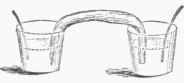
Fig. 9.

Fig. 10. Becquercl's Oxygen Circuit.

FlG. 11.
Bohneuberger's Electroscope.

Fig. 12.

Fig. 13.

Fig. 14. Schweiger's Multiplier.

Fig. 15.-Astatic Galvanometer.
c | = | E |
8 + t |
Let n represent the number of couples in-a battery; then
c | = | n E | = | E | ||
n 8 + t | 8 | + | t | |||
n | ||||||
C | = | E | = | m E | ||
8 | + | t | s + m t . | |||
m | ||||||
If the value of t is very small, the latter expression has nearly the same value as m E/8+t, or the strength of the current then increases very nearly in proportion to the increase in the size of the plates; but if the external resistance is great, the strength of the current will not be increased in proportion to the increase in the size of the plates. Hence, in magnetizing soft iron by passing a current around it through a coil of stout wire, it will be of advantage to use a small number of large couples; but in passing a current through a long wire or an electrolyte, or any poor conductor, a large number of couples is to be preferred. The coupling to overcome external resistance is represented in tig. 16, which is the arrangement adopted in telegraph batteries and in galvanoplastic operations, and is called coupling in series. Coupling for quantity, or, as it is sometimes called, coupling in multiple arc, is represented in fig. 17, where plates of the same metal are grouped together. It has the same effect as the employment of one pair of plates having an equal area of surface; increasing the sectional area of the internal or fluid conductor, and correspondingly diminishing the internal resistance; also increasing the quantity of current through the external conductors when they are of sufficient capacity, or when they offer enough resistance, of generating an equivalent quantity of heat.
Continue to:


My Books

