


Artesian Wells. Part 4
Description
This section is from "The American Cyclopaedia", by George Ripley And Charles A. Dana. Also available from Amazon: The New American Cyclopædia. 16 volumes complete..
Artesian Wells. Part 4
Directly over the site of the proposed well a wooden derrick or open tower is erected, 14 to 16 ft. square at the base and 30 to 60 ft. high, the four corner posts converging so as to form a square at the top 2 1/2 ft. in diameter, upon which rests a heavy framework for the reception of the pulley over which the drill rope is to play. Near the bottom of the derrick, and in range with the band wheel from which the power is derived, is a shaft of timber 6 or 8 ft. long, and about 8 in. in diameter, mounted on journals.

An Artesian Well.
and similar in character to the common hoisting windlass. Upon each end of this shaft is driven a large pulley called the bull wheel; between these, upon the main shaft, the drill rope, a cable of from 1 1/4 to 1 3/4 in. in diameter, is coiled, the outer end passing from it over the pulley on the top of the derrick, and attached to the drilling tools. When these are to be lowered or withdrawn, it is done by means of power applied to the bull wheel. In localities where the rock is some distance below the surface, it is customary to drive down, by the aid of a suitable weight and guideway, a heavy netal pipe, called the drive pipe; this is usu-dly of cast iron, from 6 to 8 in. in diameter and an inch in thickness; it is driven in sections of 10 ft., and great care is needed that it be not bent or deflected, since it is to guide the drilling tools. The engine is so placed that its drive or balance wheel shall be from 20 to 25 ft. from the centre of the derrick, and at one half this distance is planted the sampson post, a heavy hewn timber from 12 to 15 in. square and 12 ft. high, the top of which is fitted to receive the working beam.
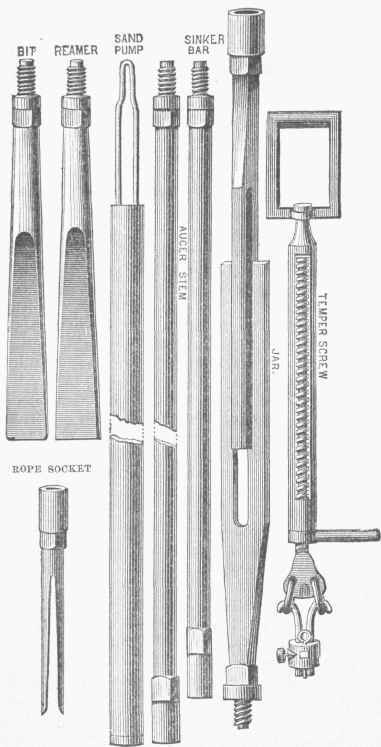
This working or walking beam transmits and applies the power to the drills; it is of wood 8 or 10 in. square, and of such a length that when balanced upon the sampson post one end may stand directly over and connect, by means of a connecting rod, with a crank attached to the shaft of the drive wheel; by the revolu-tion of this crank, which has a radius of about 20 in., a reciprocating movement is given to the further end of the working beam; on this is bolted an iron joint, to which may be attached the temper screw when drilling, or the sucker rods when pumping. The drilling tools consist of centre bits, reamers, an auger stem, jar, and sinker bar, with a socket for attaching this last to the drill rope. The centre bit is of 2 1/2-inch wrought iron, 3 1/2 ft. long, and having a wedge-shaped cutting edge of steel, 3 1/2 to 4 in. on the face. The reamer, which follows this and serves to enlarge and trim out the hole, is very similar in shape, though about an inch broader on the face, which is also more blunt; the average weight of each is about 75 lbs. The auger stem, into which bits, reamers, and dislodging tools are screwed, is a wrought-iron bar about 20 ft. long.
The sinker bar, a heavy rod of iron 10 ft. long, serves to increase the force of the blow; it is separated from the auger stem by an ingenious contrivance called a jar, consisting of two links or loops of iron or steel, which slide in upon each other when the drill strikes bottom, thus, by a | quick blow upon the top of the auger stem, in-creasing the effect of the fall; and on the up-ward movement the sudden jerk or jar serves to loosen the tools, in case they become wedged. When connected, these tools weigh from 800 to 1,600 lbs., as the hardness of the rock re-quires. The drill rope is attached to the working beam by means of a temper screw, suspended from it and made fast to the rope by a screw clamp. This temper screw is about 3 ft. long, and is made with a coarse thread that works in a thin frame. At the lower end of this screw is a wheel, by which it is let down after each stroke, whereby the tension is regulated and the drill properly guided. The tools are lifted and dropped by the rocking motion of .the working beam, and lowered or withdrawn by aid of the bull wheel and shaft.
The sediment and battered rock is removed by means of a sand pump, which is a heavy metal tube, slightly smaller than the well bore, and about 6 ft. long, with the lower end closed by a simple valve opening upward; this is lowered and withdrawn by the drill rope, and the well-man by an examination of its contents is informed of the progress and prospects of his work. The pump is used after each drilling of 6 to 12 in. The tubing of a well consists in driving down a heavy iron pipe in sections, the joints of which are flush both inside and out. At the lower end of the first section driven down is a simple ball-valve pump, the piston of which is connected with the working beam by jointed poles or metal rods. When it is desirable to exclude all water from above a given point, it is effected by binding around the tubing a leather bag of flax seed before driving it down; the swelling of this closes the space between the main wall and the tube. The steam engines in use in western Pennsylvania range from 6 to 20 horse power, one of 8 horse power being sufficient to bore a well 600 ft. deep.
Artesian wells have been sunk, though very slowly, by the aid of two men and an old-fashioned spring pole. - Among the accidents liable to occur in the boring of artesian wells, are the breaking of the drills, or their detachment from the auger stem, and the loss of the sand pump or the whole boring gear by the wearing away of the drill rope. At times the drill enters what is known as a mud vein, a thin stratum of mud or quicksand, which often flows in so rapidly as to enclose and bury the drilling tools. There are many ingenious contrivances for the removal of these obstructions, and the forms of several of the less complex are shown in the cut. Fig. 1 is designed chiefly for removing detached or broken pipe or rods. It is lowered down the well bore until the rod passes up above the ends of the two arms, when by an upward movement the two catches, being pressed forward by springs, take hold of the rod and grasp it the more firmly the greater the resistance. Fig. 2 is of service mainly in removing a detached drill or reamer; the shorter arm acts as a guide, while the hook at the end of the larger one passes below and. takes hold of the lower edge of the drill. Figs. 3 and 5 are also designed for removing broken rods.
In 3 the rod passes through the metal cylinder, and is prevented from falling back by the drop-catch and spring. Fig. 5 consists of an angular claw placed at right angles to the rod by which it is lowered; this is twisted under the shoulder of the rod, thus securing it as in a wrench. Fig. 4 is the ordinary lazy tongs, and is of very general service, as its construction indicates. - In addition to the contrivances above mentioned, the French engineers have introduced certain improved drills, pumps, etc. The drill invented by M. Goulet-Collet consists of a cylinder of sheet iron 6 ft. long, suspended by a chain, and armed at its lower end with an annular cutting head of steel, in which two knives or chisels are inserted at right angles across the opening. These chisels serve to cut the rock, which when finally divided rises with the water through the openings; these may be provided with valves, the instrument thus serving the double purpose of drill and pump. The method of boring by means of the diamond drill is essentially different from that described above. (See Boeing.) When a well fails to yield a fair amount of oil or water, an increase in the flow is often effected by means of the Roberts torpedo.
This is a thin water-tight cylinder of metal or paper, 4 to 6 ft. long and 2 or 3 in. in diameter, charged with powder, guncotton, or nitroglycerine. It is lowered to the bottom of the well, or to a depth that will bring it opposite the desired stratum, and the well then flooded. The charge is exploded by a cap or electric spark, and the explosion often clears away the obstruction from the oil or water vein. Wells yielding only 5 bbls. of oil per day have been increased by this means to 75 or 100 bbls. - -Negative artesian wells are those which serve to convey away surface waters into some absorbing stratum. They are of service about manufactories from which large quantities of impure liquids are discharged, the flow of which upon the surface would prove a nuisance.
Boring' Toois.
Continue to:


My Books

