


Hound
Description
This section is from "The American Cyclopaedia", by George Ripley And Charles A. Dana. Also available from Amazon: The New American Cyclopædia. 16 volumes complete..
Hound
Hound (canis sagax), the name of several varieties of large and powerful dogs hunting by scent, and trained to pursue the stag, the fox, the hare, and other animals, and even man. The progenitors of the hound races were probably, according to Hamilton Smith, the jungle koola (lyciscus tigris, H. Smith) and the buansuah (cants primaevvs, Hodg.), both of the warmer parts of Asia. (See Dog.) These were domesticated after the more wolf-like varieties, and display in all the breeds a tendency to the three colors of white, black, and tan, characterizing them in their wild state. The cranium has a larger cerebral cavity than in less sagacious dogs, with a more convex forehead, wider space between the eyes for the organ of smell, and broader jaws; most varieties have also a wide nose, full and prominent eyes, large hanging ears, a raised and truncated tail, and often a spurious toe on the hind feet. There are two races, the one with short hair, the hounds proper, and the other with long hair, like the setter and spaniel, and used as gun and water dogs; the pointer seems to occupy an intermediate place between them.
The faculties which make the hounds so useful in hunting must have existed in the original species, and have been cultivated in regard to special game according to the fancy of man; the blood, stag, and fox hounds have no intuitive tendency to pursue respectively man, the deer, and the fox, and these only, but have been trained with great care to hunt a single game. The most ancient form of hound figured upon the Egyptian monuments resembles much the bloodhound, which was formerly so much esteemed for its sagacity, strength, and olfactory acuteness. The bloodhound, once employed to trace felons, enemies, and fugitives, or to bring the huntsman to the retreat of a wounded animal, has been fully described under that title; it is now kept in civilized countries rather for show than use. • The stag hound is but little smaller than the bloodhound, and like it is slow, sure, and steady; in fact it is a mongrel bloodhound, the cross being either some greyhound or swift fox hound; it has a large, rather short and sharp head, long hanging ears, muscular limbs, small feet, and tail carried high; the color is always more or less white with fulvous markings.
Stag hunting, as performed in the fatiguing and cruel manner of the 17th and 18th centuries, is now rare, and this form of hound has become nearly if not entirely extinct. The fox hound of the present day is a perfect model of a hunting dog, and is a carefully bred cross between the bloodhound and the greyhound, probably with the intermixture of the southern English and perhaps other hounds; exactly how it has attained its present character it is impossible to determine. It is lower at the shoulders and more slenderly built than the stag hound, with shorter hair, and the color is white, with larger clouds of black and tan, one on each side of the head, covering the ears, another on each flank, and a third at the root of the tail. Its speed is such that none but a thoroughbred hunter can keep up with it, and its endurance so great that a pack has been known to run for ten hours, tiring out three changes of horses, and severely testing the strength of the sportsmen. Breeders differ as to the best size for fox hounds, but from 22 to 24 in. high at the shoulder is generally considered the most advantageous. The best food is thought to be oatmeal and well boiled horse flesh, attention being paid to their constitution, the season of the year, and amount of work to be done.
The cry of a pack of hounds, once so cheering and melodious, has lost much of its romantic interest from the change man has effected in the character of these animals; the other good points of a hound, such as pureness of stock, beauty of form, speed, endurance, and acuteness of smell, are more highly prized in a pack than harmonious voices. The average value of an established pack of fox hounds may be set down at about £1,000, though some have been sold for more than twice that sum; single hounds are often sold as high as 100 guineas. (See Beagle, Bloodhound, Dog, Greyhound, and Harrier.)
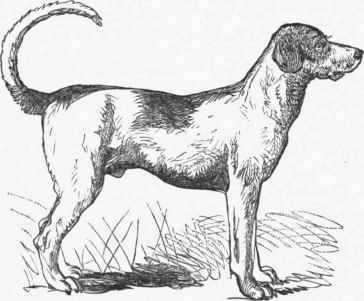
English Fox Hound.
Continue to:


My Books

