


Emergency Service Training. Continued
Description
This section is from the book "Handbook For Scoutmasters. Volume 1 & 2", by Boy Scouts of America. Also available from Amazon: Handbook For Scoutmasters.
Emergency Service Training. Continued
The Emergency Service Corps
For its effectiveness, the Emergency Service Training Plan depends upon older boys—those who have had considerable experience as Scouts.
To develop an Emergency Service Corps Patrol, the main item is to take the regular Requirements and sharpen their application to the point where each Senior Scout can go into the field knowing himself truly prepared for any emergency which may arise.
The Emergency Service Corps activities supplement the activities of the Troop. They are something plus and designed to meet a special need only as the occasion arises.
If at all possible, every Troop should organize an Emergency Service Patrol as a unit in the Council or District Emergency Service Corps.
Forming the Emergency Service Corps Patrol
An Emergency Service Corps Patrol is required to have at least five Scouts, 15 years old or older, who have met the requirements which qualify them for membership in the Corps.
Out of such members a Corps Patrol may be formed in several ways:
The ideal condition is, of course, the, situation where a Senior Scout Patrol secures the training for its members to form a full Emergency Service Corps Patrol, under its own regular leadership.
If the Troop has no Senior Patrol, but a sufficient number of qualified Scouts, a provisional Patrol may be made up of trained Scouts from several Patrols of the Troop, under the leadership of an Assistant Scoutmaster.

The storekeeper learns how to fashion blankets into protective blackout screens with these Scouts acting as instructors.
In cases where the necessary, specially trained five members are not available in one Troop, the District or the Local Council may undertake to organize Corps Patrols from among individual qualified members of several Troops. Such a Patrol, led by an Assistant Scoutmaster selected from one of the several Troops represented in the Patrol, will take its place in the District or Council Corps organization.
To safeguard the Troops from which the Scouts come, the following policy must be adhered to:
"An individual Scout who meets the prescribed requirements may become an individual member of the Emergency Service Corps if his Troop cannot at the time muster a full Patrol of such Scouts, but this is with the understanding that the particular Scout (or Scouts) involved must fulfill his obligation to the Troop by remaining active and by taking back to the Troop the things which he has learned at the Training courses which he is attending. The purpose of the Corps is, among other things, to maintain unity and to increase the size and effectiveness of the Troop through the development of a complete and objective program for Scouts of all ages."
Requirements For Emergency Service Corps Members
To qualify for membership in the Emergency Service Corps, a Scout must meet the following Requirements:
(1) Be of First Class Rank.
(2) Be 15 years or more of age.
(3) Be in excellent physical condition.
(4) Have the written permission of parents and approval of the Scoutmaster.
(5) Hold the following Merit Badges:
First Aid Pioneering Also Life Saving
Firemanship Personal Health and Rowing, where Safety Public Health necessary
(6) Pass the qualification tests: Run 1 mile in 8 1/2 minutes.
Climb an 18-foot rope, hand over hand in 15 seconds.
Tie the following knots with rope over %-inch in diameter:
Square Blackwall Hitch Bowline on a Bight
Bowline Two Half Hitches Sheet Bend
Taut Line Hitch Clove Hitch Cat's Paw
The physical requirements must be very strict, with particular attention given to condition of the heart, lungs, feet, abdomen, general physique, and general health history. Scouts should be protected by vaccination against smallpox. Inoculation against typhoid fever is highly recommended.
It is quite possible that Scouts with certain handicaps might be admitted providing they have unusual qualifications, and are not suffering from any impaired health condition which might make their participation in such a program dangerous to themselves or others. For example, Scouts crippled by poliomyelitis might be expert signal men, short wave radio operators, or dispatchers or have other qualifications of great value. Such cases will, obviously, be exceptions and should be handled individually as they arise.
Before being accepted, the Scout must fill in the Emergency Service Corps Application (Form C 1278), and secure the signatures on the application of his Scoutmaster and one of his parents or his guardian.
Leadership
Usually, an Assistant Scoutmaster assumes leadership for the Emergency Service Corps Training in the Troop or in the Senior Patrol.
It is important that a leader of the Emergency Service Corps be appointed with an understanding that he is to actually give leadership in time of emergency to the Scout group to which he has been assigned, and that he is not to be taken away from service with other organizations. At Memphis, during the flood of 1937, it was found difficult to secure Scout Leaders because they were working with the
Red Cross, the R.O.T.C. or some other unit actively engaged in relief work. The Red Cross has brought this point to the attention of its Chapters.
The leader should attend special courses in Emergency Service Training put on in his Council.
These leaders must be chosen with great care in order to obtain the proper type of sincere, energetic men of good character whom the Scouts will look to with confidence as leaders. Discipline is particularly important, and unless Scouts have leaders that they can respect, it is likely to be lax.
Program For Emergency Service Corps
The Emergency Service Corps has two great responsibilities to perform—two great opportunities:
First, to train its members for emergency service while conditions are normal, so that they can render effective aid when the actual emergency arises. Second, to carry the training program into the Troop to which the members belong, in an effort to make every Scout trained for service.
To do the first, it is necessary to integrate with a complete training plan, a sufficient amount of related activities to hold the interest of the Scouts, and to stimulate interest among those who are not yet eligible so that they will desire to become members when their age and training permit. The actual carrying out of the program when an emergency arises depends upon various factors; the kind of emergency that presents itself, the amount of destruction which has been done, and the efficiency of other organizations doing relief work. In any case, the effectiveness of Scouts will depend upon leadership, training and equipment.
To do the second, Corps members will put on, with the guidance of their Scoutmaster, a program of demonstrations, instructions, games and contests that will fit into the Troop's activities and will train the Scouts in the main features of emergency service work.
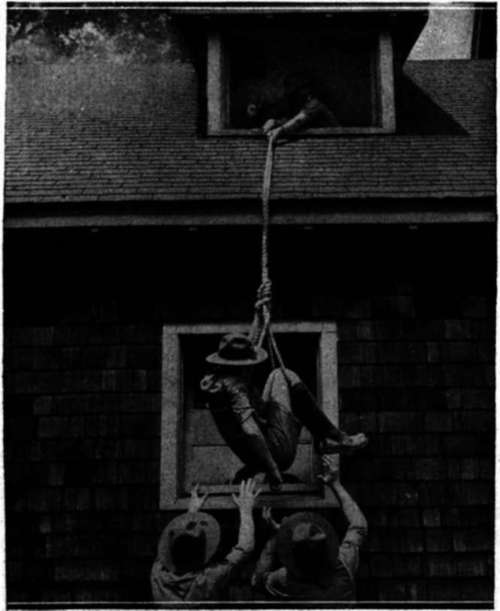
E.S.C. Scouts learn how to tie a "sling" end lower a person, just in case. Their neckerchiefs are used as smoke masks. They know how.
The Kinds Of Service To Be Performed
While Scouts will in the case of dire emergency be willing to do almost any sort of necessary work, it is believed that definite restrictions must be set up to be operative in all but the most unusual circumstances.
There are set forth below, in groups, certain things that are thought to be proper and possible Scout activities, and a list of doubtful activities to be carried on only when other help is not available.
First Group
(Limited to members of the Emergency Service Corps).
Communications, which may include foot, bicycle, boat, radio signals, carrier pigeons, motorcycle or car. Photography. First Aid, including transportation when necessary. Rescue Work when under expert direction. Construction and supervision of sanitary equipment. Erection of tents and other shelters. Providing entertainment to refugees.
Second Group
(TO BE DONE ONLY UNDER EXTRAORDINARY CIRCUMSTANCES)
(Limited to members of the Emergency Service Corps). Direction of traffic. Policing of sanitary equipment, sleeping quarters or washing facilities. Handling of soiled clothing for distribution. Burying of animals, etc.
(Scouts should not handle work which refugees should carry, nor should they replace needy workers —such as in cooking and serving, dishwashing, or the items just cited above. This does not mean refusal to do these things but rather that if done under necessity, Scouts should soon be replaced in such duties.)
Third Group
Those things which can be done by Scouts under fifteen years of age under leadership of members of the Emergency Service Corps, under conditions which will offer a maximum of protection for the younger boys involved: Service as orderlies and messengers; assisting in the registration of refugees; distributing food, when necessary; collecting, sorting, and distributing clothing (under sanitary conditions only); preparing tags and identification cards for refugees; distributing notices, handbills and generally stimulating citizens to meet financial needs for the purpose of aiding those in distress, BUT IN NO INSTANCE HANDLING CASH.
Uniform, Insignia And Membership Cards
The uniforms in all Emergency Relief Service shall be the Official Uniform of the Boy Scouts of America, supplemented with raincoats, sou'westers and dungarees bearing in large letters the designation "Emergency Service Corps, Boy Scouts of America." Every member of the Corps should be encouraged to have on hand, ready for use, wool underwear and socks; and ear protectors and mittens in sections subject tc intense cold.
If possible, supplemental equipment also should bear the distinguishing marks in large letters placed in such a position that they may be easily read: "EMERGENCY CORPS—B.S.A."
A member of the Corps is privileged to wear, on his right shirt pocket, the Insignia of the Emergent
Service Corps. When on duty and for demonstrations, Corps members wear, around their right arms, the red arm brassard with the embroidered Insignia of the Corps. Such an arm brassard should be in the possession of every member.
Cards identifying boys as members of the Emergency Service Corps should be issued, to be used only in case of necessity for identification purposes. Fingerprinting is considered desirable. Each card should bear a photograph of its owner. Both the photography and fingerprinting can be done by the Corps members with special training for doing these things.
Under no circumstances should such identification cards be used for the purpose of entering fire lines or other restricted territory, except with permission or by request of the Red Cross or other relief agency, and the approval of the police.
Training And Mobilization
Training and mobilization plans must obviously be worked out by each Local Council to meet local conditions and needs.
Training should be by Patrols, Troops, District Service Corps, and Council Corps, with frequent District mobilizations and an occasional Council mobilization.
A method of communication for mobilization should be perfected to include such means as are necessary when mechanical devices for the purpose are not operating. Suggested details for such mobilization are given in Chat 20, page 358.
A point of warning in regard to mobilization: Be sure it is purposeful. Mobilization just for the sake of mobilizing is not enough. When the Scouts get to the mutual gathering point, there must be a job there for them to perform. Otherwise, a general let-down will result.

These hiqhly efficient Scouts have set themselves difficult problems to solve. They will be prepared when an emergency comes.
The Emergency Service Training Troop
It should be clearly recognized that the Emergency Service Corps is but a part of the greater picture— the plan of making every Troop an Emergency Service Training Troop.
It is only as the members of the Emergency Service Corps Patrol impart the training provided them in the District or Council Corps, to all the Scouts in all the Patrols of the Troop with which they are associated, that Emergency Service becomes effective.
Requirements
To encourage the permeating of this training, an official rating is given to Troops who undertake certain phases of emergency work.
In order to acquire and maintain the rating of an Emergency Service Training Troop, and receive the official streamers to be attached to the Troop colors, a Troop must:
(1) Have in the Troop one or more active members of the Emergency Service Corps; and one or more Assistant Scoutmasters (or the Scoutmaster) who is a Corps member or a duly appointed Corps leader, and who has taken or is taking training to be given in turn to all Scouts of the Troop.
(2) Have adequate leadership for Emergency Service Training.
(3) Conduct a program of emergency service training in the Troop for every Scout, regardless of age or rank. This training is under the Scoutmaster's direction, with the aid of the Troop's Emergency Service Corps leaders and members.
Emergency Service Apprentices
Any First Class Scout of certified physical fitness (medical examination required) who declares his determination to become a member of the Emergency Service Corps and to take the required training for promotion into the Corps as soon as possible, may with the approval of his Scoutmaster become an Emergency Service Apprentice.
To be accepted, he must fill in the Emergency Service Apprentice application.
Continue to:


My Books

