


Our Solar Family
Description
This section is from the book "Time Out for Living", by Ernest DeAlton Partridge and Catherine Mooney. Also available from Amazon: Time Out for Living.
Our Solar Family
Next to the earth, the most important object in the universe for us is the sun. Without the sun we would not only be in darkness, but we would almost immediately perish from intense cold.
The Solar System
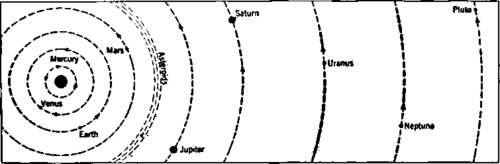
If the planets, including the earth, went around the sun on little wire paths, the solar system would look like the diagram. The paths of the planets are, of course, invisible and are nearly circular. The diagram shows their relative positions.
We would suffer the cold of space, and the mercury in our own thermometers would freeze solid. Fortunately, the sun has an enormous supply of heat, so that for millions and perhaps billions of years the earth will enjoy sunlight and warmth.
The sun is incredibly hot. Nothing in the sun can remain solid. Iron would not only immediately melt, but would become a gas. We are very familiar with ice, water, and steam. When the temperature becomes warmer than 32° Fahrenheit, ice will melt; it becomes liquid or water. If we keep on heating the water until it becomes 212°, it will turn into a gas which we call steam. Iron, rock, or any of the elementary substances of which the earth is made can also be either a solid, liquid, or gas. To turn iron or a piece of rock into gas or vapor requires a tremendously hot furnace. In the sun everything becomes a gas. At the surface of the sun, the temperature is about 11,000°. In the center, it is several tens of millions of degrees. We can talk about such temperatures but we cannot imagine what they mean.
Thus the sun is a great ball of gas, so dazzling and so hot as to defy description. It is nearly one million miles in diameter. Our sun is also in a state of perpetual turmoil. Explosions send masses of incandescent gases away from the surface at a velocity of many miles per second. These gases will rise gracefully like a rocket for hundreds of thousands of miles. Then they will fall back to the surface of the sun and be engulfed in the seething turbulence.

The Sun, as seen through a telescope and not much magnified. When sun spots were discovered, some people thought that they were unmelted pieces of rock floating on the surface of the liquid sun. Even as late as two hundred years ago one distinguished astronomer thought that sun spots were holes in the incandescent atmosphere, through which we could see the hard rock surface of the sun.

Solar Prominences, a mass of glowing gas hurled 140,000 miles from the surface of the sun. What giant forces are causing such eruptions? In 1883 the volcano Krakatoa in a terrific explosion blew debris up into the sky above the clouds. Compared with these terrific solar eruptions Krakatoa is a mere candle flame. The earth would be about the size of the white spot.
The sun is a star or, if you wish, the stars are suns. That doesn't mean that all stars are exactly alike or that the sun is just the same as every star. There are small differences among the stars. The sun represents one type of star.
We are not the only round ball that is revolving around the sun. Nearest the sun there is a small body called Mercury. It revolves around the sun in about eighty-eight days. Mercury is so hot, however, that there could not possibly be life there. Then comes Venus, which is almost exactly the same size as the earth. It is at least conceivable that life might exist on Venus. It has such a dense atmosphere that wc never see much more than the tops of the clouds. Astronomers see so little beyond the clouds that they are not sure how long a day lasts on Venus. It may be twenty-four hours or several months. These balls revolving around the sun are called planets. The third planet away from the sun is our earth. Our distance from the sun is about ninety-three million miles.
If we continue our journey from the sun, we come to the earth's nearest outside neighbor - the planet Mars. More books have been written about Mars than about any other planet except the earth. Ever since the invention of the large telescope people have wondered whether there are inhabitants on Mars. There are greenish black areas, which some observers think may represent forests or grass. Most of the planet is slightly red or yellowish. It has been assumed that these colors indicate desert regions.
The most striking features are the brilliantly white polar caps. They increase in size during the Martian winter and diminish during the summer. Wc do not know just what they are. Mars is so cold that it is difficult to imagine how icecaps, such as we have, could melt in summer. We have some reason to believe that parts of the white caps on Mars are layers of fleecy clouds, which are shining by reflected sunlight. The air on Mars is about as rare as that on our high mountains. At night the temperature on the Martian land must be extremely cold, even at the equator. This curious planet is a long way from the sun, about 140 millions of miles.
The next planet is the largest of all and is about 500 million miles away from the sun. Its name is Jupiter. It is so large that when we see Mars and Jupiter side by side in the evening sky, Jupiter looks the brighter. Here again our ignorance is greater than our knowledge. We are looking upon an atmosphere full of clouds, and we arc not at all sure that we have ever seen the body of Jupiter. It has eleven moons; but most of them are so faint that they can be seen or photographed only in the very largest telescopes. Galileo, who lived about 1600 a.d., discovered the four brightest moons with his small telescope. When Galileo learned that two lenses, held some distance apart, made far-away objects appear to be near by, he had made the first practical telescope. Besides discovering the four moons around Jupiter, he discovered the mountains on our moon and the spots on the sun.
Continue to:


My Books

