


Chapter Twenty. Enjoying Music
Description
This section is from the book "Time Out for Living", by Ernest DeAlton Partridge and Catherine Mooney. Also available from Amazon: Time Out for Living.
Chapter Twenty. Enjoying Music
Music, like many other things in life, can best be enjoyed in association with others. There are many advantages in having a congenial group of friends who are interested in becoming acquainted with the various parts of the music world. The possibilities in this connection are almost endless because the field of music is so rich and varied.
How To Start A Music Club
It is an easy matter to form a musical group. Invite a few of your friends in for the evening and plan a short musical program. After the refreshments have been served, discuss with them, informally, the matter of organizing a club. If you are wise, you will have discussed the club beforehand with one or two of them to know how they stand. They can help to start the ball rolling when the time comes.
Before your friends assemble, it is well to have in mind the various advantages that can be gained by organizing a music club. You could point out that by co-operating it would be possible for various members to play their instruments together. Those who sing could form small choral groups. All would enjoy attending various concerts and broadcasts together. Furthermore, by meeting together occasionally, it would be possible to hear new records brought by various members. Some individuals who are interested in music and have made a study of it would surely be willing to meet with your group and discuss certain phases of the art.

A splendid high-school symphony orchestra is shown on this page and the page opposite.
One of the first things to do, of course, is to select a name for the club. Some suggestions are Aeolian Society, Mozart Music Club, Tuesday Evening Music Club, Troubadours. No doubt you can think of other names that would be more suitable for your particular purpose.
At the first meeting of your society, it would be wise to select temporary officers and appoint one or two committees to plan programs for future meetings. It would be well, too, to decide upon the most convenient time and place of meeting. By rotating from one home to another, the meetings as well as the surroundings would be varied.
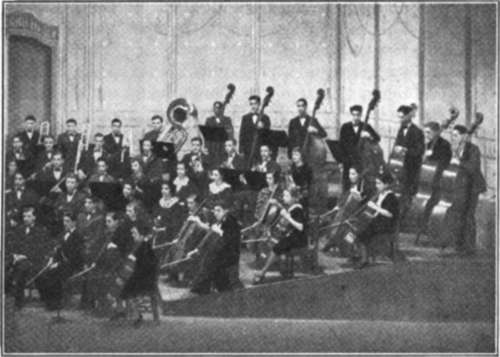
Some high-school orchestras produce exceptionally good music, and have a good time at it, too.
Choosing A Theme
The field of music is so broad and includes so many different possibilities that it is easy to suit the taste of nearly every individual. Just what your particular group will want to include in their activities will depend to a large extent upon their experience, the kind of instruments they play, and what they like in music. These things, of course, will be apparent during the first meeting.
In the beginning, it might be wise to have a varied diet for your musical appetite. Later on you might desire to specialize a little more. For example, as a group you may have heard and become interested in the works of Mozart. At seven years of age he wrote music. It would be very interesting to trace the music of his life as he grew in understanding and technique.
You would no doubt be amazed to hear the music he wrote at your age. This may interest you in learning more about his life and the kind of people who lived in the time of Mozart.
An endless procession of personalities passes along the great highway of music. Some of the committees in the club could search for these interesting musical people and become acquainted with them. After you have heard about their personalities, their lives, their successes, their defeats, in fact all about them, the music they have produced will mean much more to you.
Special occasions and holidays will be very important to your musical club. Take the musical stories of Christmas, for example. During this time of year it would be interesting to find out the story of caroling. How did it originate and how has it been carried on in various countries? You might learn to sing the familiar English carols and some new ones from other countries. On Christmas Eve it is great sport to bundle up warmly and go out caroling. Your father, your mother, and your grandparents could tell you how they used to go caroling in a bob-sleigh. You may find a new way of expressing the Christmas spirit in an experience such as this.
There are other holidays, too, with certain kinds of music associated with them. For example, you can think of songs or compositions that are especially associated with Thanksgiving, Hallowe'en, Easter, and St. Patrick's Day. Your club might be helpful in promoting musical festivals for these special days and in this way make a definite contribution to the community.
"Going Places." Occasionally, as a group, you may wish to attend concerts and recitals. By finding out in advance what the program is to be, and the names of some of the musicians, you can prepare yourselves for the musical treat. Through the use of phonograph records and special reports by members, you can become acquainted with the compositions. If some outstanding artist is to be included in the concert, it is always helpful to become better acquainted with his personality by reading and discussion.
Making Music
The success of a music club will depend to a large extent upon the degree in which the various members learn to participate in making music themselves. They need not all know how to play the piano or some other instrument. There are many other ways of expressing oneself musically. Even to hum the theme of musical compositions helps one to appreciate their value. Occasionally it might be advisable to invite older friends who are musically inclined and have them help the group with their activities.
Keeping A Record
By all means, keep a neat and logical record of your meetings. A scrapbook for your programs will grow in value as the months and years roll by. Clippings about the club programs, invitations, and so forth are all good material for your book. At the last meeting of the year it would be interesting to review the activities of the previous months and lay a better plan for the coming season.
As a final suggestion, don't keep your music confined within yourself or the four walls of a room. Get together with your musical friends and take your love for music into the community where others, too, can learn the value of this art in their lives. After all, music is made to be heard.
Continue to:


My Books

