


The Line Of Head. Part 3
Description
This section is from the book "The Laws Of Scientific Hand Reading", by William G. Benham. Also available from Amazon: The Laws of Scientific Hand Reading.
The Line Of Head. Part 3
In examining the beginning of the Head line note how sharp the angle formed by the lines of Head and Life. The more pointed this angle (90), the more sensitive the subject, the easier are his feelings hurt, and if in addition the sensitive pads are found on the ends of the fingers, this sensitive disposition will be extreme. The subject will do almost anything rather than hurt the feelings of others, and the lives of such will be often made unhappy by unintentional slights. The type of the subject and his finger-tips must be taken into consideration here. With pointed tips and this acute angle the subject will be entirely lacking in self-reliance, timid, cautious, leaning constantly upon someone else, and suffering a fall every time the support is taken away. With thick fingers and square or spatulate tips the indications will not be extreme sensitiveness, but must be read as denoting prudence and caution. Often the Head line is merged in the Life line at the start, and in this case the head did not begin to assert itself, but the subject depended upon others until the year when the line breaks away from the line of Life. Sometimes the Head line does not leave the Life line until well along in its course (91). In this case the mental activities began later in life.
This even goes so far as to produce in some hands the formation of an obtuse angle (92), which shows the subject to be somewhat callous to slights. If, with this latter marking, the finger-tips be square or spatulate and the fingers and palm thick and red, the subject will be very dense, and if only the lines of Head, Heart, and Life are present, it will indicate elementary heaviness of intellect and unimpressionability. These subjects will be cautious, non-committal, dependent on others, lacking ability to command, unoriginal, blunt, and tactless. When the line of Head is distinctly separated from the line of Life (93) it shows primarily self-reliance. The subject is original, is not bound down by the views of others, acts for and depends upon himself, can plan well, is guided by his own judgment, is independent and courageous in his views, and therefore this separation, if not too wide, is a fine marking. The wider the separation the greater the degree of self-reliance, consequently the marking may degenerate into such boldness and self-esteem that the subject becomes foolhardy and not a safe counsellor.
With this separated line note the tips, for, if pointed, the self-reliance may run to idealism, if spat-ulate, to great energy and originality, producing a brain fertile in new schemes, and, as the subject does not ask advice, he is likely to commit grave errors. Square tips are safest, for their good common-sense will be a restraining element. Note the length of the fingers, for, if very short, the quickness in making up the mind, added to the self-reliance of the separated lines, easily leads to impulsive, hasty, and dangerous conclusions. If, in addition, the fingers are smooth, impulsiveness will be intensified. Knots indicate a restraining element that it is good to have present with these separated lines. This marking, in whatever degree of separation it is seen, always indicates a subject with well-defined individuality; the wider the separation the more marked is the self-reliance and the consequent individuality. Always regard this marking as requiring care, for the owner is an unusual subject, and everything must be weighed in order to determine whether the self-reliance and self-esteem shown by the indications run to a danger point.

No. 91.
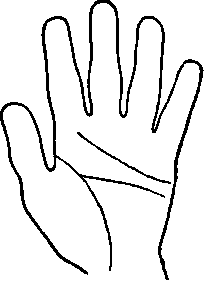
No. 92.

No. 93.

No. 94.
It might be supposed that these separated lines would indicate lack of sensitiveness, as does an obtuse angle formed by the line starting low on the Life line, but such is not the case. In fact the opposite is true, for the separated Head and Life lines produce most sensitive people. They do not always show nor own it, but such is the case. I have made up my mind, after having investigated a great deal in the endeavor to discover why this sign should indicate sensitiveness, that it is owing to pride, for the subject being extremely self-reliant, and confident of his own ability, allows his feelings to be hurt by anything which indicates that others have not the same degree of confidence in him that he has in himself. Sometimes the line of Head rises inside the line of Life on the lower Mount of Mars, and, after crossing the Life line, winds its way across the hand (94). This subject is extremely vacillating. He starts many things with enthusiasm and before he dies will have made innumerable changes. He is a shifter who constantly alters his opinions and does not continue in the same way of thinking long at a time. He is always intense in his views, makes most violent resolutions, and changes his mind with facility, but always with the same vigor.
These subjects are rarely successful, for they do not stick to anything long enough to win. They are always aggressive, for the Head line rises from lower Mars, consequently they are frequently in trouble, always picking quarrels, and are avoided by those who do not want contention. The shifting mind and quarrelsome disposition are a poor combination, for one can never tell what tack these people may take next. If the color of the hand and lines be red, this will add to the unpleasantness of the indication, if yellow, the subject will be intolerably mean, in addition. The less mentality the hand indicates, the less will the subject be able to overcome the trouble, but good first phalanges to the fingers, a long second phalanx of thumb, with a long, narrow, or paddle-shaped first phalanx of that member, will give the subject forces with which he can largely counteract the shifting disposition indicated by such a Head line.
Continue to:


My Books

