


Character Of The Lines - Defects, Repair, Strengthening Lines. Part 5
Description
This section is from the book "The Laws Of Scientific Hand Reading", by William G. Benham. Also available from Amazon: The Laws of Scientific Hand Reading.
Character Of The Lines - Defects, Repair, Strengthening Lines. Part 5
When a grille is seen on any Mount, look for a bad or spoiled specimen of the type, or one who has the health defects peculiar to his type. A square may repair a grille if it boxes the defect entirely, but such markings are rare, and even so beneficial a sign as the square cannot entirely dissipate the danger of a grille. Note the lines in a grille to see if they are deep or shallow, and if in proportion to the rest of the lines in the hand, weaker than they or stronger. If the grille is very strong, deep, and red-lined it will be more pronounced in its bad effects; if its lines are less deep than the other lines, it is less of a danger. See whether the vertical lines cut their way through the cross lines (in which case it will not be so bad a grille) or if the cross lines cut the vertical lines cleanly. Some Current can pass if the vertical lines cut their way through; none can get through if the cross-lines cut the deepest. A grille with lines not running exactly vertical and horizontal is not as bad as one which is found composed of vertical and horizontal lines running at right angles. Thus with all grilles gauge with judgment your estimate of their destructive force, and do not apply the worst effect of a bad grille to a less dangerous one.
Carefully estimate the good of your subject by Chirognomy in order to get the true effect of the grille as applied to him, and always use great care with this sign.
Cross-bars (13), or horizontal lines closely grouped together without the vertical lines of the grille, I consider a worse indication than the grille itself, for in this case the Current is entirely bloeked and has no chance to escape except by overflowing the obstruction, and to do this it must first overflow the surrounding parts. I have given the name of Cross-bars to this marking, as I have often encountered it as a single sign and verified its bad effects. The cross-bars will bring out the bad side of a Mount, such as health defects, and fortunately are not often found. When you encounter this sign, see how strong and deep are the cross-lines, also how they compare with the rest of the lines in the hand. The deeper they are, the worse the indication, and vice versa. The Current theory will always unlock their seriousness.
The Circle (14) is quite a rare sign, and is chiefly valuable when found on the line of Life, or on the Mount of Apollo, or line of Head under the Mount of Apollo. Such markings emphasize the Apollonian tendency to trouble with the eyes. This indication I have verified in a few instances. When seen it will be accurate as indicating delicacy of the eyes, but is not seen on the hands of all who are either blind, have poor vision, or weak eyes. It is not usually perfectly marked. Imperfect circles sometimes close their edges, however, and become perfect in shape as the difficulties with the eyes increase.

No. 13.

No. 14.
The Trident (15) is found at the upper end of a line, is sometimes a single sign, and sometimes is connected with either the lines of Saturn, Apollo, or Mercury, or with a chance line that runs in a vertical direction. It is a favorable indication when found on the upper end of a line, as it allows a good escape of the Current through proper channels. It adds strength to the line of Apollo, increasing its brilliancy and the chances of success for the subject. The trident is a rare marking and always & good one. It must be perfectly marked to give its full meaning.
The Star (16) is an important and valuable sign. It is found in many hands, in all possible locations, and is sometimes a good indication, sometimes a bad one, depending entirely upon its location. As the Current flows along the lines it is ready at any moment to burst into a flame and illuminate its surroundings. Just as the Electric Current produces the electric light, so the Life Current also produces periods or points of illumination. The star is the electric light of Palmistry, the place at which the Current sends out its points of light from a common centre; and thus the star, if small and even in proportion, means illumination, and if large and diffused, explosion. It is always a lighting up and intensifying indication wherever seen. Be careful in handling stars to note their formation, size, depth of lines, location, and relative proportion to the rest of the lines. You will see stars perfectly formed, with each ray of the same length and coming from a common centre, forming a perfectly proportioned marking. These are the best stars, and give the even illumination that lights up a Mount or line without destroying it.
When the star is imperfectly formed and the lines do not proceed from a common centre it is a poor star, partaking of the defects of a grille and producing feeble light, and is in no sense so brilliant a marking as the perfect star. If the star is large, with deep, red lines, and a deep dot for the centre, it is the explosion which destroys, as does the boiler which bursts. On the Life line it means sudden death, on the Head line it means an explosion in the mental faculties, or insanity, and wherever found this large, deep star is excess, which means danger. Instead of having to memorize the meaning of a star in all of its locations, fix in your mind the Current theory and the fact that the star is the light or the explosion, according to its formation. Whenever seen, instead of trying to remember what it means in each location, simply say : " What will this kind of a star do for the subject when located in the position in which I find it? Will it light up and make more brilliant, or will it explode and destroy? "If you have correctly judged the kind of a star, you can apply either its brilliancy or its explosive force to the location or line on which you find it. This is the only correct and at the same time simple way to read stars.
It is such an important sign, and so often found, that you must be able to read it quickly and correctly whenever it is met. Only the general theory of the star is intended to be made plain here : the application will be made to different lines and Mounts later. The star is the illumination, the electric light, making brilliant if a good one, but the danger signal or explosion if too large, deep cut, and red.

No. 15.

No. 16.

No. 17.
No. 18.
The Cross (17) is a common sign. It is sometimes a well-marked single sign, and sometimes is formed by lines crossing other lines. Always note how deep the lines forming it are, and how they are in proportion to the other lines. A deep-cut cross is a sign of grave import, especially if highly colored. The cross is an obstacle or a defect, and generally produces either a bad quality, a health defect, or a change in the course of the subject's life. The Current running along the line on reaching the cross "burns out the fuse," to use electrical parlance, and a stoppage for repair is necessary, often with the result of changing the course of the subject's life. In any location it must be regarded as unfavorable, and as indicating a defect.
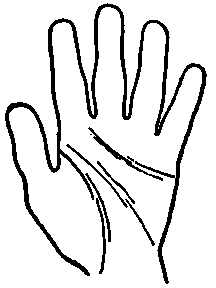
In the repair of any line, weak, broken, or defective in any way, Sister lines (18) are most valuable. Whenever you see a weakness or a defect in any line, look to see if a sister line runs alongside, adding its strength or repairing qualities. A weak line with a sister line makes a good combination, almost as good as a single strong line. Good lines are made better by sister lines, and in every place they appear regard a sister line as of decided benefit.
The study of the general characteristics of the lines and signs of which this chapter treats is the keystone to the study of the individual lines and combinations. I have been explicit concerning each change in the lines, all defects, and the way individual signs are produced, as I wish to get the general theory of the Current well fixed in your mind. The application of this hypothesis to the individual lines makes it easy to read their innumerable variations, and it is only this conception of the Electric Current which will make it possible to reason out all of the possible combinations of lines you will be called upon to read.
Continue to:


My Books

