


Torque Converters. The Constantinesco Torque Converter. Continued
Description
This section is from the book "Workshop Receipts For Manufacturers And Scientific Amateurs. Supplement Aluminium To Wireless", by The Chemical Publishing Co.. Also available from Amazon: Workshop Receipts For Manufacturers And Scientific Amateurs.
Torque Converters. The Constantinesco Torque Converter. Continued
Theory And Operation Of The Model
Technically, the theory of the mechanism is as follows : When the motor is running slowly the pendulum tends to oscillate about the rod (8) and little, if any, movement is imparted to the pawls ; this corresponds to a low power. Should the resistance to movement in the rear axle be great, however, the fulcrum recedes towards the weight (5). Owing to the inertia or reluctance to vibrate quickly the face plate then pivots about the weight and a greater force is exerted on the strips (9) to drive the shaft (10). In this way the gear accommodates itself automatically to the work to be done.
In operation the rod (1) is rotated by the motor, the eccentric (2) tends to drive the strips (9) to and fro as the weight oscillates. This to and fro movement of the strips (9) results in a corresponding movement of the pawls. As the pawls are mounted to lie in opposite directions round the gear wheel (15) the latter is driven in one constant direction in a series of pulsations.
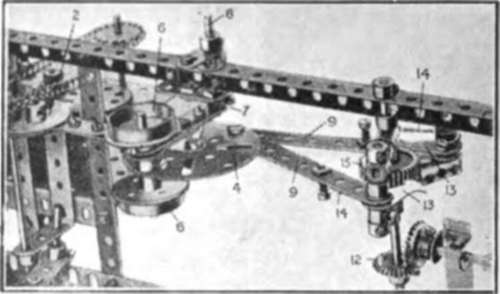
Fig. 210.
Remarkable Torque Obtained
An interesting detail is the remarkable increase in torque obtainable even from so small a form of Converter as that adopted in the Meccano model. This is demonstrated by jacking up the rear axle to allow the driving wheels to freely rotate, when it has been found impossible to prevent the revolution of the driving shaft when gripped with the finger and thumb below the universal joint. When it is remembered that the driving force is obtained only from a small electric motor, driven by a 4-volt accumulator, the remarkable effect imparted by the Torque Converter becomes apparent. By holding the shaft with greater or less degree of pressure the Converter may be made to demonstrate its automatic adjustment to a varying load or resistance in a remarkably effective manner.
Automatic " Gear " Adjustment
The automatic adjustment of the gear to the'load and to the gradient is one of the most interesting features of this model, and to watch it operate is a fascination that will delight everyone with engineering interests. The turning movement delivered to the back axle is in the nature of a number of impulses given by the pawls to the gear wheels. In this model these impulses vary from about 12 teeth of the gear wheels (on what is equivalent to top gear) to 1 or 2 teeth, when great power is required to overcome considerable resistance.
The model can of course be operated by hand if desired, there is no actual need for an electric motor for demonstration purposes, it, however, does make it more interesting to watch the effect of different loads upon the mechanism. In the case of a motor-car fitted with this Torque Converter, the car can be at rest relative to the ground and yet the engine slowly rotating, and slowly swinging the weighted rod from the top end, and so giving no motion at all to the pawl equivalents on the car. If it then be desired to move the car, the throttle on the carburetter is opened more, the engine increases in speed, and so works up to the state of affairs shown in Fig. 205, the pawl equivalents begin to operate, and the car starts to move, more throttle opening gives a higher speed and so on.
Continue to:


My Books

