


The Universal Oxy-Coal-Gas Blowpipe
Description
This section is from the book "Workshop Receipts For Manufacturers And Scientific Amateurs. Supplement Aluminium To Wireless", by The Chemical Publishing Co.. Also available from Amazon: Workshop Receipts For Manufacturers And Scientific Amateurs.
The Universal Oxy-Coal-Gas Blowpipe
This blowpipe is constructed on the injector principle, by means of which oxygen pressure (about 151b. per square inch) is made to draw the necessary coal gas from the town's supply, and to deliver both gases, well mixed, and at sufficient pressure at the blowpipe nozzle.
Each blowpipe is supplied with three interchangeable heads for different - size work. (Refer to table on page 430.) Its design is similar to the blow-pipes previously described and the notes on working, cleaning, etc., apply equally well.
Oxy-Coal-Gas Lead Burning Blowpipe
The working principle of this blowpipe is exactly similar to the oxy-coal-gas brazing blowpipe mentioned above, the nozzles being of proportionate size for lead burning, etc.
The Endurance Pressure Regulator
A pressure regulator must be fitted to all oxygen and combustible gas cylinders employed for welding, see Fig. 225.
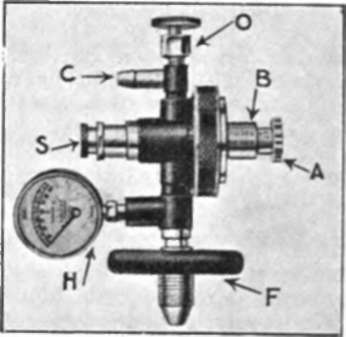
Fig. 225.
The regulator is attached to the cylinder by means of the flynut and nipple F. the high pressure gauge H registering the contents of the cylinder.
O is the outlet valve and C the connection to which the tubing from the blowpipe is connected. The safety valve S prevents any injurious pressure being reached in the regulator body.
The outlet pressure is regulated by turning the engraved sleeve A until the figure and line indicating the pressure required coincide with the end of the surrounding sleeve B.
Oxygen regulators supplied for use with metal-cutting apparatus are usually unsuitable for use with welding blowpipes because they are not constructed to give accurate regulation of the gas at very low pressures, this being an essential feature of all welding regulators. The table on page 430 indicates the type of regulator which we recommend for use with the sizes of blowpipe tabulated.
When the regulator is used on D.A. cylinders the outlet pressure is very low, and the regulator should be adjusted accordingly.
Endurance Automatic Regulators are measuring instruments, and although made to withstand yard and workshop use they necessarily contain some delicate parts, and for this reason should be handled carefully.
The regulator should never be dismantled by the user. If it becomes defective in operation it should be returned to the Company for overhauling.
The pressure gauges fitted to regulators being small are only approximately accurate in their readings and if the regulator is constantly in use they gradually become inaccurate. The gauges should be returned to the Company for adjustment or be replaced with new ones at intervals not exceeding two years.
The Hydraulic Back Pressure Valve
With all oxy - acetylene blowpipes where acetylene is drawn direct from a generator, or from an intermediate acetylene gasholder, a hydraulic valve is a necessity. See full instructions given on page 82 and read carefully.
Acetylene Generators, Carbide. Dissolved Acetylene and Oxygen : The Acetylene Generator.- there is no part of the welding equipment which requires to be more thoroughly understood and carefully operated than the acetylene generator. It is false economy to purchase a generator that is too small or only just large enough for the job, this, perhaps, being especially true in the case of small portable generators.
See full instructions given on page 84 and read carefully.
Carbide
See page 86 and carry out all the instructions there given carefully.
Pressure Of Acetylene
If good welds are to be obtained, it is extremely important that acetylene which is to be used for welding should be supplied at a constant pressure. Small portable generators used for metal cutting are often of the displacement type in which a considerable fluctuation of pressure takes place and this variation of pressure does not matter for rough cutting. Such generators, are, however, quite unsuitable for welding since it is impossible to maintain proper regulation of the blowpipe flame, which in consequence may alternately oxidise and carbonise the weld, All portable and fixed genera-tors for welding should be so arranged that a pressure of about 8in. water column is maintained when in use, and this pressure should not vary more than 2in. between the limits of no load, and the full load as indicated by the rated capacity of the generator.
Where gas holders are constructed with bell lifts, the bells should not be weighted to give a pressure exceeding that for which the generator is constructed. Care must be taken to keep the water seal of the gas holder fully charged.
Continue to:


My Books

