


Autographic Work Drawings
Description
This section is from the book "Workshop Receipts For Manufacturers And Scientific Amateurs. Supplement Aluminium To Wireless", by The Chemical Publishing Co.. Also available from Amazon: Workshop Receipts For Manufacturers And Scientific Amateurs.
Autographic Work Drawings
Plans or diagrams can be made with a Stylus pen and Stylus plate, but the wheel pen must be used when fine, detailed work is required.
The stencil may be stretched on an ordinary drawing board by means of drawing pins, but a stretching board will be found more satisfactory. Care must be taken to stretch the stencil on the stretching board as tightly as possible. To do this, first clamp the heading under the top bar, and then clamp the bottom corners under the rods, finally loosing the top bar and pulling the sheet one corner at a time, as tightly as possible and re-clamping.
Drawings can be made with the wheel pen by any of the following methods :-
1. ;Lay the original drawing on a zinc plate, and place over it a transparent celluloid sheet. Over that stretch the wax sheet and make your stencil by tracing over the copy with the wheel pen.
2. ;If the drawing is on fairly thin paper, it may be laid over the wax sheet and traced over with the Stylus. This will impress the design on the wax sheet, which is then cut with the wheel pen on the zinc plate.
3. Place the drawing under the wax sheet and trace very lighlty with a Stylus ; remove the drawing and re-trace with a firm line.
Four perforated drawing pens are provided for making various different lines.
The first method only necessitates one operation, that of tracjng over the drawing, and this method will generally be found the most convenient. When using the wheel pen, only sufficient pressure should be used so that the perforations will appear clear and distinct when held before a light. If too much pressure is used, the perforations made by the pen will run one into the other, and the stencil will produce bad work.
A stencil made on the zinc plate is sharper and finer than when cut on the celluloid plate, and it is not necessary to regulate the pressure on the pen so carefully.
The ruling pens should be used with the back of the pen against the ruler.
The wheel pens should be cleaned, the zinc plates rubbed over, and errors corrected as described for handwriting.
Autographic Work. Music
This is done by means of the wheel pen and Autographic stencil paper. The staves can be rules by means of an ordinary T-square, but the spacing of these is greatly facilitated by the use of a special stave-ruling T-square and stave-ruling pen. Note punches, by means of which the black notes can be quickly and neatly made, can be obtained.
The various articles mentioned for the reproduction of drawings or music can be supplied separately or in the form of a complete outfit.
Very little attention is required by these machines, in order to get good work. Such points as, seeing that the stencil is put on smoothly, is not knocked in any way and damaged, that the feed adjustment is correct for the thickness of paper being used, that the rubber rollers of the " pick-up " gear are free of oil and perfectly clean, that the correct amount of ink is being used, are merely matters asking for just ordinary care, etc. The names of the various parts shown in Fig. 128 are as follows :-

Fig. 129.
1. ;Automatic inking device.
2. ;Automatic paper feed.
3. ;Pressure lever.
4. ;Screw for adjusting pressure to various paper thicknesses.
5. ;Scale that gives correct adjustment.
6. ;The handle.
7. ;Automatic indicator.
8. ;Automatic quick-drying device
9. Automatic lock.
In the above described type of duplicating machine, i.e., those in which a wax stencil is used, there is naturally a limited number of copies that can be obtained off one stencil, and also the stencil cannot be taken off and stored for use at a later date, etc. Therefore another type of duplicating machine has been invented by which, using metal type, practically any desired number of copies can be obtained off the one setting up. Fig. 129 shows a duplicating machine that uses separate metal type, and has several ingenious features. Once the machine is set up for use, the action of getting the copies is entirely automatic. Very many different styles of type are available, and these can be used in either one or two different holders. Fig. 130 shows the segment used on these machines when it is assumed that the layout will not be required again after the duplicating then in progress is finished. Fig. 131 shows an ingenious style of curved form, shaped naturally to the printing cylinder. and can he filed awav flat like correspondence, with the type set up in it, all ready for use at any later date. Of course when the matter thereon has been finally finished with, the separate type can easily be taken out and used again, etc. The machines can be worked either with a ribbon to give the necessary impression or by direct inking. In the former case ribbons for either purple, black, blue, or green can be obtained. In the case of direct inking, i.e., printing, a large number of ordinary printing jobs can be done, either from electros, zincos, vulcanised stereos, or printer's face type. The machine can be supplied with an electrical attachment so that it can be operated for long periods at high speed, and copies turned out at the rate of up to 5,000 per hour. This practically renders the office independent of the printer for most of the work usually sent out. This type of machine is simple and easy to operate properly, and skilled labour is not required to look after it, but someone with the average supply of common sense and care.
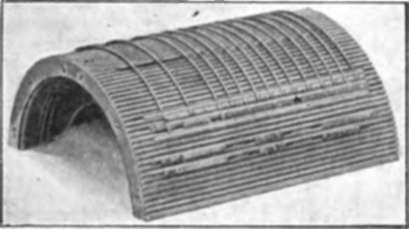
Fig. 130.
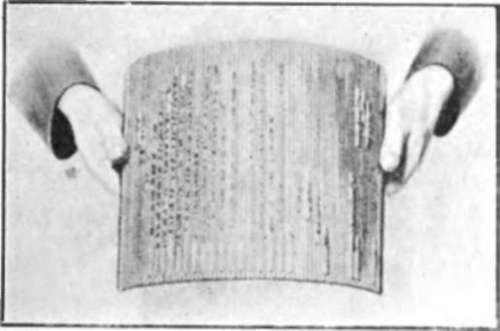
Fig. 181.
Continue to:


My Books

