


Timber. Part 4
Description
This section is from the book "Manual Instruction: Woodwork. The English Sloyd", by S. Barter. Also available from Amazon: Manual Instruction: Woodwork.
Timber. Part 4
Shrinkage Of Timber
A log in drying is reduced in bulk, and this reduction lessens the circumference. The fibres on the outside of a felled log in shrinking continue to adhere to each other in the main, but this fact causes a tangential contraction to arise, and at intervals cracks open from the outside, and continue, as the timber dries, to run in towards the centre of the log.
We have, then, in the longitudinal fibres a tangential and radial contraction at the same time, but the cells of the medullary rays being in the opposite direction will not contract as much radially as the annual rings, and consequently, as an inevitable result of the various contracting tendencies, splitting takes place, usually contiguous to the medullary rays.
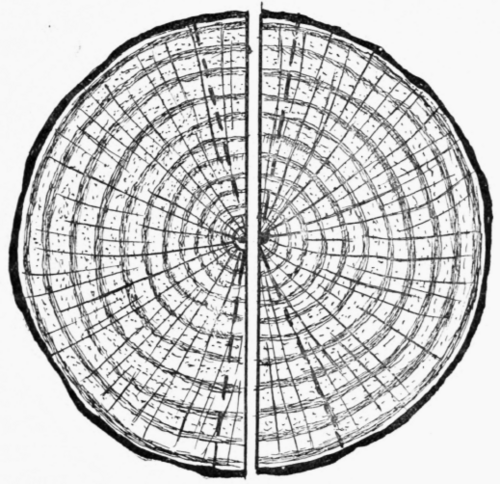
Fig. 24.
Contraction with a strong tendency to split the timber at the medullary rays must take place, and steps have to be taken to prevent this splitting from entirely ruining the baulk. The woodman accordingly splits the log in halves, as in fig. 24, or even in quarters, as in fig. 25. Now only a segment of the circumference is included in each piece, which, being separated from the remainder, is able to shrink much easier in a tangential direction. The dotted lines in fig. 24 show the contraction which usually takes place. It must be observed that logs are not split in this way because the shape is preferred to that of a log, but to save worse splitting taking place. In fact, the inevitable splitting is recognised, and the halving and quartering being the forms in which least waste in conversion would probably arise, they are cut up in this way as being the least wasteful plan.

Fig. 25.
Owing to the frequent lopping of small branches and shoots, the bending and twisting of growing trees due to prevailing winds and other causes, the fibres frequently become very twisted and even involved in an extraordinary manner, notably in the large burrs of pollard oaks and willows.
These latter wavy twisting fibres are in some woods much valued for ornamental purposes, and trees are sometimes kept well pruned with the intention of producing this peculiarity.
Let us consider now the effect of twisted longitudinal fibres in a plank.
Fig. 26 shows the end section of a series of planks cut out of a straight-grained tree where the pulling tendency of the contracting fibres has curved the planks at the side, and has caused the outer edges of the middle plank to become thinner than the centre.
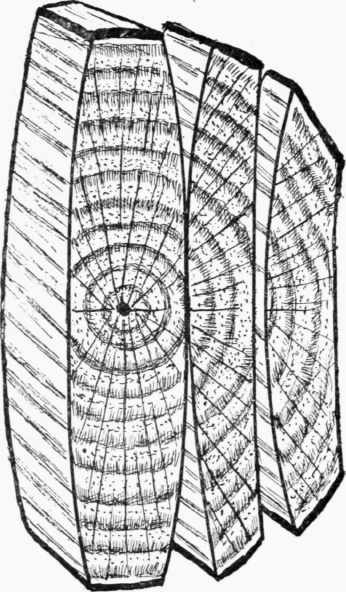
Fig. 26.
Suppose now that the other end of the fibres in the timber are twisted, the section of, say, the large plank at a distance of twelve feet might resemble that of the next plank in the illustration, no longer containing the centre of the tree. This middle plank would be true when first cut, but it would become gradually concave at one end, while the other end remained fairly true except for the slight thinning of the edges. Irregularities from twisting will take much more complicated forms. Planks which have warped or twisted in this way involve great waste in preparation for work, as it is clear that they must be rendered true before anything can really be done with them.
A certain amount of restraint can be exercised on a plank which, on inspection, is suspected of being very liable to this twisting. A manual training teacher should avail himself of whatever knowledge of timber he may possess, in intelligent storing of his stock, which may otherwise be rendered more or less unserviceable from this twisting.
Contraction taking place almost exclusively at right angles to the medullary rays, the effect on a baulk of timber which contains the heart of the tree near the centre will cause cracks something like those in a baulk, as shown in fig. 27, and another case, where the centre of the tree is near one corner of the baulk, is shown in fig. 28.
This splitting is much more likely to happen under hot air seasoning than any other.
Heart shakes are serious defects in timber. They are developed in the growth of the tree, but are more apparent when seasoned. If there are only one or two shakes no great harm is done, as the woodman will split the logs along their course, but if many exist, making a star shake, the timber is almost spoiled, only very little serviceable timber being obtainable.
Cup shakes are cracks along the line of the annual rings, caused by some vicissitude in the growth of the tree destroying the cohesion between two annual rings.
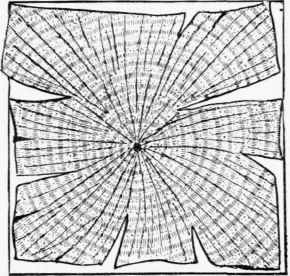
Fig. 27.

Fig. 28.
This is much more common in certain trees, notably pitch pine, than in others, and, of course, always causes a loss of effective timber capable of conversion into planks, etc.
Continue to:


My Books

