


Model XXVIII. - A Hanging Box
Description
This section is from the book "Manual Instruction: Woodwork. The English Sloyd", by S. Barter. Also available from Amazon: Manual Instruction: Woodwork.
Model XXVIII. - A Hanging Box
Fig. 285
This box is jointed in the same way as the preceding one, and, in fact, there is nothing new introduced except the hinge-ing, and, as it is only required to nail two small pieces of leather on to serve as hinges, this is extremely easy.
The drawing should be the front and side elevations, or the isometric projection.
The timber required, yellow deal, will be 3/4 in. thick throughout, and the other dimensions of the wood are as follows: - Two pieces 7 ins. long by 6 1/4 ins. wide for the ends, one piece 10 1/2 ins. long by 4 1/4 ins. wide for the front, one piece 11 ins. long by 7 1/4 ins. wide for the bottom, one piece 11 1/2 ins. long by 9 ins. wide for the back. The lid and rail should be made from one piece of wood, 7 1/4 ins. wide and 11 ins. long.
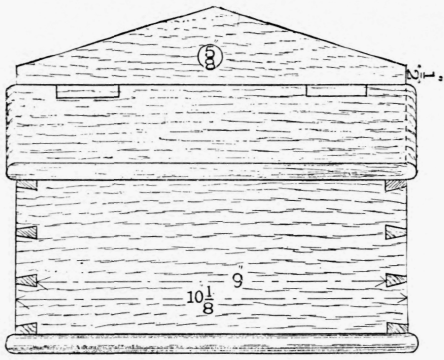
Front elevation.
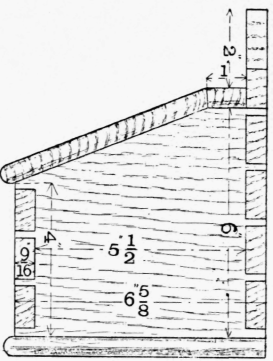
Side elevation.
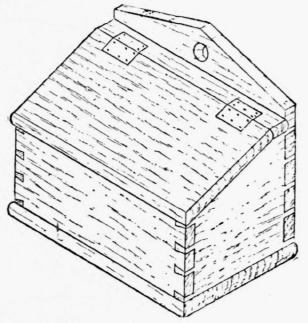
Isometric projection.
Fig. 285.
Plane up all the wood to the finished dimensions. The sloping top of the ends should be sawn, and planed true, but the depth in front should be 1/16 in. more than the measurement of the finished model. Set out the pins on the end of the short sides, leaving the two end ones of each row a little full - 1/32 in., and mark the depth of the mortices on the back and front of the box, as in the preceding exercise. Saw and pare out the waste between them. Apply the pins to the ends of the back and front, as in fig. 283, and mark the shape of the mortices : complete these, and glue the sides of the box together. Observe that the face edges should be downwards in the case of all the four sides.
Saw, and plane the sloping top of the back, and bore the hole in it. The sides can now be glued together, and the whole of the surfaces and edges 'flushed' off true.
Model the rounded edges of the bottom, lid, and rail, these two latter in one piece, with plane and file. Saw the rail off from the lid. Bisect the angle of inclination of the lid to the rail, and setting the bevel to the angle obtained, shoot the edge of both lid and rail. Nail the rail and bottom on, and then nail on the leather hinges. These need not necessarily be used, but if the box is intended to hold salt, leather hinges will be found much better than iron or brass, which will be quickly corroded.
Continue to:


My Books

