


The Self-Acting Lathe. Part 3
Description
This section is from the book "Turning Lathes", by James Lukin. Also available from Amazon: Turning Lathes: A Guide to Turning, Screw Cutting, Metal Spinning and Ornamental Turning.
The Self-Acting Lathe. Part 3
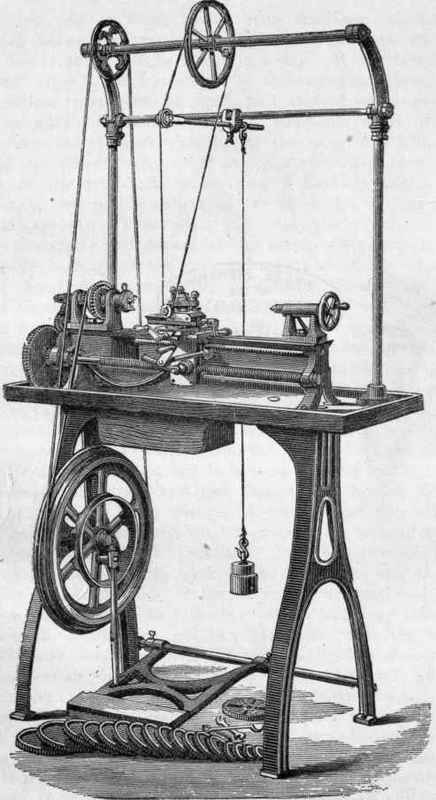
PLATE XIII. - MINIATURE SCREW-CUTTING LATHE.
Plainly, it is not difficult, so long as we can get the proper proportion out of wheels in the same plane, to get any even number of threads to the inch from a leading screw of a quarter pitch. Starting with a pair of the same number of cogs, we have seen that the pitch of the leading screw will be exactly copied. Halve that on the mandrel, and the pitch will be twice as fine, because now the work will turn twice while the screw turns once; and so on - the smaller the mandrel wheel, the greater the number of threads that will be cut in l in. of length. The wheels generally rise by five cogs, from 20, the smallest, to 120, with two of 60 for use to get the equal pitch with that of the screw. It is convenient to keep the one on the screw unchanged, and this is commonly of 60 teeth in small Lathes, which is a convenient size; or, if preferred, that on the mandrel may remain the same, and the screw wheel be the one to change - it is merely a matter of convenience : but, for a time at least, while getting into the way of reckoning, one or the other should be constant. A short Table is annexed, suitable for a 60 wheel on mandrel, unchanged: -
Threads to inch required. | Mandrel Wheel. | Stud Wheel. | Screw Wheel. | |
1 | 60 | Any of suitable size. | 15 | And so on for all even numbers, as long as the requisite wheel is in the set, e.g., 24 threads would require four times 90 =. 360, which will not be supplied. |
2 | 60 | 30 | ||
3 | 60 | 45 | ||
4 | 60 | 60 | ||
5 | 60 | 75 | ||
6 | 60 | 90 | ||
7 | 60 | 105 | ||
8 | 60 | 120 |
But, again, suppose with a 60 wheel we try to find a screw wheel to produce 3½ threads to the inch, we find it would be one with 52½ cogs. We must, therefore, change our 60 mandrel wheel for another - say, of 80 cogs - and with 70 on the screw, the required pitch will be obtained; for 70 bears the same proportion to 80 as 52½ does to 60.
Perhaps the simplest way to get at it is this. Set down the number of threads required, and under it the number of threads to the inch on the leading screw, making it a fraction thus: Required 6 threads to the inch, with a leading screw of 4 to the inch, 6/4. As we have no wheels of so few cogs, multiply both by the same number - say, 10 - we get 60/40. The bottom figure will be the mandrel wheel, the top one the screw. Both these wheels are in the set. But if we want, instead, to use our 60 wheel on the mandrel, we can manage it, for we have but to multiply the 6/4 by 15 instead of 10 - thus, 90/60. We now get the 60 on the mandrel, and 90 on the screw, as already set down in the Table. We will now take the fractional pitch, 3½ to the inch. Set it down as before, and multiply by 10, thus 3½/4 x 10 = 35/40; or, if more convenient to use larger wheels, multiply again by 2, and we obtain 35/40 x 2 = 70/80, which is also the same as shown in the table, 80 on the mandrel and 70 on the screw.
When the wheels set in one plane are incompetent to produce the speed required, we have to break up the single fraction into two, and thus get the sizes of the stud wheel and pinions. I may observe here, that it is of no consequence whether we place the pitch required above or below in the so-called fraction, and for one reason we may perhaps conveniently reverse it in treating of stud wheels. Thus, to cut 6 with a screw of 4 to the inch, 4/6 x 10 = 40/60, or 6/4 = 60/40; only we have to remember that the mandrel wheel will be that which we get from the pitch of guide-screw - i.e., in this case, the 40 wheel - a fact easy to remember. To work with the extra wheels, suppose we have to cut 9 to the inch with a screw, as before, of 4, 4/9 x 10 = 40/90 = 4/9 x/x 10/10. We can multiply 4/9 x 5 = 20/45, which wheels we have at hand, and, as we have a pair of 60, we can multiply 10/10 x 6 = 60/60. We thus get 20/45, 60/60. The top are the drivers, the bottom the driven. So we put 20 on mandrel, driving 45 on stud, on which we also place 60 as driver, and gear it to 60 on the screw. We have worked as before, only we have cut up the one fraction into two. Now, it might have happened that we had but one 60 wheel, in which case, for the sake of practice, we will work differently.
We begin with 4/9 x 10 = 40/90 = 8 x 5/45 x2. We may leave the 45 and 5, and multiply the 8 and 2 by 5. We now get 40/45, 5/10 and can again multiply the latter pair by 10, and get cutting Lathes have attached, generally speaking, a plate, with the numbers engraved, for ordinary Whitworth pitches, to suit the particular guide-screw and set of wheels, rendering calculation unnecessary. But the above has been given to explain the principle, and to enable the workman to calculate for himself in respect of any unusual pitch of screw he may have to cut. It may happen that, with the usual set of twenty-two wheels, it may not be possible to get certain pitches exactly, and then the nearest that is practicable within a very small fraction must take its place, and will often answer very well for a short length; for the difference in that case will not be perceptible. A nut, e.g., cut with nine threads, may apparently fit a screw of eight or ten, if it has only to go on a few turns. Of course, it is only for such a common, rough job that such fit would pass muster.
50/100, or by 6, and get 30/60. Let us suppose the latter to be found preferable. The whole will stand 40/45, 30/60 and we put 40 on mandrel, to gear with 45 on stud, which also carries 30, to gear with 60 on the screw. To prove it, multiply the drivers together, and also the driven, and the original fraction will recur 40 x 30 / 45 x 60 =1200 / 2700 = 12/27 = 4/9. Screw.
The principles here laid down are carried out, in a later chapter, by a practical workman, accustomed to all operations of the kind. A Table is there added, to save, to a certain extent, the trouble of calculation. At the same time, it is of great importance to a latheman to become independent of such Tables, which are rather conducive to laziness. They are, however, useful as a means of checking and verifying calculations previously made by the workman.
Continue to:


My Books

