


The Ornamental Drill And Eccentric Cutter. Part 3
Description
This section is from the book "Turning Lathes", by James Lukin. Also available from Amazon: Turning Lathes: A Guide to Turning, Screw Cutting, Metal Spinning and Ornamental Turning.
The Ornamental Drill And Eccentric Cutter. Part 3
The Eccentric Cutter.
This instrument - of which an illustration is annexed (Fig. 27) - enables a turner to do much of the preceding work; but, in addition, he has the means of carving out many forms otherwise incapable of being made in the lathe - such, for instance, as cubes and polygons. The eccentric cutter will also produce most beautiful and intricate patterns on face work, when such can be composed of interlacing circles, as is the case with the majority of such patterns. For stepped fluting it is also a superior instrument to the drilling spindle, because its range is greater. By its means, broad recesses can be cut out; and, the more it is used, the more will its many uses be discovered. The simpler operations carried out by its aid we shall proceed to describe; the rest will soon be discovered by the turner.

Fig. 27. - The Eccentric Cutter.
The eccentric cutter is made, up to a certain point, exactly like a drilling instrument, but, instead of a socket, a small steel frame is attached, of which, when the apparatus is lying in the tool receptacle of the rest, the upper face is exactly level with the lathe centres. It will be seen by the drawing that it is filed down for that purpose. The frame constitutes a little slide-rest, to hold the small cutters, which are carried along by a leading screw of ten threads to the inch, and are secured, by a screw clamp, at any distance from the centre. The screw head is graduated to ten divisions, so that each shall represent upon the slide -join. Generally there are also engraved half-divisions. To set the instrument for face work, a point tool is inserted, and made to tally with the minute mark left in the centre of the work, as described in reference to the drill. If all is "at centre," and the instrument made properly, the tool will drill a hole, and not cut a circle. Unless it will do this, it will be useless for ornamental turning; and when the tool is thus set, the index at the milled head of the slide ought to read Zero. If it does not, however, it is not fatal to the tool, but is inconvenient, especially in copying any published patterns. It must b*e always remembered that, as the face of the slide is diametrical, the face of the tool, and not the bevelled side, must lie upon it; and in testing it, that side must be really dead flat, and not in the least bevelled off at the point, otherwise the instrument may be condemned unjustly. Evidently, to a certain extent - i.e., if the frame is not in the way - the eccentric cutter can be used, with suitable tools, for the work more generally effected by the drilling instrument, only the shanks of the tools must be flat.
But the range of work that this instrument is capable of is far wider than that of the drill. With a quarter-hollow flat tool, very large beads can be cut, and with a pointed tool an immense variety of patterns can be traced and deeply cut. All such patterns are produced by interlacing circles of various sizes. These can be placed diametrically, like A, Fig. 28, or carried round the circle like B. In the former case, the work would be held still by the index peg; in the latter, the mandrel would be moved round so many divisions after each cut. With a metal turning rest it would be very difficult to space the radial circles, especially if they are to be cut at very small distances apart. The spacing must necessarily be done by the cross slide, moved a certain distance after each cut by the screw; and unless it is an unusually accurate one, and its head divided, the result would show great unevenness and inequality. Here, again, as in all such work, the very slightest irregularity in a pattern is fatal. Hence, with such a rest, it will be easier to make circular work, because the circles will be spaced by the division plate and index. Even then, however, each advance of the tool must be to an equal degree, or some circles will be cut more deeply than others, which will in effect alter the distances between them. Fig. 28, of course, merely shows the nature of this work. In practice, there would be five or six circles where one is drawn here. Coarse work, however, deeply cut, looks well in ivory.
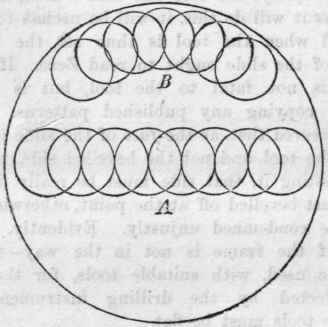
Fig. 28. - Interlacing Circles.
Passing from traced, or mechanically engraved patterns - a variety of which will suggest themselves in practice - we must go on to show how this instrument is used as a carving tool, and especially to cut out rectangular work. Figure 29 represents a cylinder which has been turned, and is held in the chuck (A), and by the back centre, if necessary. The part B is flat, and to cut it so the eccentric cutter is used, with a small, flat, or round-ended cutter in it. The slide-rest is adjusted so as to place the stem of the instrument exactly at right angles to the lathe bed and mandrel. The ornamental rest has a cradle, to ensure this position, but it is quite possible to do without it. If the cylinder is itself true, it can be secured, as usual, by the index peg, and then, when the rest is set true - as nearly as can be done by band- - the tool may be set just to touch one end, and can be carried along the work horizontally, at height of centres. If it just touches throughout its traverse, the setting is true; if not, the rest must be re-adjusted. If now the tool is set just to cut the cylinder, and rapidly rotated by the overhead while carried along by the slide-rest, a series of circular cuts
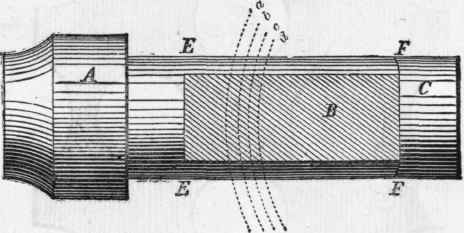
Fig. 29. - Squaring Cylinder by Eccentric Cutter.
(a, b, c, d) will result, running into each other, and a fiat will be produced upon the cylinder. It is represented as bounded at E F by straight lines; but these will, in reality, be curved if the flat is not cut clean out at each end of the cylinder. If it is so cut, the curve will be obliterated. If the index peg is, to begin with, in hole 180, it is plain that, by moving it to hole 45 (180/4 = 45), we shall turn the cylinder exactly one quarter round. If, therefore, we cut one face by guess, until nearly the right size, and then, shifting to 45, we do the same, the cuts will at last meet, and produce an angle of 90°, or a square. It will be exactly right if the tool at 45 A has been advanced exactly as far as it was at 180. When the two cuts thus meet, therefore, the distance the tool has advanced is noted, and marked upon the rest-slide. In cutting the other two flats, it will only be necessary to work exactly to the mark thus made. Here, again, an ornamental rest has a stop-screw, as well as marked divisions. At present, an ornamental rest cannot be got under £10, and may reach £75 with all recent additions. But the Britannia Company, Colchester, are scarcely likely to allow this state of things to continue. Undoubtedly, a very useful rest may be produced for less money, although the finish may not equal that of the more costly article. Ornamental turning would, probably, in that case be more extensively practised; and it has a fascination which few can resist who have once given it a trial, or seen it done by a skilled hand. From the very slight sketch given here, it will be readily conjectured that the eccentric cutter is of very extensive service as a carving, beading, fluting, and engraving tool. It can be used to cut out rings and washers from flat pieces of ivory, and small or large discs, such as are used for counters. Such a plate as represented in Fig. 30, which might be the base of a vase, or anything or nothing, can be cut out by this instrument with great facility, even if ¼in. thick. The tool has to be set in very rapid revolution, and advanced very gently; but the work proceeds with fair celerity, and the cut is clean, without leaving tool marks, if the cutter is itself well made and strong, and its spindle works, without the slightest shake, in its bearings. "With proper adjustments, cubes, and geometrical solids of various kinds can be accurately carved, and the several surfaces left from the tool highly finished, and even polished.

Fig. 30. - Shaping Work with Eccentric Cutter.
Continue to:


My Books

