


How To Make A Settee
Description
This section is from the book "Carpentry For Beginners - Things To Make", by John D. Adams. Also available from Amazon: Make Magazine.
How To Make A Settee
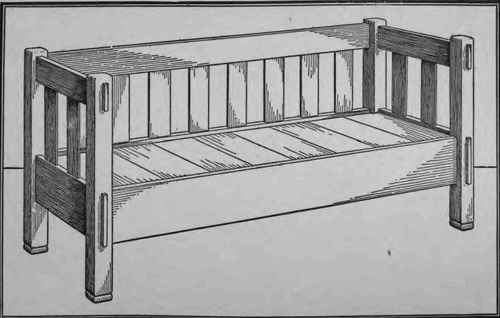
The loose cushion has so many advantages over the regular form of upholstering that it has become very popular in recent years. A settee or chair provided with loose cushions may be arranged so as to be comfortable for almost any position the occupant may assume, and has the further advantage that it can always be easily and thoroughly cleaned. These cushions may be made from a variety of materials such as Spanish leather, pantosote, velour, burlap, etc., and are quite attractive in appearance. But a slight idea of the comfort of this piece of furniture can be had from the cut, as the settee is shown completely bare.
The following is the preferable order of preparing the various pieces: Start with the corner posts. After squaring up to the proper length - giving special care to the tops - mark out the location of the mortises. It will be noted on the drawing that the cross-bar tenons extend slightly beyond the corner posts. Those of the front and the two back-rails extend into the posts for one and one-quarter inches. In forming the feet make a saw cut for a depth of three eighths of an inch on the four sides, and then finish with the chisel. Having completed the corner posts take up the crossbars for each and fit them to the posts, which operation will probably require more care than any other in the construction. Next prepare the front and two back-rails, fitting them to the corner posts as already mortised. The grooves for the four end and eight back boards must now be cut in the cross-bars and back-rails, and the twelve boards fitted thereto. The putting together may now be proceeded with. Connect the corner posts of each end with the cross-bars, using glue at all joints. The two ends thus formed may then be set up and connected by the front and two back rails (with the eight back boards in position, of course). Should there be any question as to the stiffness of the joints of the corner posts with the rails and cross-bars each corner should be reenforced with a large block firmly secured with glue and nails. When the seat is in position these blocks will not be seen. To hold the seat boards up nail strips on the inner sides of the rails and cross-bars, so set that the seat line will fall about a half inch below the top of the rails. This slight depression keeps the cushions in place. For the seat, or back, one long cushion, or three shorter ones, may be provided. These must be firmly filled and be of uniform thickness all over.
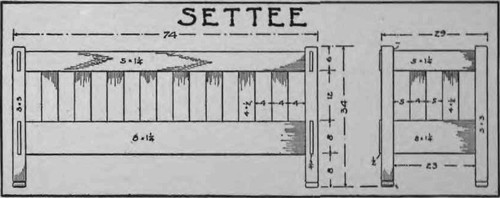
Mill Bill | |||||
PCS. | DIMENSIONS | ||||
4 | 3 | X | 3 | X | 35 |
2 | 1 1/4 | X | 8 1/4 | X | 71 |
1 | 1 1/4 | X | 5 1/4 | X | 71 |
2 | 1 1/4 | X | 8 1/4 | X | 30 |
2 | 1 1/4 | X | 5 1/4 | X | 30 |
12 | 1/2 | X | 4 1/4 | X | 13 |
9 | 3/4 | X | 8 | X | 26 |
Continue to:


My Books

