


How To Use The Tools. Part 2
Description
This section is from the book "Our Workshop", by Anonymous. Also available from Amazon: Our Workshop.
How To Use The Tools. Part 2
The toothed edge of the saw should be held nearly vertically in the thrust, or cutting strokes. If it be allowed to become much inclined to the work, the depth to be sawn is practically increased, and the labour proportionally augmented. When the wood is very hard or thick, the saw must be grasped with both hands; the difficulty of directing its course is then, however, much increased. Sometimes the wood to be sawn is too short to be conveniently held on the trestle. When this is the case, it must be fixed either on the bench or in the screw chops.
If we required to saw a short piece of board, about ten or twelve inches in length, we should fix it in an upright position in the chops, and hold the upper end of the wood with the left hand, and drive the saw with the right. This is a favourite position with many workmen, who prefer the erect to the stooping attitude. It is of great importance to become habituated to certain defined positions when at work; for if the body be inclined at one time and erect at another, the character of the work remaining unchanged, no accuracy can be expected, as the action of the tools is greatly influenced by the-posture of the workman. If the work be fixed on the bench so that the part to be sawn overhangs a few inches, the saw must be held with both hands, and allowed to hang down in front of the operator, the toothed edge being from him and towards the work. As the tool cuts, the carpenter advances, still maintaining the saw in its pendent position. Careful practice is the only way in which you can attain skill, not only in mechanical operations, but in everything, however trivial it may be, that you undertake.
Our pupils should take every opportunity of watching practical men at work, and should never suffer a silly, false pride to hinder them from asking for information, which, if properly solicited, will never be withheld. A clever, intelligent workman feels a proper pride in the art he professes, and is really gratified when a young fellow asks him to solve the difficulties which all amateurs are certain to experience in their undertakings.
For the present we must lay aside the saw and examine the plane, which is the tool by which the smooth, finished appearance is imparted to all carpentry and joinery works.
The plane consists of a long, narrow piece o1
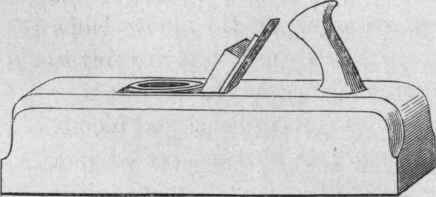
Fig. 3. - Jack-plane.
hard wood, made as true and smooth in every direction as possible.
Fig. 3 will give you a general idea of the Jack-plane, which is used for reducing the rough wood to a uniform surface. The iron, as the cutting blade is called, is in shape very similar to a firmer-chisel (fig. 4). A wedge-shaped opening is made through the wood or stock of the plane, in which the iron is inserted. The narrow end of the wedge-shaped opening is at the bottom of the sole or stock, through which the sharp edge of the iron slightly projects.

Fig. 4. - Firmer-chisel.
As it is not only important, but absolutely necessary, that the workman should understand the construction of the tools he uses, we must request our pupils attentively to examine the several views of the plane we are about to consider.
Fig. 5 is a section taken through the length of the stock, dividing it in the middle or centre of its width. The iron, a b, is clearly seen; also the wedge, w, by which the iron is firmly fixed in the inclined position. The solid wood behind the iron, on which it rests, is called the bed. The narrow opening at a is the mouth, and the inclined wall at a c is called the wear. The angle of the wear should not be great, otherwise the wearing away of the sole of the plane will tend to enlarge the mouth; at the same time the angle must not be too slight, or the plane will choke; that is, the shavings will stick fast, and prevent the tool working. The second inclined wall, c d, is termed the front the angle of which is unimportant. The mouth is generally about one-third of the length of the plane from the front end, not only in the long, but also in the smoothing-planes. The dotted lines, e f (fig. 5), show where the stock would stop in a smoothing-plane, in which the iron is similar. Fig. 6 is a general representation of a smoothing-plane. The wedge for fixing the iron is shown in two views in

Fig. 5.
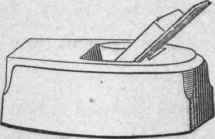
Fig. 6. - Smoothing-plane.
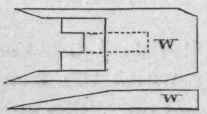
Fig. 7.
The handle, or toat, t, by which the plane is driven forward, is simply in the form of a horn, as in figs. 3 and 5, for these and panel-planes; but longer planes have handles, fixed in the same relation to the iron, but in shape they much resemble the handle of a hand-saw.
Most of the surfacing-planes are fitted with "double irons." The irons are shown in section to a larger scale in fig. 8. The lower iron, a a, is the cutter, while the upper, or break-iron, b b, only bends the shavings out of the way of the edge of the iron proper, and directs them up the "wear." The end, b, of the break-iron, is formed with a large curve, and the edge which rests on the cutter is made only moderately sharp, as it is not required to cut. The two irons are fastened together by the screw, s, which is "tapped" into the boss, t, formed on the break-iron, which is shown separately in fig. 10. The cutter is seen disconnected from the break-iron in fig. 9. The long slot, m, enables us to adjust the irons longitudinally, and also, to a slight extent, sideways. The round hole, h, is a little larger than the head of the screw, s, to permit the latter to pass through when we wish to separate the irons, which is accomplished by unslacking the screw about one turn, and sliding the break-iron back towards the hole, h. The break-iron of the jack-plane is generally fixed, so that its edge is one-sixteenth or one-fifteenth of an inch behind the edge of the cutter. If the break-iron be set back, say one-eighth of an inch, it will not bend the shavings sufficiently, and the planing will very probably be rough. The nearer the edges of the irons are to each other, within certain limits, the smoother will be the work produced, but the labour of driving the plane will be much increased. The edges of the irons are set farther apart in the jack and similar planes than in the smoothing-planes, as the surface of the work is not finished until a more advanced stage.
Continue to:


My Books

