


Rate Of Growth
Description
This section is from the book "The Mechanical Properties Of Wood", by Samuel J. Record. Also available from Amazon: The Mechanical Properties Of Wood.
Rate Of Growth
To understand the effect of variations in the rate of growth it is first necessary to know how wood is formed. A tree increases in diameter by the formation, between the old wood and the inner bark, of new woody layers which envelop the entire stem, living branches, and roots. Under ordinary conditions one layer is formed each year and in cross section as on the end of a log they appear as rings - often spoken of as annual rings. These growth layers are made up of wood cells of various kinds, but for the most part fibrous. In timbers like pine, spruce, hemlock, and other coniferous or softwood species the wood cells are mostly of one kind, and as a result the material is much more uniform in structure than that of most hardwoods. (See Frontispiece.) There are no vessels or pores in coniferous wood such as one sees so prominently in oak and ash, for example. (See Fig. 22.)
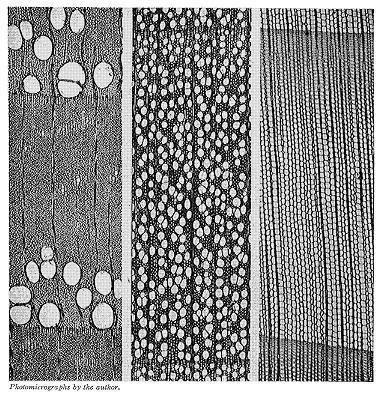
Figure 22
Cross sections of a ring-porous hardwood (white ash), a diffuse-porous hardwood (red gum), and a non-porous or coniferous wood (eastern hemlock). × 30. Photomicrographs by the author.
The structure of the hardwoods is more complex. They are more or less filled with vessels, in some cases (oak, chestnut, ash) quite large and distinct, in others (buckeye, poplar, gum) too small to be seen plainly without a small hand lens. In discussing such woods it is customary to divide them into two large classes - ring-porous and diffuse-porous. (See Fig. 22.) In ring-porous species, such as oak, chestnut, ash, black locust, catalpa, mulberry, hickory, and elm, the larger vessels or pores (as cross sections of vessels are called) become localized in one part of the growth ring, thus forming a region of more or less open and porous tissue. The rest of the ring is made up of smaller vessels and a much greater proportion of wood fibres. These fibres are the elements which give strength and toughness to wood, while the vessels are a source of weakness.
In diffuse-porous woods the pores are scattered throughout the growth ring instead of being collected in a band or row. Examples of this kind of wood are gum, yellow poplar, birch, maple, cottonwood, basswood, buckeye, and willow. Some species, such as walnut and cherry, are on the border between the two classes, forming a sort of intermediate group.
If one examines the smoothly cut end of a stick of almost any kind of wood, he will note that each growth ring is made up of two more or less well-defined parts. That originally nearest the centre of the tree is more open textured and almost invariably lighter in color than that near the outer portion of the ring. The inner portion was formed early in the season, when growth was comparatively rapid and is known as early wood (also spring wood); the outer portion is the late wood, being produced in the summer or early fall. In soft pines there is not much contrast in the different parts of the ring, and as a result the wood is very uniform in texture and is easy to work. In hard pine, on the other hand, the late wood is very dense and is deep-colored, presenting a very decided contrast to the soft, straw-colored early wood. (See Fig. 23.) In ring-porous woods each season's growth is always well defined, because the large pores of the spring abut on the denser tissue of the fall before. In the diffuse-porous, the demarcation between rings is not always so clear and in not a few cases is almost, if not entirely, invisible to the unaided eye. (See Fig. 22.)
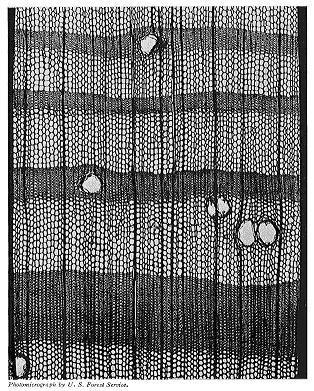
Figure 23
Cross section of longleaf pine showing several growth rings with variations in the width of the dark-colored late wood. Seven resin ducts are visible. × 33. Photomicrograph by U.S. Forest Service.
If one compares a heavy piece of pine with a light specimen it will be seen at once that the heavier one contains a larger proportion of late wood than the other, and is therefore considerably darker. The late wood of all species is denser than that formed early in the season, hence the greater the proportion of late wood the greater the density and strength. When examined under a microscope the cells of the late wood are seen to be very thick-walled and with very small cavities, while those formed first in the season have thin walls and large cavities. The strength is in the walls, not the cavities. In choosing a piece of pine where strength or stiffness is the important consideration, the principal thing to observe is the comparative amounts of early and late wood. The width of ring, that is, the number per inch, is not nearly so important as the proportion of the late wood in the ring.
It is not only the proportion of late wood, but also its quality, that counts. In specimens that show a very large proportion of late wood it may be noticeably more porous and weigh considerably less than the late wood in pieces that contain but little. One can judge comparative density, and therefore to some extent weight and strength, by visual inspection.
The conclusions of the U.S. Forest Service regarding the effect of rate of growth on the properties of Douglas fir are summarized as follows:
"1. In general, rapidly grown wood (less than eight rings per inch) is relatively weak. A study of the individual tests upon which the average points are based shows, however, that when it is not associated with light weight and a small proportion of summer wood, rapid growth is not indicative of weak wood.
"2. An average rate of growth, indicated by from 12 to 16 rings per inch, seems to produce the best material.
"3. In rates of growths lower than 16 rings per inch, the average strength of the material decreases, apparently approaching a uniform condition above 24 rings per inch. In such slow rates of growth the texture of the wood is very uniform, and naturally there is little variation in weight or strength.
Continue to:


My Books

