


Tools. Part 13
Description
This section is from the book "Elements Of Woodwork", by Charles A. King. Also available from Amazon: Elements Of Woodwork.
Tools. Part 13
A saw to be used upon green lumber should have coarser teeth and more set than one which is to be used upon thoroughly dry, seasoned wood. A panel saw in tended for use upon fine finishing work usually is ground so thin upon the back that it needs little or no set. Some workmen set a saw so heavily that it will do for several filings; while this is satisfactory for a soft saw to be used upon common work, it is not a good plan to treat a fine, hard saw this way, though the latter may be touched up once or twice. (D.) In filing, it is important that the file should be carried at the same angle the entire length of both sides of the blade. For a cutting-off saw, the file should be carried at an angle with the side of the blade of from 60° for soft wood to 70° for hard wood, as shown in Fig. 92; and for general work, at an angle about halfway between the two.
The file may be carried horizon tally, as at aa, Fig. 93, which makes all the teeth of the same size; as at A, Fig. 94; or it may be carried as at bb, Fig. 93, which will make the teeth of the shape shown at B, Fig. 94. The latter method is preferred by many workmen, as it allows the file to run more smoothly, thus lengthening its life a little. There is no difference in the efficiency of the saws filed by these methods, but if filed as at bb, Fig.
93, it is more difficult to keep the teeth of the same size, and to make a good-looking job.
In filing a cutting-off saw, the top of the file should be held more or less slantingly, as shown in Fig. 95, according to the hook which it is desired that the teeth shall have. The more hook a saw has, the faster it will cut, but the cut will be rougher in proportion. Experience is necessary to discover just the right angles at which the file should be held; after considerable practice, the file will naturally drop into the correct position.
File every tooth upon each side of the saw to a perfect point, one half of the filing being done from each side; file the entire length from one side, then reverse the saw and file from the other side. This cannot always be the exclu sive practice if a saw is in very bad shape, because if the teeth are of uneven sizes, care must be used, and more filed from some teeth than from others. It may, in such a case, be necessary to go over the saw two or three times, but it should be done very carefully, so that the bevel of the teeth may be pre served and their length kept the same. Observe each tooth, and press toward the point or the handle of the saw, as may be necessary. The file should be carried with its point toward the point of the saw, filing the cut ting or the front side of the tooth of the farther side of the saw, and the back of the tooth next ahead on the nearer side with the same stroke. If the point of the saw is carried toward the handle of the saw, it makes the teeth chatter, and upon a hard saw, may make them break. It also causes an excruciating noise, and shortens the life of a file, as the continuous chatter against its teeth will soon break them, and destroy the file.
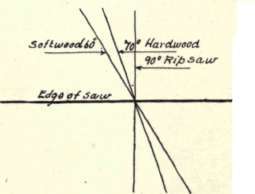
Fig. 92. - Angle of the File with the Edge of the Saw.

Fig. 93. - Angle of the File with the Sides of the Saw.

Fig. 94. - Results of Filings as at aa and bb, Fig. 93.
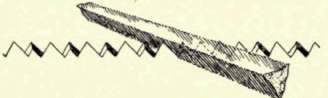
Fig. 95. - Method of Carrying a File to obtain the hook of a cutting-off Saw.
A ripsaw requires more set than a cutting-off saw, and if, as usual, the file is carried square with the blade both ways, the saw may be filed from one side.
After a saw is filed, it should be laid upon a perfectly flat surface, and given a light touch with a flat file or a whetstone, to remove the burr caused by the file, as in Fig. 96.

Fig. 96.- Removing the Burr after Filing a Saw.
The teeth of the compass saw should be a combination of the rip- and the cutting-off saw, as it does the work of both as occasion requires. The teeth should be nearly as hooking as those of a ripsaw, and the front teeth filed at an angle of about 80° with the side of the saw. In filing the back of the teeth, the hand should be carried a little lower than horizontal. Figure 41, C, shows three views of the teeth of a compass saw.
Suggestive Exercises
27. What should be the quality of all mechanics' tools? Is a good, serviceable tool always finely finished? Are tools made espe cially for some dealer always reliable? What is the safest method to follow in buying tools? How may the efficiency of a tool be known?
28. Describe two forms of benches. Describe a modern vise.
29. Describe the rule in common use.
30. For what is the try-square used? Why should special care be used in purchasing one? How may a square be tested?
31. Compare the steel square and the try-square.
32. Describe the bevel and its use.
33. For what is the gauge used? Should the graduations of the gauge be depended upon in setting it? What special form of gauge is useful ?
Continue to:


My Books

