


Woodworking Machines. Part 3
Description
This section is from the "Educational Woodworking For Home And School" book, by Joseph C.Park . Also see Amazon: Educational Woodworking For Home And School.
Woodworking Machines. Part 3
88. The Speed Of Circular Saws
As a rule the rim of a circular saw should travel about 9000 feet (nearly two miles) per minute. Saws differ in diameter, and in order to get the correct speed different revolutions must be made, a small saw making a greater number of revolutions per minute than a larger saw. A saw 12" in diameter is about 3 feet in circumference and must make 3000 revolutions per minute in order to have the correct speed. If the speed of a saw is too high, the saw will not cut well, for it will heat and buckle and will not run true. It is also very dangerous. On the other hand, saws run at too low a speed will not work well. The following table gives the speed at which circular saws should be run: -
Table Of Speed Of Circular Saws
Size or Diameter of Saw | Rev. per Min. |
Inches | Speed |
8 | 4,500 |
10 | 3,600 |
12 | 3,000 |
14 | 2,585 |
16 | 2,222 |
18 | 2,000 |
20 | 1,800 |
22 | 1,636 |
24 | 1,500 |
Size or Diameter of Saw | Rev. per Min. |
Inches | Speed |
26 | 1,384 |
28 | 1,285 |
30 | 1,200 |
32 | 1,120 |
34 | 1,050 |
36 | 1,000 |
38 | 950 |
40 | 900 |
Size or Diameter of Saw | Rev. per Min. |
Inches | Speed |
42 | 870 |
44 | 840 |
46 | 800 |
48 | 750 |
50 | 725 |
52 | 700 |
54 | 675 |
56 | 650 |
Size or Diameter of Saw | Rev. per Min. |
Inches | Speed |
58 | 625 |
60 | 600 |
62 | 575 |
64 | 550 |
66 | 545 |
68 | 529 |
70 | 514 |
72 | 500 |
89. Rules For Calculating The Speed Of Saws, Pulleys, And Drums
Problem 1
The diameter of the driven being given, to find its number of revolutions.
Rule
Multiply the diameter of the driver by its number of revolutions, and divide the product by the diameter of the driven; the quotient will be the number of revolutions of the driven.
Problem 2
The diameter and revolutions of the driver being given, to find the diameter of the driven, that shall make any given number of revolutions in the same time.
Rule
Multiply the diameter of the driver by its number of revolutions, and divide the product by the number of revolutions of the driven; the quotient will be its diameter.
Problem 3
To ascertain the size of the driver.
Rule
Multiply the diameter of the driven by the number of revolutions you wish it to make and divide the product by the revolutions of the driver; the quotient will be the size of the driver.
90. Single Sur-Facer
This machine is not absolutely necessary in a manual training shop, yet it is very useful. It is built with special reference to doing smooth work on wood, from 1/16" to 6" in thickness'. Surfacers are made in 16", 20", and 24" widths. The tight and loose pulleys (10" by 5 1/4") on the countershaft should make 800 revolutions per minute. A machine like this should never take the place of work that should be done by hand, yet very often it is most practicable to have the benefits of such a machine. With it old stock can be worked up and used, thus saving much in the expense account.
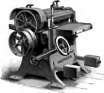
Fig. 131. Single surfacer.
91. Jointer
The jointer is a machine used, as its name implies, in squaring, smoothing, and taking the wind out of timber, glue-jointing, beveling, chamfering, rabbeting, molding, tonguing and grooving, beading, cornering, cross graining, tenoning, etc. It has attachments and adjustments for all of these kinds of work, thus making it a very valuable machine in a manual training equipment. Jointers are made in different sizes. A 12" cut is about the right size for this work. The speed of the tight and loose pulleys should be 900 revolutions per minute- The jointer is a dangerous machine to use, and one cannot be too careful in operating it.
92. Wood-Turning Lathe
There are many different makes of wood-turning lathes on the market at the present time. One of the most popular makes for manual training work is the Reed 10" swing lathe, shown in Fig. 133. A sectional view of the headstock is shown in Fig. 134. These lathes are supplied with countershaft, large and small wood-turning face plates, pair of wood-turning centers, tee rest holder, three tee rests of different lengths, and blue print holder. At the close of each exercise in turning the student should dust off all parts of the lathe very carefully so that it is left in perfect order. In wood turning the speed of the lathe should be adjusted to the size of the block that is to be turned. A small block should revolve faster than a large one. The following is a table of speed used in wood turning: -

Fig. 132. Jointer.
Diameter of Work | Revolutions per Minute | Surface Speed in Feet per Minute |
1 inch | (About) 3000 | (About) 785 |
2 inches | 2500 | 1308 |
3 | 1500 | 1178 |
5 | 1000 | 1259 |
8 | 600 | 1257 |
12 | 600 | 1880 |
18 | 300 | 1414 |
24 | 250 | 1571 |
93. Belts
A belt should be of a uniform quality and the laps in the leather should be near together. If the laps are far apart, it indicates that the leather was cut in long strips, which cannot give a good quality of belting, for in so cutting an inferior part of the hide must be used. "Short lap" belts are considered the best. Belts should be run with the grain or hair side next to the pulley, because the hair side is the weaker side of the belting. By running a belt in this way the. stronger side of the belt comes on the outside, where there is the greatest strain. They should be run horizontally or at an angle, and with the drawing side underneath in order to get the best contact with the pulleys. Care should be exercised in getting belts wide enough to do a given amount of work without slipping. A belt should not be overloaded and should not be run too tight. The surfaces of belts should be kept in a pliable condition by using a good quality of belt dressing.
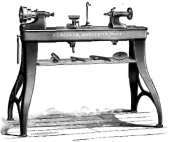
Fig. 133. Wood-turning lathe.
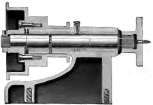
Fig. 134. Sectional view of headstock.
The strength of good leather belting is estimated at from 4000 to 4500 pounds per square inch of section. A well-laced joint is about one third as strong. The amount of space covered on a pulley is called the "arc of contact." When the pulleys are of equal sizes, the arc of contact is 180 degrees. If the pulleys are unequal in size, the arcs of contact are unequal, the larger pulley having the greater arc of contact. The best speed for belts is about 4000 feet per minute. Large pulleys are more desirable than small ones if the belt speed is not too high.
Continue to:


My Books

