


Evener And Singletree
Description
This section is from the book "Shop Projects Based On Community Problems", by Myron G. Burton. Also available from Amazon: Shop Projects Based on Community Problems.
Evener And Singletree
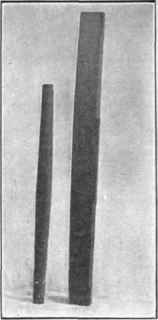
Materials
Hickory (Chap. III., Par. 39) or Straight-grained Oak (Chap. III., Par. 29).
Singletree -
1 pc. 2"x2 3/4"x35" rough or S 2 S
Evener -
1 pc. 2 1/8"x4 3/4"x48" rough or S 2 S
Introductory Statement
Singletrees are in constant use both in cities and on the farm or wherever any kind of team work is being done. Singletrees are frequently broken, and although they can be purchased on the market, yet since they are so simple in construction it is well for a boy to be able to make them.
The best material for this purpose is clear, straight hickory; a good quality of ash or oak may be used.
One great advantage in a farmer boy's being able to handle tools comes from the fact that he can spend his odd hours or rainy days in making things which will save him considerable expense.
References:
Modern Blacksmithing and Wagon Making, Holmstrom. Fredrick Drake
Co., Chicago. Farm Buildings, H. V. Van Hoist. The National Builder, Chicago, 111. The Gasoline Engine on the Farm, Putnam. Norman Henly Pub. Co.,
New York. Electric Light for the Farm. Schneider, Spon & Chamberlain, New
York. Home Water Works, Lynde. Sturgis & Walton, New York. Suggestions for Home Blacksmithing, Library of Work and Play, Sleffel. Doubleday, Page & Co.
Doubletree Orevener
Singletree
Suggestions For Original Design

Three Horse Evener
Double Tree Or Evener Specifications
Plane one surface of the material perfectly smooth and mark it the working face (Chapter II., Paragraph 2). Plane one edge perfectly straight and square for the working edge (Chapter II., Paragraph 4). Square one end (Chapter II., Paragraph 5). Gauge the width which the evener must be at the widest point (Chapter II., Paragraph 6 or 7); measure and cut the desired length. Lay out the width at each end; measure carefully and locate the middle; with a lead pencil square a line across the working face at this point.
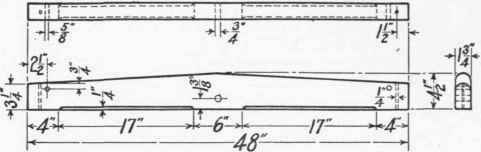
You will notice from the drawing that the front side of the evener is to be perfectly straight, with the corners chamfered, while the rear side is to be tapered, or rounded, just as you may see fit. Lay out these lines for the taper on the rear side, saw them out with the rip saw, and finish with the plane; round this edge slightly, as shown in the drawing.
On the front side lay out the chamfer (Chapter II., Paragraph 8). This chamfer may be cut with the drawing knife (if you have none use a pocket knife and complete it with a small plane). Locate and bore the holes as shown in the drawing (Chapter II., Paragraph 9).
Finishing
With a sharp steel scraper remove all pencil marks and rough places; finish with one or two coats of linseed oil.
Singletree
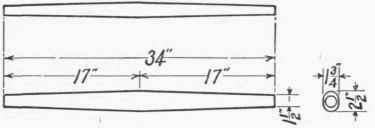
Although the singletree does not have any perfectly straight surfaces it will be well to prepare a working face and working edge from which to lay out dimensions (Chapter II., Paragraphs 1, 2, 3, 4). Lay out the tapered shape of the singletree, and saw it out with the rip saw. With the drawing knife or plane chamfer the corners, and plane the singletree to the proper shape.
Finishing
With the wood file or sharp steel scraper remove all tool marks. It may be smoothed with sandpaper (Chapter II., Paragraph 16). When all tool marks have been removed, finish with one or two coats of linseed oil.
Optional and Home Projects Employing Similar Principles.
Three-Horse Evener
1. In the Suggestions for Original Design the idea of a three-horse evener is presented. The evener is very similar in construction to the doubletree presented in the lesson. The principal difference is that the hole for the king-pin is bored at one-third the distance from the end, thus giving the single horse sufficient leverage to equal the team.
Neck Yoke
2. The problem of making a neck yoke is very similar to that of shaving and shaping the form of a singletree. Of course the length and shape of this project will not be the same but the principles of construction are almost identical.
Continue to:


My Books

