


Plumbing. Part 2
Description
This section is from the book "The Care Of A House", by T. M. Clark. Also available from Amazon: The Care Of A House.
Plumbing. Part 2
Sewage pump.
It is hardly necessary to say that the fluid is an admirable, though dilute, fertilizer, and the lover of a garden soon comes to look upon his cesspool, if equipped with a pump in this way, as a precious source of big and brilliant flowers, luxuriant shrubbery, and thick green grass. As the pumping out of the cesspool stops for a time the course of the overflow rivulet, allowing the ground over which it flows to dry and aerate, any annoyance from it is prevented, ground subjected to alternations of sewage saturation and aeration being quite inoffensive.
If a pump is desirable for a cesspool so situated that the water from it will not back up into the house, even if it should overflow, it is still more valuable for a cesspool which, if it overflows, will flood the basement; and such a pump, if not permanently set, ought at least to be available in emergencies for every cesspool. As, however, the cesspool pump is often a more agreeable object of contemplation to the horticulturist members of the family than to the housekeeper, it is desirable to know how its use may be rendered less frequently necessary, by the employment of some more automatic method for absorbing the overflow harmlessly. The best system for this purpose, where the conformation of the ground permits its application, consists of a receiving-cesspool, or settling-basin, which is usually made with tight floor and walls, of brickwork in cement, and a number of lines of open-jointed subsoil absorption-pipes, laid ten or twelve inches below the surface of the ground, and filled through the medium of a flushing-tank, which receives water from the settling-basin, and, when full, discharges its contents all at once into the subsoil-pipes. The water so discharged finds its way immediately out of the joints between the pipes into the soil around them, and is absorbed, the ground then being left to the influence of the air until the next discharge.
H
Subsoil irrigation.
The essential requisite for such a system is that ground shall be available for the distribution pipes at such a grade that they can be laid within twelve inches of the surface without raising the water level in the receiving-basin so high as to flow the sewage back into the house. As the flushing-tank must be filled by the overflow from the receiving-basin, and must discharge at a level from two to four feet lower, according to the variety of flushing-tank used, the surface of the distribution area must be at least three feet below the bottom of the cellar of the house, and should be more, if possible.
Where such a tract, containing a few hundred square feet, is available, no system of sewage disposal for country houses approaches, for efficiency, cleanliness, and economy, that by subsoil irrigation. Although the first cost is much greater than that of an ordinary cesspool, varying from about a hundred dollars for a simple system, suitable for a house with one bath-room, to several hundred where a large amount of sewage is to be disposed of, the expense of cesspool cleaning, which sometimes amounts to as much in a single year as the whole cost of a better system, is saved, the subsoil-pipes only needing to be taken up once in two or three years, cleared of possible sediment with a stick, and replaced; while there is no danger of the backing of sewage into the house, there are no new cesspools to be dug when the old one fills up, and there is no contamination of the ground, the liquid which flows from the joints of the distribution-pipes being so thoroughly oxidized and transformed by the nitrifying agencies which fill the surface soil that, after many years of use, no trace of sewage matters can be found in the earth around the pipes.
For the economical planning and execution of a system of this sort, even for a small house, professional advice is desirable; but it may be of assistance to those out of reach of such advice to say that the subsoil-pipes should be two-inch agricultural sole tile (Figure 13), laid one-quarter of an inch apart, and the joint covered with a bit of tarred paper while the earth is refilled around them. Many architects lay them on strips of board to keep them in line, and concave tiles can be had for the same purpose, which have the advantage over boards that they do not rot away and dislocate the whole line of pipes resting on them; but with care to compact the earth evenly under them, they can be laid with satisfactory results directly on the natural soil. For a house with one bath-room about five hundred feet of subsoil-pipe should be used. This is much more than enough to dispose of all the sewage, even in a clay soil; but the pipes are cheap, and, as some of them are sure to settle, and fill up with the soft sediment which immediately collects where the flow is checked, ample margin should be allowed. The lines of pipe should be laid with a pitch of one inch in twenty-five feet. With a greater pitch the sewage flows too rapidly to the end of the line, and may make its way to the surface there, unless the last tile is turned slightly downward. With a less pitch the flow is sluggish, and the more distant pipes will not do their work.
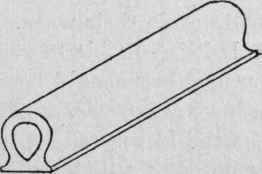
Fig. 13.
If it is possible to avoid it, none of the distribution-pipes should be more than twelve inches below the surface, as the purifying influence of the soil is very slight below that point. There is no danger that the sewage will freeze in the pipes unless it should stagnate in some depression; or that the ground will freeze around them so as to refuse to absorb the warm flow. For supplying the lines of subsoil-pipe, four-inch vitrified drain-pipe is generally used, jointed with cement, the hubs pointing downward, and with numerous Y or double Y branches into which the first tiles of the subsoil lines are cemented. The upper end of the line of vitrified pipe terminates at the flushing-tank, and the lower end should be continued by a long line of open-jointed tiles, so that sediment may not collect in the main pipe and cut off the branches. The flushing-tank may be either a siphon-tank, of which many varieties are sold, or a tilting-tank of galvanized iron (Fig. 14), pivoted so that it will tip over when full, recovering itself when the liquid in it has been discharged. Siphons have the disadvantage of occasionally filling up with grease, throwing the drainage system out of use until the siphon is removed, and the grease melted out; and they require greater depth than a tilting-tank, but they are much used. Tilting-tanks, if preferred, must generally be made to order, and should work in a special chamber (Fig. 15), filling by an overflow-pipe from the settling-basin, and pouring their contents, when they tip forward, directly into the mouths of the main distributing-pipes, several of which may branch in various directions from the tilting-tank basin, if necessary. The overflow-pipe from the settling-basin, by which the tilting-tank is filled, should be made with a bend, dipping below the surface of the water in the settling-basin, in order that scum may not pass over. The cost of the tilting-tank with its basin is no greater than that of a siphon, and it has the advantage that it never clogs, and can be readily inspected and cleaned without interrupting its functions.
Continue to:


My Books

