


Chapter IX. Troubles With Plumbing, And Their Remedy
Description
This section is from the book "The Care Of A House", by T. M. Clark. Also available from Amazon: The Care Of A House.
Chapter IX. Troubles With Plumbing, And Their Remedy
The disorders to which plumbing in houses is subject may be divided into three classes: those connected with the drains and waste-pipes; those which appear in connection with the supply-pipes; and those which, affect fixtures of various kinds.
Naturally, the first symptom of a defect in the waste-pipes of a house is a disagreeable odor, the locality of which will, to a certain extent, indicate its cause. In modern houses all the pipes, including the waste-pipes, are exposed to view, or can easily be examined by removing a casing of some sort; and, unless the trouble is quite evidently connected with some fixture, it is well to trace in this way the whole length of the main soil-pipe, examining particularly the joints. It is not unusual to find that settlement, or the shrinkage of the floors, has pulled the lead with which the joints of cast-iron pipes are made tight partly out of the socket; and, in this case, a few minutes' work with a caulking tool will drive the lead back into its place, and make all tight again; and, even where the lead has not visibly started from its place, a little caulking will generally make a joint tight about which there is a suspicious odor.
Defects in waste-pipes.
Imperfect joints.
Where it is impracticable to caulk thoroughly a joint in a cast-iron pipe which has been found to leak slightly, the householder need not hesitate to apply putty around it, over the lead. Although architects refuse to accept from a contractor any cast-iron waste-pipes which show putty in the joints, on account of the danger that the joint may have been made tight with putty, instead of the more permanent lead, there are many cases where the slight leaks which develop themselves, in course of time, in all lines of cast-iron pipe exposed to the variations of temperature in dwelling-houses, may be perfectly cured in this way; and the putty can be renewed as occasion may require. Only the very best putty should be used for such purposes, the mixture of marble dust and petroleum sold as cheap putty affording no security; and in basements and other places where rats are likely to get at the putty, it should be mixed with red lead, to prevent them from gnawing it away.
If the joints of the soil-pipe are found to be tight, and no small "sand-holes" are discovered in the, pipes or fittings, the air-pipes, which communicate freely with the soil-pipe, and are of the same material, and jointed in the same way, should be examined, and, if necessary, subjected to similar treatment.
Occasionally, although not very often in modern plumbing work, a dangerous leak of sewer-gas is caused by improper arrangement of pipes, forming a "by-pass." In Figure 25, suppose W to be a wash-basin, with an S trap, S, under it, and B to be a bath, with a round trap, T, under the floor. Both traps are back-vented by the air-pipes, A, A, connected into a main air-pipe, P. If the waste from the wash-basin is connected into the bath-waste beyond the trap, as it should be, no sewer-gas can escape either into the washbasin or the bath, so long as the traps are full; but it sometimes happens that a careless or ignorant plumber, to save a little pipe, or give the job a neater appearance, will connect with the bath-waste inside the trap, T, as shown in the figure, thus opening ' a free passage for the sewer-air which comes up the bath-waste, and is stopped by the water in the trap, T, through the two air-pipes and the basin-waste to the "house side " of the bath waste, through which it pours in a stream, entering the room by the waste and overflow of the bath. Such a defect as this is not generally shown by the water-test, as minor connections are made after the main pipes have been tested, but it may have very serious consequences; and, if a by-pass of this sort should be discovered, the waste and overflow openings through which it allows sewer-gas to escape should be securely plugged with corks, or covered with strong paper, pasted on, until a plumber can be called in to make the necessary changes in the pipes.
Putty.
Air-pipes.
By-pass.
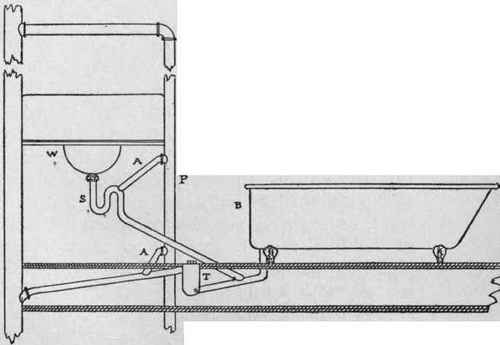
FIG. 25.
If none of these defects are found to explain an unpleasant smell about the waste-pipes, the trouble may come from the outside. Where a main trap is used on a house-drain, it was formerly the practice to contrive a "foot vent," just inside the trap (Fig. 26), to supply fresh air to the system of waste-pipes in the house. Where the main trap is placed in a pit outside the house, the foot vent usually opens into the pit. Where the main trap is inside the house, the foot vent is commonly carried up a few feet on the cellar wall, and then turned outward, ending at a grated opening in the wall of the house; or is brought up through the ground, close to the outside of the house, and covered with an open cap. As the soil-pipe always extends through the roof, and the inside of the house is generally warmer than the outside air, there is, at ordinary times, an upward current through the soil-pipe, and, in consequence, an inward draught at the foot vent; but the sudden discharge of any considerable quantity of water from one of the house fixtures temporarily reverses the current, the rush of water carrying the air with it, so that, for a moment, air comes out of the foot vent, instead of being drawn in, and the air which comes out brings with it the odors of the drain. If there is a window near the opening of the foot vent, these odors are very likely to be unpleasantly perceived, particularly if the window belongs to a room constantly occupied.
Foot vent.
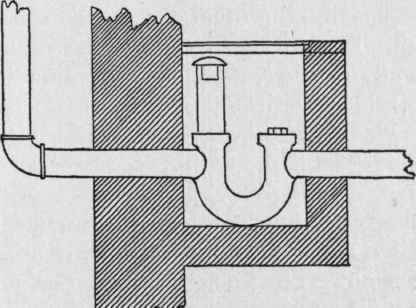
Fig. 26.
In order to make sure whether this is the origin of the trouble, some one should be stationed at the foot-vent opening, while another discharges a bath-tub or wash-tray in the house; the coincidence of an unpleasant smell at the foot vent with the discharge of the fixture in the house will be good evidence that this is the source of the annoyance. The best remedy for it would be to take out both the foot vent and the trap; but, if the official regulations do not permit this, the foot vent should be extended to some place where its occasional exhalations cannot reach a window. Occasionally, the other end of the soil-pipe is at fault. The strong current which, with modern plumbing, usually ascends the pipe, diffuses itself to a considerable distance around its upper opening; and, in houses with steep roofs, and attic rooms, it often happens that the top of a soil-pipe is left open near a window. An inspection of the upper portion of the pipe will show what the conditions are in this respect; and, if necessary, the pipe may be extended to a greater height, supporting it by carrying it up beside a chimney or dormer. In some houses, particularly in cities, the rain-water conductors are connected with the soil-pipe, without a trap between, and, in such cases, bring a plentiful supply of drain-air to the dormer windows which happen to overlook the gutter. Where this is the case, the simplest remedy is to put a trap between the conductor and the soil-pipe, and this is generally required by law, where there are windows in the roof above the gutter. In houses with flat roofs, where there are no windows above the gutter, the trap between the conductor and the soil-pipe is unnecessary, and is in some respects objectionable, as it is apt to fill with ice in winter.
Continue to:


My Books

