


Thomas Sheraton. 1750-1806. Part 7
Description
This section is from the book "The Practical Book Of Period Furniture", by Harold Donaldson Eberlein And Abbot McClure. Also available from Amazon: The Practical Book Of Period Furniture.
Thomas Sheraton. 1750-1806. Part 7
Types Of Design
Sheraton employed most of the classic types of design which had been introduced into English furniture by the Brothers Adam. We find swags (Fig. 3, and Plate XXXII, p. 240), spandrel fans, floral wreaths, square, oval and round paterae and water leaf motifs. There are certain designs, however, that are peculiarly characteristic of Sheraton. These are the oval (Key XIV, 5; Plate XXXII, p. 240; Fig. 7, and Fig. 8,B), the slender and graceful shaped urn, the conch shell and the star. He was also much given to the water leaf pattern. The lyre pattern (Key XIII, 1) he borrowed from Hep-plewhite. The Roman diamond lattice which he used so largely in his chair and settee backs (Fig. 1, B and H) was of his own introduction. Fluting and reeding he employed most extensively.
Structure
The structure of Sheraton chairs is apparently frail. They are not, of course, as robust as the chairs made by Chippendale, but Sheraton had considerable structural knowledge and so planned his chairs and settees that support was given at the necessary points. For that reason they are deceptive in appearance and have outlasted other furniture of heavier make but less carefully planned. The cabinet-work was mainly rectilinear in carcase, saving, of course, the serpentine or bowed front chests of drawers and the shaped sideboards.
Mounts
The mounts of Sheraton furniture were much like those on Hepplewhite furniture. Both types have the engraved ovals, with ring handles (Fig. 10, B), the round ringed or chased mounts with either brass knobs or rings (Key XIV, 4; Fig. 4, and Fig. 6), the octagonal mounts with ring handles (Fig. 10, C) and the simple bail handles (Fig. 10, A; and Key XIV, 2). In addition to these, Sheraton furniture, in the latter part of the century, often has lion-head handles with rings suspended from their mouths (Key XIV, 1; and Plate XXXV, p. 254). The key-plates are generally of diamond-shaped ivory, flush with the surface of the door or drawer. When ivory was not used a narrow, brass, flush rim took its place.
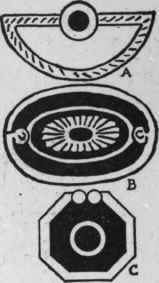
Fig. 10. Typical Sheraton Mounts.
Finish
While Sheraton furniture was doubtless often finished in the same manner as indicated in preceding chapters, much of it was unquestionably finished in the manner set forth in Sheraton's own directions quoted in the footnote at the end of this section.
The following is a wax polish recipe preserved for many years in an old Philadelphia family. It may be used for a finish where the wood has been given a first dressing of oil, but may also be profitably used as a weekly polish on any furniture: Melt a lump of beeswax of sufficient size in a pint of turpentine over a slow fire. If a reddish colour is desired a little alkanet root in a cheesecloth bag may be suspended for a while in the mixture. When cool it should be of thick creamy consistency. Polish with a soft flannel cloth, using only a small portion of the mixture at a time. Rub briskly but not too hard.1
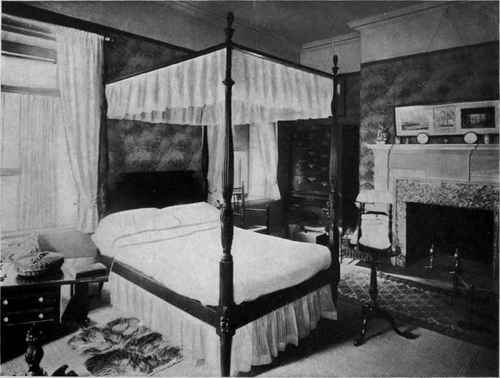
PLATE XXXVI. SHERATON BEDSTEAD AT UPSALA, GERMANTOWN, PHILADELPHIA By Courtesy of Miss Sallie W. Johnson, Philadelphia.
1 Polish - .... The method of polishing amongst cabinetmakers is various, as required in different pieces of work. Sometimes they polish with beeswax and a cork for inside work, where it would be improper to use oil. The cork is rubbed hard on the wax to spread it over the wood, and then they take fine brick-dust and sift it through a stocking on the wood, and with a cloth the dust is rubbed till it clears away all the clemmings which the wax leaves on the surface.
At other times they polish with soft wax, which is a mixture of turpentine and beeswax, which renders it soft and facilitates the work of polishing. Into this mixture a little red oil may occasionally be put, to help the colour of the wood. This kind of polishing requires no brick-dust, for, the mixture being soft, a cloth of itself will be sufficient to rub it off with. The general mode of polishing plain cabinet-work is, however, with brick-dust and oil, in which case the oil is either plain linseed or stained with alkanet root (see Alkanet Root ). If the wood be hard, the oil should be left standing upon it for a week; but if soft, it may be polished in two days. The brick-dust and oil should then be rubbed together, which in a little time will become a putty under the rubbing cloth, in which state it should be kept under the cloth as much as possible, for this kind of putty will infallibly, secure a fine polish by continued rubbing; and the polisher should by all means avoid the application of fresh brick-dust, by which the unskilful hand will frequently ruin his work instead of improving it; and to prevent the necessity of supplying himself with fresh brick-dust he ought to lay on a great quantity at first, carefully sifted through a gauze stocking; and he should notice if the oil be too dry on the surface of the work before he begin, for in this case it should be re-oiled, that it may compose a sufficient quantity of the polishing substance, which should never be altered after the polishing is commenced, and which ought to continue till the wood by repeated friction becomes warm, at which time it will finish in a bright polish, and is finally to be cleared off with the bran of wheaten flour.
Chairs are generally polished with a hardish composition of wax rubbed upon a polishing brush, with which the grain of the wood is impregnated with the composition, and afterwards well rubbed off without any dust or bran.
Continue to:


My Books

