


George Hepplewhite. 1786. Part 4
Description
This section is from the book "The Practical Book Of Period Furniture", by Harold Donaldson Eberlein And Abbot McClure. Also available from Amazon: The Practical Book Of Period Furniture.
George Hepplewhite. 1786. Part 4
Stools
By the time of Hepplewhite's prosperity stools had ceased to be fashionable and were not in demand.
Sofas And Settees
In Hepplewhite's sofas and settees we meet with two distinct varieties - the upholstered sofa (Key XII, 1) with strong French affinities and the chair-back settee, which was simply a succession of chair backs of one or the other of the typical forms joined together, sometimes as many as five being placed in a row of graduated size. All their characteristics were those of the chairs and need not be further dwelt upon.
The upholstered sofas had rounded or square legs like the chairs, but the preference seems to have been for the former. Backs were simply bowed or else broken into a number of curves rising towards a crest in the middle (Key XII, 1). The backs were often curved round to form the arms, which then dropped with rapid curve to meet the seat at the top of the front leg. These sofas usually had eight legs and were much longer than the older settees of preceding periods. Another form of long sofa had stuffed and rolled over arms and an arched back.
Window Seats
Window seats were made with rolled over ends and arched backs like the last-mentioned form of sofa or else with rolled ends and no backs. Occasionally we find the seats rounded in the rear and the back curved and caned and closely resembling some of the Louis Seize settees. These are late.
Daybeds
A form of daybed resembling one end of an upholstered sofa was used, and its lines were distinctly of French inspiration.
Bedsteads
The ordinary bedsteads in Hepplewhite's day had lost their unwieldy and ponderous superstructure and were surmounted by a simple tester, which often consisted of merely a pine frame to hang the valances and curtains from (Key XII, 4). Hepplewhite and Sheraton pillars bore a close resemblance to each other, but those of Hepplewhite were apt to be of heavier proportions and have square or slightly-tapered bases (Key XII, 4 and 5). The upper portion of the posts tapered gradually to the top and was often embellished with delicate spiral wreathing running about the reeding. Acanthus or water leaf ornament usually adorned the lower part of the upper section. Sometimes the top part of the posts was merely fluted.
Tables
Tables were of great number and variety. First of all, there were range tables in sections. The end sections were semi-circular and often had a drop leaf on the side. These two ends, along with other rectangular tables of similar pattern placed between them, were often put together to make long dining tables (Plate XXVII, p. 216). Then there were the semi-circular (Key XI, 5), semi-oval or serpentine-fronted side tables, which were meant to stand beneath mirrors or between windows. Then again, there were the card tables with serpentine or bowed fronts and a folding leaf that either lay flat on its companion half of the top or stood up against the wall when not in use.
There were also the Pembroke tables with two rectangular drop leaves, a drawer at the ends in the under framing and squared tapered legs with spade feet.
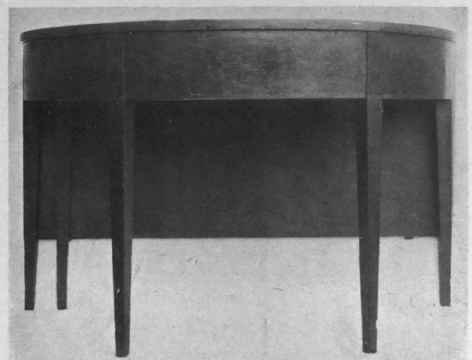
END SECTION OF MAHOGANY INLAID HEPPLEWHITE RANGE TABLE, TAPERED LEG AND BANDED ANCLE.
In possession of Harold D. Eberlein, Esq.
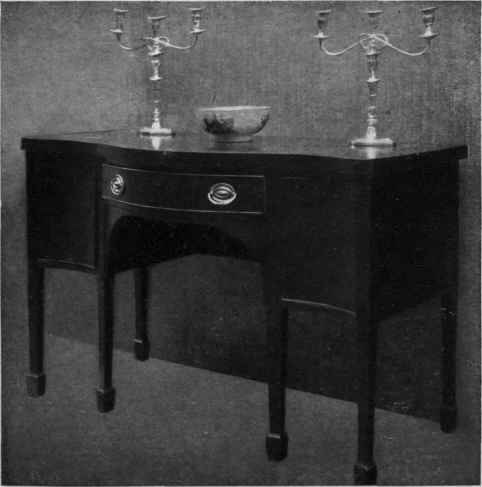
MAHOGANY INLAID SERPENTINE FRONT HEPPLEWHITE SIDEBOARD, TAPERED LEG AND SPADE FOOT.
By Courtesy of Mr. Richard W. Lehne, Philadelphia.
PLATE XXVII.
Besides these there were little work tables, either square or octagonal, with drawers, and a drop bottom suspended from the lower drawer. There were writing tables (Plate XXV, p. 204) for the library, with tiers of drawers on either side and a knee space in the centre. Last of all, there were special tables, such as drinking tables, which it will not be necessary to discuss, as they were not typical.
Continue to:


My Books

