


Settles, Settees, And Sofas. Part 4
Description
This section is from the book "Furniture Of The Olden Time", by Frances Clary Morse. Also available from Amazon: Furniture of the Olden Time.
Settles, Settees, And Sofas. Part 4
The sofa in Illustration 224 belongs to the Misses Hosmer of Concord, and stands in their old house, filled with the furniture of generations past, and interesting with memories of the Concord philosophers. The lines of this sofa are extremely elegant and graceful, and its effect quite classic. The legs are what is known as the Adam leg, which was designed by the Adam brothers, and which Sheraton used frequently. The style of the sofa is that of the Adam brothers, and it was probably made from their designs about 1800-1810. The writer has seen a window seat which belonged to Charles Carroll of Car-rollton, after exactly this design, without the back.
The back of the sofa in Illustration 225 follows the same graceful curves as the one in Illustration 224. This sofa was found by the writer in the shed of a farmhouse, on top of a woodpile, which made it evident what its fate would be eventually, a fate which has robbed us of many a fine piece of old furniture. After climbing upon a chair, then a table, the sight of these carved feet protruding from the woodpile was almost enough to make the antique hunter lose her insecure footing; but with the duplicity learned in years of collecting, all emotion was concealed until the sofa had been secured. The writer knows of four sofas, all found near Worcester, measuring the same, seven feet in length, and with the same carving of oak leaves upon the legs and ends, but this is the only one of the four which has the carved oak leaves across the front of the seat, and the rows of incised carving upon the back rail. The sofa was covered with black haircloth, woven in an elaborate design, and around the edge of the covering ran the brass beading which may be seen in the illustration. This beading is three-eighths of an inch wide, and is of pressed brass, filled with lead, so that it is pliable and may be bent to go around a curve. Such beading or trimming was used in the place of brass-headed tacks or nails, and is found upon chairs and sofas of about this date, 1815-1820. Illustration 226 shows one of a pair of sofas without backs. The frame is of mahogany with legs and arms carved rather coarsely. The covering is of stiff old brocade, probably the original cover when these sofas were made, about 1820, for the Warner house in Portsmouth, where they still stand. The panelling of the old room, built in 1716, shows behind the sofa, and on the floor is the Brussels carpet upon which is a stain from wine spilt by Lafayette, when he visited the house in 1824.
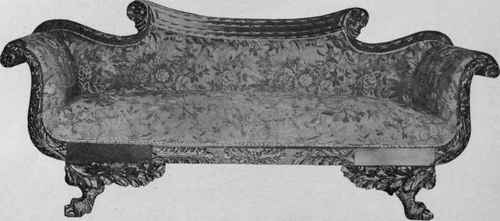
Illus. 224. - Sofa, 1815-1820.

Illus. 226. - Sofa, about 1820.
The sofa in Illustration 227, known as a cornucopia sofa, from the design of the carving, shows the most ornate type of this style. The frame is of mahogany, and the ends of the arms are carved in large horns of plenty, the same design being repeated in the carving of the top rail of the back and in the legs, which end in a lion's claw. The round hard pillows, called "squabs," at each end, were always provided for sofas of this shape, to fit into the hollow made by the curves of the cornucopia. This sofa is owned by Dr. Charles Schoeffer of Philadelphia.
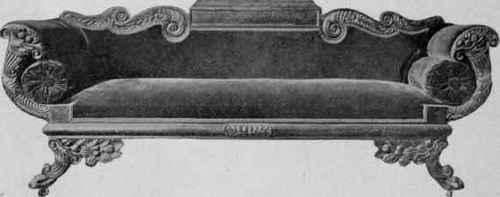
Illus. 227. - Cornucopia Sofa, about 1820.
Illustration 228 shows a sofa and miniature sofa made about 1820 for William T. Lane, Esq., of Boston, and now owned by his daughter, Mrs. Thomas made, that they might sit one each side of the large sofa. This fashion of making miniature pieces of furniture like the larger ones was much in vogue during the first quarter of the nineteenth century.

Illus. 228. - Sofa and Miniature Sofa, about 1820.

A sofa of similar lines is shown in Illustration 229. The back and legs are different, and reeding takes the place of the twist in Illustration 228.
The sofa and chair in Illustration 230 are part of a set of furniture bought by the father and mother of the late Major Ben : Perley Poore, for their house at Indian Hill, about 1840. These pieces are interesting not only for the design of the mahogany frames, carved with swans' necks and heads, but for the covering, which is of colored haircloth, woven in a large figure in red and blue upon a gray ground. The seat of the sofa is worn and has a rug spread upon it, but the back and pillows and the chair-seat are perfect.

Illus. 230. - Sofa and Chair, about 1840.
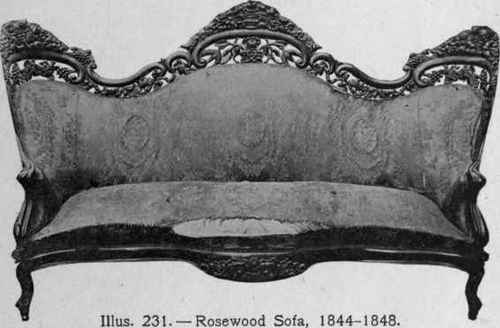
From 1844 to 1848 a cabinet-maker named John H. Belter had a shop in New York, where he manufactured furniture, chiefly from rosewood. The backs of the chairs and sofas were deeply curved, and in order to obtain the strength necessary, thin pieces of rosewood were pressed into the desired curve, and the several thicknesses glued together, and pressed again. The strong back made in this way was then elaborately carved, in an openwork pattern of vines and leaves. The sofas of these sets were usually in the shape shown in Illustration 231, which belongs to Mrs. M. Newman of New York. Many of the wealthy families of New York had this Belter furniture, which was always covered with a rich silk brocade. It is eagerly sought for now and brings large prices.
Continue to:


My Books

