


Chairs. Part 4
Description
This section is from the book "Furniture Of The Olden Time", by Frances Clary Morse. Also available from Amazon: Furniture of the Olden Time.
Chairs. Part 4
Windsor chairs are found in several styles, two of which are shown in Illustration 146, owned by the writer. Side-chairs like the arm-chair were made with the dividing strip which connects the arms left out, and the rounding top rail continuing down to the seat. The other chair in the illustration is known as a "fan back" from its shape with the flaring top.
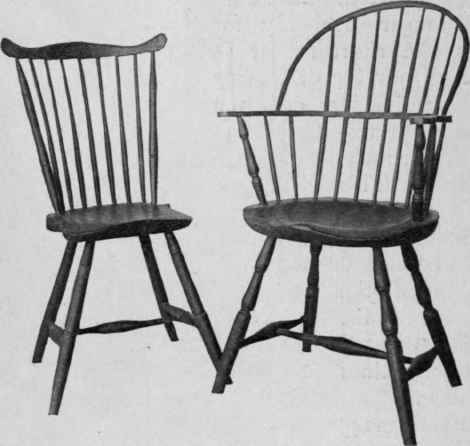
Illus. 146. - Windsor Chairs, 1750-1775.
Illustration 147 shows a "comb-back" Windsor rocking-chair, owned by Mrs. Clarence R. Hyde, of Brooklyn, N. Y. The middle spindles are extended to form the little head-rest, from which the name is derived.

Illus. 147. - Comb-back Windsor Rocking-chair, 1750-1775.
A fine, high-backed arm-chair, and a child's chair are shown in Illustration 148, owned by Miss Mary Coates of Philadelphia. These chairs may have been some of the original Philadelphia-made Windsor chairs, as they were bought in that town by Benjamin Horner, who was born in 1737.


Illus. 148. - High-back Windsor Arm-chair, and Child's Chair, 1750-1775.
Windsor writing-chairs are occasionally found, and one is shown in Illustration 149, possessing more than common interest, for it is said to have belonged to Thomas Jefferson, and upon its table may have been written the Declaration of Independence. It now belongs to the American Philosophical Society of Philadelphia. The seat is double, the top one revolving. The legs have been shortened.

Illus. 149. - Windsor Writing-chair, 1750-1775.
Illustration 150 shows two late Windsor rocking-chairs, the one of curly maple being several years later than the other, as the rockers, short in front and long behind, bear evidence. These chairs are owned by the writer.
The Dutch chair with bandy or cabriole legs and a splat in the back made its appearance with the early years of the eighteenth century, and was the forerunner of the Chippendale chair. The first Dutch chairs have a back similar in form to the Queen Anne chair in Illustration 108, slightly higher and narrower than later backs. They are sometimes called Queen Anne chairs, and sometimes parrot-back, from the shape of the opening each side of the solid splat. The stretchers or under-braces of earlier chairs are retained in the first Dutch chairs, one of which is shown in Illustration 151, owned by Mrs. Charles H. Prentice, of Worcester.

Illus. 150. - Windsor Rocking-chairs, 1820-1830.
The first mention found of claw-and-ball feet is in 1737, when "six Crowfoot chairs" appear in an inventory. In one of 1750, "chairs with Eagle's foot and shell on the Knee" are entered.
A chair is shown in Illustration 152, still retaining the stretchers, but with the claw-and-ball foot and a shell at the top of the back. This chair was made about 1720-1730. It belongs to Walter Hosmer, Esq.
Illustration 153 shows a chair also belonging to Mr. Hosmer. It is made without stretchers, and the splat is pierced at the top.
A chair which retains the form of the Dutch chair, with "Eagle's foot and shell on the Knee," is shown in Illustration 154, but the splat is cut in an elaborate design, with the centre opening heart-shaped, which was the shape of the earliest piercing made in the plain splat. This chair and the one in Illustration 155 are in the Poore collection at Indian Hill, Newburyport. They show the development from the Dutch to the Chippendale style. The legs in Illustration 155 are carved upon the knee with an elaborate form of shell and a scroll. The splat is not pierced, but has a curious design of ropes with tassels carved at the top. These chairs were made about 1740-1750. The backs of the last four chairs are made with the characteristic Dutch top, curving down into the side-posts with rounded ends, with the effect of back and sides being in one piece.
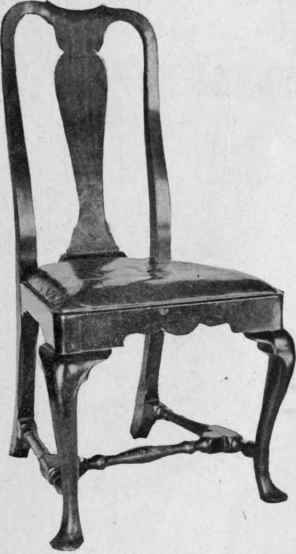
Illus. 151. - Dutch Chair (back stretcher missing), 1710-1720.
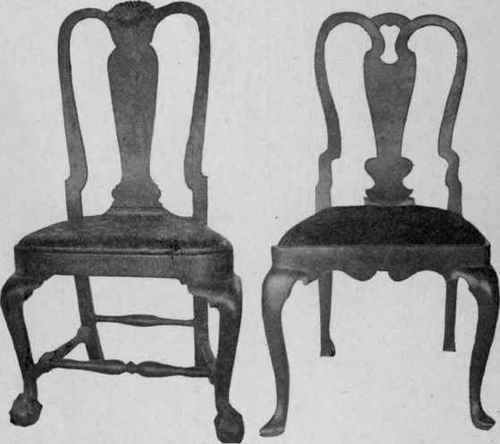
Illus. 152 and Illus. 153. - Dutch Chairs, about 1740.
A style of chair common during the first half of the eighteenth century is shown in Illustration 156; one chair having turned legs while the other ends in a Spanish foot. The tops are in the bow shape, and the splats are pierced, showing the influence of Chippendale fashions. The splat is alike in both, but the country cabinet-maker who probably made these chairs may have thought the splat would look as well one way as the other, and so put one in upside down. They are in the Deerfield Museum, and were made about 1750.
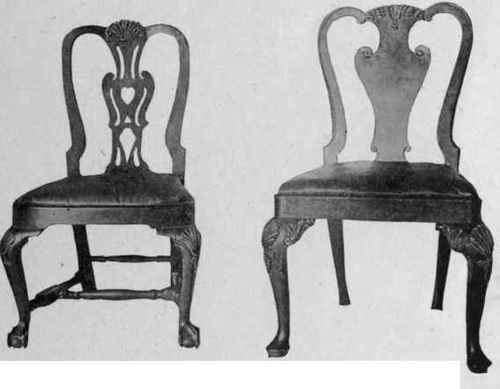
Illus. 154 and Illus 155. - Dutch Chairs, 1740-1750.
A roundabout chair in the Dutch style is shown in Illustration 157. The bandy legs end in a foot with a slight carving in grooves, and the seat is rounding upon the corners like that in the ordinary Dutch chair. This very graceful chair is owned by Francis H. Bigelow, Esq., of Cambridge.
Easy-chairs formed a part of the bedroom furniture inventoried during the eighteenth century, and they were made in various styles, with Dutch, Chippendale, and Hepplewhite legs. Hepplewhite gives a design in 1787 for what he calls "an easy-chair," and also a "saddle-check chair," while upon the same page, with intentional suggestion, is a design for a "gouty-stool."

Illus. 156. - Dutch Chairs, 1750-1760.
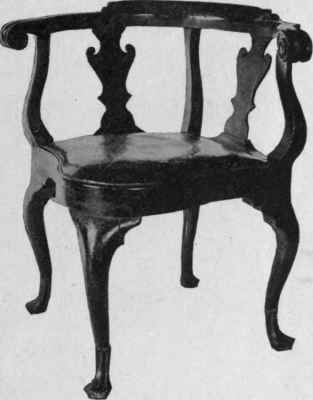
Illus. 157. - Dutch Roundabout Chair, 1740.
Continue to:


My Books

