


Chippendale. Part 3
Description
This section is from the book "The Old Furniture Book", by Hannah Hudson Moore. Also available from Amazon: The Old Furniture Book.
Chippendale. Part 3
He not only designed many houses for wealthy patrons and altered many others, but he was afterward appointed landscape gardener at Kew, and knighted.
The older Chinese furniture which one sees in Europe dates from the eighteenth century, and was made for and imported by the Dutch; hence the medley of styles. Elaborate bedsteads, tables, and cabinets were decorated with ivory figures in relief. There is furniture of this description in the United States, splendidly carved out of cedar and decorated with hundreds of tiny figures of men and women carved from ivory and set on. Such a piece is shown in Figure 21, the original of which is at Memorial Hall, Philadelphia.
Not only was Chinese furniture in wood and wicker brought from the Orient, but the Dutch, whom we have come to look upon as ready imitators, followed Oriental styles not only in furniture but in pottery as well. Chippendale specifies nine of his designs for chairs in Chinese style as proper for a lady's dressing-room, especially if it were hung with an India paper. They were likewise recommended for Chinese temples. These chairs commonly have cane bottoms with loose cushions, but if required may be stuffed and have brass nails.
As early as 1711 Addison comments on the motley confusion heaped up in a lady's library, where there were few books but "Munkies, Mandarins, and Scaramouches " without end; and to keep these ornaments in countenance was also furniture made after Chinese designs.
Besides these styles Chippendale also used a modification of the Gothic, notably in such places as the doors of cabinets, or the doors and the tops of bookcases. Horace Walpole, in his little Gothic villa at Strawberry Hill, had awakened a still further taste for a revival of Gothic designs; and everybody, to be in the mode, had their cabinet doors and bookcases with embattled tops and Gothic tracery. Of all the styles Chippendale adopted and adapted, this one left the least enduring trace. More successful were his bookcases based on Louis XV. style. They are of mahogany and have the rococo ornaments peculiar to this style. This work shows off gilding admirably. These bookcases with drawers and desk, as well as the bureaus, were used in bedrooms which were often boudoirs and studies as well. So a receptacle which could be quickly locked was quite necessary.
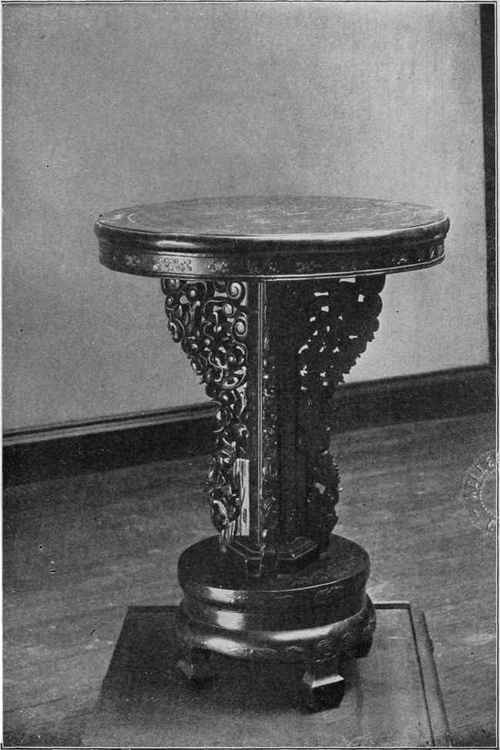
Figure 21. CARVED CEDAR TABLE.
In Chippendale's catalogue are directions given for many small articles which were much in demand and highly fashionable when the book was written, but for which the present day and generation has no use. Such were the charming little tea-caddies with brass handles and locks, stands for candles, or china jars or animals with which the drawing-rooms of those days were crowded. There were also carved brackets, decorated with the bird we have spoken of before, and exquisite foliated designs making graceful adornments for any room, and often neglected in sales where other and better-known examples of this period bring fabulous prices. When carved in pine these brackets are always gilded, but occasionally they may be obtained in walnut and mahogany.
The designs for such pieces are largely original with Chippendale, for their use had just become 'needed, and we must remember besides that it was Chippen-dale's misfortune to live in a transition period, and that the rococo which preceded him, and by which his first work was influenced, died very hard. Indeed his first style might be called rococo, and the designs swelled and bulged, were covered with meaningless and fantastic ornament, and ran riot through all styles and countries. It had for its chief merit the fact that it was executed with great delicacy and beauty and had a grace about it which was always pleasing. The two sides of a design are seldom alike, and the merit of such pieces is due purely to the skill of the carver. Yet it was under his skilful hand that later the beauty of simplicity was once more proved, and he sought classic models for his inspiration. Speaking himself of designs for French chairs he says, "for greater variety the feet and elbows are different." The moulding around the bottom of the edge of the rails also comes under his consideration, and he mentions Spanish leather or damask as good material for covering chairs.
He it was who exemplified the principle that each part of a piece of furniture should be adapted to its use, and that overloading an article with ornament did not necessarily add to its beauty. After his rococo period came the rage for Chinese designs, and lastly the plain and solid style with which we are familiar.
Two very handsome chairs are shown ,in Figure 22, the side chair showing an abundance of exquisite carving on the knees and in the splat. It is wonderful what variety he encompassed working in the small space and confined shape of this part of a chair. It will be observed that in all the chairs shown no two splats are alike.
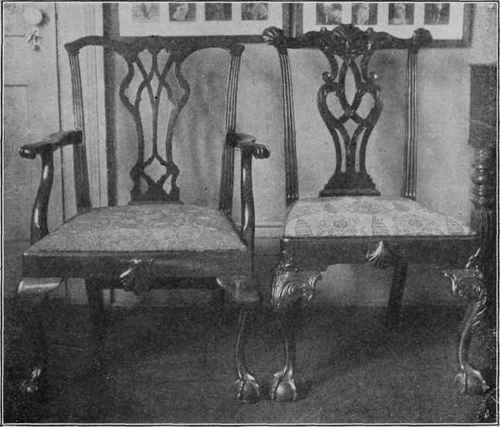
Figure 22. CHIPPENDALE CHAIRS.
All the construction of the Chippendale furniture of the last period is remarkably solid and of the first order, and the wood is of a dark and rich mahogany. The best pieces of this period are those in which the originality of the designer had full play, and when he was not influenced by either the French or Oriental taste. The furniture of this period, fine and free in design, was well adapted to the fashions and mode of life of the people for whom it was made. He retained the roomy character of the Dutch furniture, which was needed for the style of dress affected by both sexes. The Spanish furniture of oak, with cane work or leather, introduced by Catherine of Braganza, was not the only innovation brought to England by that lady, for Evelyn says in his "Diary ' for May 30, 1662, "The Oueene ariv'd with a traine of Portuguese ladies in their monstrous fardingals or guard-infantas . . . Her Majesty in the same habit, her foretop long and curiously turn'd aside."
Continue to:


My Books

