


Cupboards And Sideboards. Part 2
Description
This section is from the book "Old Oak Furniture", by Fred Roe. Also available from Amazon: Old Oak Furniture.
Cupboards And Sideboards. Part 2
After 1610, in which year the Sothertons sold the property, the old house passed through many vicissitudes, becoming so debased in the latter part of the nineteenth century as to be used as a common warehouse. From this degradation it was rescued, in 1899, by the public spirit and antiquarian zeal of Mr. Leonard G. Bolingbroke, a Norwich citizen, who, with the greatest taste and discrimination, has restored the mansion to something like its original state.
When the place was thus acquired, one piece of furniture remained which had followed the fortunes of the house for a period of about four centuries. This is a large oak armoire in one of the upper rooms, which is of such a size that there is no doubt whatever it was made, or at least joined together, in the house. It is a tall, heavy piece, in the Flemish style of the beginning of the sixteenth century, and is furnished with precisely similar handles and hinges to those which we find the Hanseatic League fitted on to so many presses and cupboards in the reign of Henry VIII. Since the Continent was generally ahead of us in changes of style, the armoire may have been made during the latter years of the occupation of Thomas Cawse, who, as a mercer, would trade largely with the Flemings. It was, however, more probably constructed for one Nicholas Sotherton, the first tenant of the family of that name, whose initials and merchant's mark appear upon various alterations which he made in the building. Few such instances can be found in our own country of furniture remaining in the medieval building for which it was originally constructed; and this instance is the more remarkable in that the house has passed through many vicissitudes, and been denuded of all its other movable contents.
The 'strong chest' at Cley-next-the-Sea, Norfolk, the painted Newport coffer, and the Bayeux armoire, are striking exceptions to the rule of mutability, but it may be pointed out that these are all ecclesiastical pieces, while the example at Strangers' Hall is one made for a domestic residence.
How much we occasionally owe to indifference to antiquities is exemplified here in a very striking manner. Had the Strangers' Hall, instead of being neglected, been taken in hand some years earlier, it would no doubt have been restored in the abominable fashion prevailing in the middle of the nineteenth century, and the Flemish armoire, as well as other interesting details, altered or swept away as of no consequence.
The credence is a much more squat piece of furniture than the armoire, and of considerably smaller size. In ecclesiastical establishments the name attached to this piece of furniture sufficiently indicates its purpose for displaying as well as containing the sacred vessels of the church. Domestic credences, however, hint at some darker meaning, for on them the meats were placed to be carved, and it was the duty of the steward, or taster, to eat a small portion of each joint before the lord of the house and his family were served, and thus to safeguard them against assassination by poison.* These credences were provided with a locker for the remains of food, and were sometimes built up at the back in the form of several stories, the superstructure being used for the flagons and cups for the wine, which had to be assayed in a like manner. In their expanded form they became known by the distinctive name of 'court cupboards.' The later and more usual types of this species of furniture will be dealt with later on.
It is probable that no Gothic cupboard of English make with its original superstructure now remains to us, but some very elaborate productions of French and Flemish work in this category are still in existence.* At Ockwells Manor is an excellent specimen of the domestic credence, dating from the early part of the sixteenth century, and another example, dating from the reign of Henry VIII., is in the collection of Mr. Morgan Williams, of St. Donat's Castle, Glamorganshire. The latter possesses in its front a pierced panel of Gothic design, to admit air to the food within, and also two drawers underneath pierced with Gothic perforations - being, in fact, one of the earliest pieces of furniture with drawers that has come under my observation.
* That the office mentioned continued in some instances down to a comparatively late period the following extract from Lord Fairfax's 'Household Regulations,' made about the middle of the seventeenth century, sufficiently testifies: 'Let no man fill beere or wine but the cupboard-keeper, who must make choice of his glasses or cups for the company, and not serve them hande over heade. He must also know which be for beere and which for wine; for it were a foul thing to mix them together.'
In the great hall at Haddon is the once-neglected remnant of a fine domestic credence dating from the early part of the sixteenth century. Its doors are embellished with the broad, flat, delicate mouldings usually associated with the Italian taste of the early Renaissance. At one time it must have possessed pendants after the Gothic fashion, though these have now disappeared. Late fifteenth-century cupboards, which were probably used as credences, also exist in the churches of Louth, Lincolnshire, and Minehead, Somersetshire, the former being given by the Vicar, Thomas Sudbury (1461-1504), and the other being a fine piece of flamboyant design, which suggests the work of a foreigner residing in England. The Mine-head cupboard, like Mr. Williams' piece, possesses drawers, but its original iron fittings have disappeared. It sometimes happens that the decoration of credences or hutches is not confined to the front and sides, the back also being carved with a beauty and care which suggest that the piece was intended to stand in the centre of a room.
* According to Parker, in the Court of Burgundy the number of shelves in a buffet, or cupboard, was regulated by the rank of the owner, but he says this significance does not appear to have prevailed in England. That, however, the splendour of a multiplication of stages or shelves was a fitting attribute of dignity we have plenty of indirect contemporary evidence. Stowe, the sixteenth-century chronicler, in his description of the festivities accompanying the wedding of Prince Arthur, eldest son of Henry VII., with Katherine of Arragon, notices a triangular cupboard, five stages high, at Westminster Hall, set with plate valued at £1,200. Hall, also writing in the sixteenth century, mentions a great cupboard of ten stages high standing in Westminster Hall at the coronation of Anne Boleyn, which was 'filled with gold plate most marvellous to behold.' The instances recorded of Cardinal Wolsey's magnificence in this particular direction are numerous.
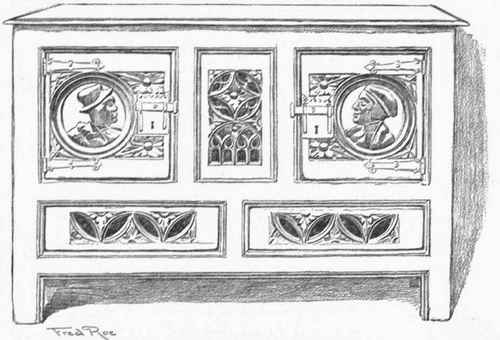
LATE. GOTHIC CUPBOARD, PIERCED WITH TRACERY.
In the possession of Morgan S. Williams, Esq.
Continue to:


My Books

