


Coffers And Chests After The Renaissance. Part 3
Description
This section is from the book "Old Oak Furniture", by Fred Roe. Also available from Amazon: Old Oak Furniture.
Coffers And Chests After The Renaissance. Part 3
In St. Mary's Church, Lichfield, immediately opposite the historic birthplace of Dr. Samuel Johnson, are two Elizabethan chests, one of them a superb carved and inlaid production, as fine a thing of its kind as can be seen. A more elaborate example, and one which evidently exhibits the skill of a very up-to-date craftsman, may be seen in the north transept of the Church of St. Saviour, Southwark, or, as it was anciently called, St. Mary Overie. This supremely sumptuous and beautiful piece, though perhaps of no later date than the Lichfield chest, is much more advanced in design, exhibiting the finest architectural characteristics of the later Renaissance, and being, therefore, in this respect, ahead of its time. It is of grand dimensions, having three small drawers at the base, the structure above bearing exquisitely proportioned pilasters and pediments as well as window-shaped panels, around which the surface of the woodwork is marked with squares to resemble masonry.* The strapwork on the frieze and the bases of the pilasters is both delicate and elaborate, while the flat surfaces are inlaid with floral emblems and coats of arms. As an architectural piece this chest, which seems little known, is one of the finest in existence.
It will be noticed that amidst the inlaid strapwork on the lid are the initials H. H. O., connected with a geometrical guild mark, being those of the donor, Hugh Offley, Sheriff of London in 1588, and his son-in-law, Harding. Hugh Offley was a city merchant, who was Master of the Leather-sellers' Company in 1577- 1578, and again in 1584-1585, afterwards becoming Alderman and Sheriff. He was a man of unusual munificence, even for a London merchant. 'His donation of "one gilt standing cup with cover' weighing 42 1/2 ounces is recorded in Liber Curtes, p. 298, under date 8 August, 1578.' Shortly before his elevation to the Shrievalty he ' "set forth, at his own expense, a costly show of Prince Arthur with his Knights of the Round Table," in the presence of Queen Elizabeth at Mile End Green.' * There can be little doubt that Offley gave the chest to mark the year of his tenure of office, and it would therefore have been placed in the church less than fifty years after Prior Linsted surrendered the establishment to Henry VIII. - a singular fact when one considers its relatively late character.
In an early part of Chapter IV (The Renaissance - And After) (The Renaissance - And After). mention was made of an inlaid classic panel, dated 1569, which exists in the Cross Keys Hotel at Saffron Walden.

DEVICE AND INITIALS ON LID OF THE SIXTEENTH-CENTURY MUNIMENT CHEST IN ST. SAVIOUR'S CHURCH, SOUTHWARK.
* There is reason to believe that the three drawers are additions of a later date, being merely fronted with the inlaid surface, which was cut out from the plinth of the chest for their reception. The sides and back, as well as the edge mouldings round their front, are merely of common deal.
* 'History of the Leather-sellers' Company,' by William Henry Black, F.S.A., 1887.
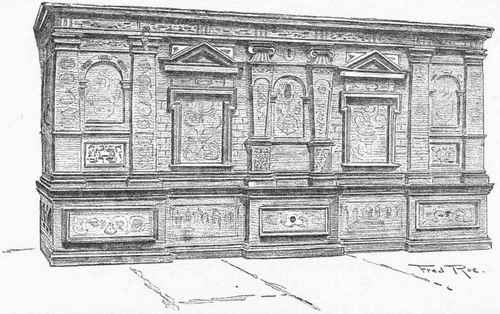
THE 'OFFLEY CHEST,' ST. SAVIOUR'S CHURCH, SOUTHWARK.
The chest at St. Saviour's and this panel should be compared, and may be adduced as instances of what peculiarly advanced work was being carried out by the more progressive craftsmen side by side with the old types.
Inlaid articles of furniture of the Elizabethan period are now so much sought after that many really excellent and genuine plain chests, as well as other articles, are frequently spoilt by modern inlay, barbarously added 'to meet the demand.' It rarely happens, though, that these doctored pieces succeed in deceiving the practised eye.
One may occasionally meet with panelled chests bearing grotesquely-carved heads, somewhat resembling the productions of the early Renaissance, which do not, however, actually belong to a period anterior to the early part of the seventeenth century. Many good judges have been deceived by this fanciful resemblance, and at least one chest of this type may be found in the Victoria and Albert Museum wrongly ascribed to the early part of the sixteenth century.* Along the top rail of these chests is invariably incised some such inscription as 'fere god' or 'give to the por for the lord sake,' that in the Kensington Museum exhibiting the legend: 'fere god love god *.' The portrait panels (if these distorted carvings can be so termed) are generally alternated with others carved with a leaf or flower of unknown variety, bearing a distant resemblance to the conventional representations in vogue during the reigns of the last Henrys. Evidences of their later origin may be detected in the shape of the lettering appearing on them, the degeneracy of their mouldings, the weak, imitative character of the heads, and lastly, but not least, in the fact that these grotesque representations are not enclosed in medallions, but merely surrounded by a square roughly incised on the surface of the panels.
I have studied with interest a good many of these chests, and in nearly every instance have succeeded in tracing their origin to a limited area in the West of England. They all bear evidences of the same individuality in mannerism, and there can be no doubt whatever that they proceeded from the workshop of some seventeenth-century craftsman, who clung to the traditions of an earlier style, from which he was unable entirely to free himself.
* No. 833, 1898.
Continue to:


My Books

