


XVI. Domestic Prints
Description
This section is from the book "Home Furnishing", by George Leland Hunter. Also available from Amazon: Home Furnishing.
XVI. Domestic Prints
BETWEEN the hand-blocked French and English prints illustrated and described in Chapter XX and the domestic draperies that form the subject of this chapter, no comparison or competition is possible. The former sell at from $ 1 to $ 5 a yard, the latter from 10 to 50 cents. But the latter are only 36 inches wide (and the tickings a little narrower still), while many of the former are from 50 to 54 inches wide, and some of them on linen or even wool, instead of cotton.
Technically and artistically the color work of the roller prints is inferior. The colors are necessarily thinner, and being impressed on one another wet, equal accuracy and delicacy of toning cannot be secured. Most significant of all, the repeat of the patterns in roller prints must occur at least once in 18 inches, the engraved copper roller being from 9 to 18 inches in circumference. This means that compared with block prints, the repeat of which is limited only by the number of blocks employed, the effect of roller prints is monotonous.
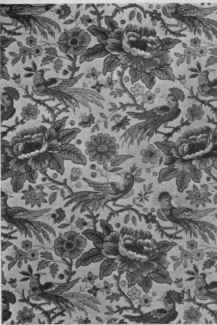
I. Coventry bird pattern on plain cretonne.
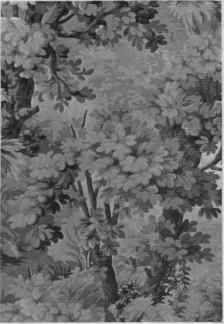
2. A tapestry effect on rep cretonne.
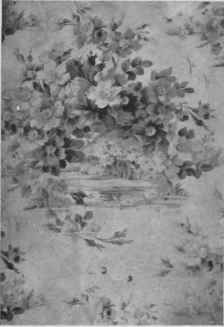
3. An ambitious attempt on rep cretonne.
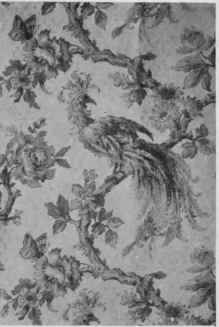
4. Another ambitious and not unsuccessful attempt on taffeta.
However, this has at least one compensating advantage, for it makes roller prints safer in the hands of the decorative ignorant and inexperienced. To apply the large-figured prints from abroad successfully on walls, windows, or furniture, requires taste and skill of no mean order.
In short, the domestic goods are excellent of their kind, and meet the necessities of householders who have limited purses. The fact that the design standard is constantly and rapidly improving shows not only that the manufacturers are alive, but also that the taste of those who purchase domestic goods is being educated. For of one thing we may be sure: while force may bring horses to the trough, it cannot make them drink. What the public want they get in the long run, and no one but a genius like William Morris is able to make an immediate and lasting impression upon their taste.
Worth noting is the fact that a large proportion of the domestic printed patterns are put forth on several cloths - taffetas as well as plain and rep cretonnes. Tickings and dimities have patterns peculiar to themselves, mostly stripes, although they do share a few designs with the taffetas and the cretonnes. Silkolines have dropped out of most of the better-class stores, and are confined to the comforter trade and the rural districts. Once the piano trade absorbed many in the form of lambrequin-printed scarfs or throws, given away with the instrument as an inducement to purchase.
The prices of domestic prints range as follows: Taffetas from 30 to 35 cents a yard; rep cretonnes 35 to 50 cents; plain cretonnes 15 to 20 cents; linen taffetas 50 to 75 cents; tickings and dimities 25 to 30 cents; silkoline 10 to 15 cents; and even less for very inferior fabrics; chintzes, painted on plain cloth in imitation of the small-figured English chintzes - particularly the hand-blocked ones with their delightful smudgy effects - from 35 to 40 cents.
I am afraid that the European manufacturers look with no friendly eye upon the imitations and reproductions of their goods made in America. One can hardly blame them. In some cases the effort and the accomplishment have been to kill the sale of the original without bringing much profit to the imitator. But on the whole, the tendency of American makers to improve their product in the European direction, has worked to the advantage of the importers. The farther our American makers get away from the "bargain counter" price basis, and closer to the quality and style basis, the larger the proportion of our fine trade that will be sufficiently educated to pay the price for the best hand-blocked draperies.
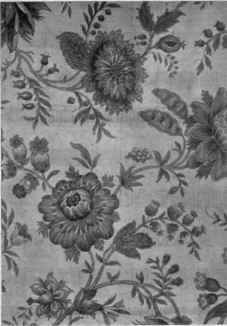
5. A well-arranged floral on woven-stripe taffeta.
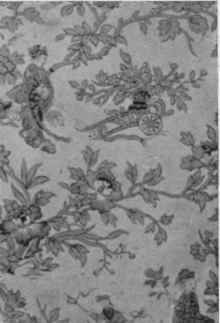
6. Chinese floral on plain cretonne.
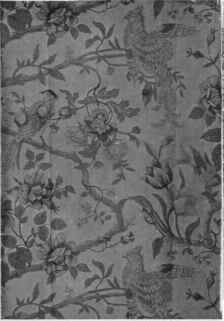
7. Flower and bird pattern on printed strie ground.
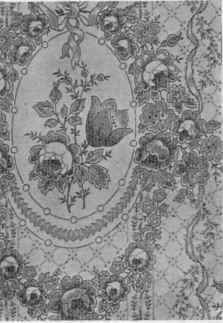
8. Hampton, a ribbon-floral on taffeta.
Several years ago a great deal of noise was made over the fact that domestic printed drapery and wall paper manufacturers were swapping patterns, so that the customer could match his walls in paper, to his draperies and furniture upholstery in cretonne. Sketches were made and illustrations printed in the trade magazines showing one pattern regnant and rampant throughout an entire interior. Occasionally, of course, this may be permissible if the pattern selected be not too pronounced. And often the effect of matching slip covers to wall paper will be delightful. But as a rule, one of the three, and usually two of the three - draperies, wall hangings, upholstery - should be free from emphatic ornament.
I would call the especial attention of my readers to the availability for cutting up into applique borders on plain-ground cotton draperies, of the stripe patterns found mostly on tickings and dimities. Some of the florals on cretonne also make up well into coverings and flounces for simple bedroom furniture. How well, is illustrated in the upholstery departments of many of our big shops.
Continue to:


My Books

