


Sec. 2. - Furniture Incrusted With Pique
Description
This section is from the book "A History Of Furniture", by Albert Jacquemart. Also available from Amazon: A History Of Furniture.
This section is from the "" book, by .
Sec. 2. - Furniture Incrusted With Pique
What the Italians call tarsia, marquetry work, should be, if we may accept Garzoni's definition in his " Piazza Universale," the same thing as the work designated by Pliny, under the name of cerostrotum; according to his etymology, therefore, this word indicates a combination of wood with inlaid pieces of horn, and more especially designates the species which is called "pique" when it comes from the East, and "certosino" when it is of Italian origin.
The intarsiatori or marquetry workers, made their appearance in Italy from the thirteenth century. In the fifteenth, Giuliano da Maiano, aided by Giusto and Minore, Benedetto da Maiano, his brother, with his pupil Domenico di Marietto, strike out a new path by employing various or tinted woods. Baccio Pellini, David de Pistoja, Guido del Servellino, Geri d'Arezzo, Girolamo del la Cecca, made themselves famous after these, and in the sixteenth century Bartolommeo di Pola, Fra Gabriello and Fra Giovanni di Verona, Fra Raffaello di Brescia, Fra Sebastino di Rovigo, Fra Damiano di Bergamo, in 1551, are the most celebrated "intarsiatori." It is doubtless to these numerous brethren, that is to say, to artists formed in religious communities, that this style owes its name of " lavoro alla certosa" (Carthusian work), or by abbreviation, " certosino," the word work being understood.
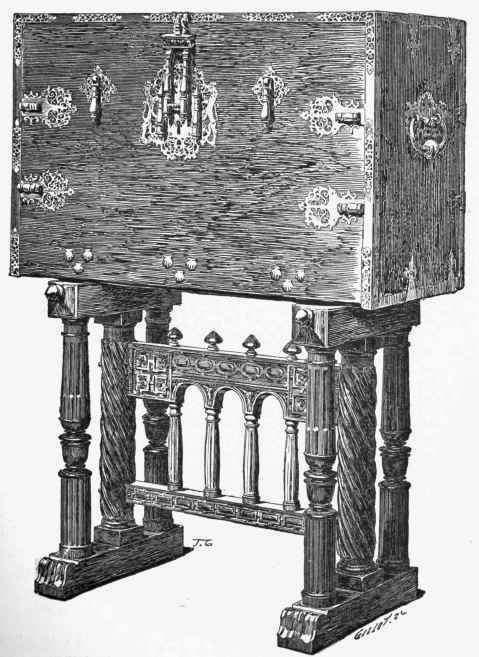
Wooden coffer with fittings of pierced wood and central falling panel; Spanish work of the Seventeenth Century (Collection of M. Monbrison).
In their eagerness to carry the wood marquetry-work beyond its rational limits, artists sought to make it represent scenes and landscapes, as many of their celebrated churches testify; a senseless attempt which could end in nothing durable, and which we shall, nevertheless, see renewed in France in the two last centuries.
The real certosino which we have to discuss at this moment, originated in Venice, and was an Oriental imitation; from the thirteenth century to the end of the fourteenth, the incrustations were in black and white wood, sometimes heightened with ivory; it was not until later, that the number of coloured woods was increased, and that ivory was used with its natural tint, or stained green; sometimes small metallic plaques were added to the work. These primitive labours are almost always of small dimensions; consisting of boxes and jewel-caskets of rather hasty make. When the inlaid work is applied to furniture, it is at first with a certain reserve; a chest (bahut) belonging to M. Henri Cernuschi is simply ornamented with fillets round its circumference, and on each side by a circle formed of small bone lozenges, incrusted in the brown wood. This chest dates from the fifteenth century. Later on come the cassoni, the cabinets, the folding tables, the seats shaped in the form of an X, and even elegantly carved high-backed chairs in which coloured woods combined with ivory, form geometrical designs of great richness; often in circular medallions or in the middle of panels a vase appears, whence issue flowered stems, which rise upwards, spreading out like a bouquet of fireworks.
Nothing can be more elegant than this style of furniture, the only defect of which is its uniformity; for notwithstanding some small flowers and rare floriated scrolls, what chiefly predominates in the decoration is a repetition of starry circles, lozenges, and other regular geometric figures. The hotels of M. de Rothschild are abundantly furnished with all works "alia certosa," which may be cited amongst the most beautiful of the kind.
Nearly all the furniture in pique, "alia certosa," comes from Italy; but some may be met with, among the most striking, which have been manufactured in Portugal; they are generally to be recognised by the plentiful appliances of pierced copper which ornament them. The cabinets have complicated corners and keyholes, which the gilding renders peculiarly brilliant.
Continue to:


My Books

