


Glass of The East
Description
This section is from the book "A History Of Furniture", by Albert Jacquemart. Also available from Amazon: A History Of Furniture.
This section is from the "" book, by .
Glass of The East
And if we turn to the products of the East how much more applicable will be the remark! We have already expressed our belief that from these regions came the secret of ornamental enamelling on glass. In China, in India, in Persia and Asia Minor, the knowledge of the enameller's art goes back to the remotest antiquity, and if this fact has been overlooked till quite recently, it is because there is a general tendency among us to associate the unknown with the known, in order to make of both one vast whole. Chardin, when travelling in Persia and visiting the wine house in Ispahan, tells us that the golden or ruby-red liquor sparkles in large bottles of "Venetian glass." It was less troublesome for him to give currency to this error than to ascertain whether the "surahes," cut or glittering with gold and enamel, may not have been of Persian workmanship. When speculation began to spoil the mosques of Asia Minor and Egypt of those lamp-shades, offerings of Mussulman devotion, they were suspended in the cabinets of the collector long before anyone thought of inquiring whether their inscriptions might not contain dates and names of historic interest. This gap has henceforth been made good. We have of the year 1259 a lamp dedicated at Damascus by Sanjar Halebi, who, after the assassination of Kutuz, caused himself to be proclaimed sultan under the names of Malek el Adel el Alem el Mojahid. Another is inscribed with the names of Malek-en-Nasr, Nur Eddin Mohammed, Mamaluke Sultan of Egypt of the Baharite dynasty, who reigned from 1293 to 1341; then follows Malek-en-Nasr Hassan, Sultan of Egypt and Syria from 1348 to 1360. To the same line of sultans belongs the lamp dedicated by Almonayad Abul Nasr Sheikh (1412-1420). Lastly, another with the name of Argun Na'ib (vicar) must have been made by the Argun or lieutenant of Tamerlane and Governor of Samarkand in 1405.
We do not mention some other very remarkable pieces, because their legends, arc doubtful, and may refer to several persons of the same name, but it should be observed that it is easy enough to distinguish the products of Egypt and Asia Minor from those of Persia, the former being of thick glass, often greenish, and embellished with ornaments of a more sketchy and less minute character than the latter, the material of which is also very transparent. To Persia mainly belongs the cup, with stand and lid, in the form of a minaret, round which are twined gold borders, delicate as lacework, and enamelled foliage, with graceful ornamental flowers, as well as the longnecked bottles generally widening out towards the mouth to receive the wine. There is one specially interesting specimen, bearing a gold inscription on a blue enamel ground, and lower down a number of Persian figures indulging in a state of intoxication. There is a dancing girl, to whom is presented a glass filled with wine, men seated, and drinking or pouring out the ruby liquor, and a woman holding a "surahe" and a cup, which she has just filled. This wonderful piece is one of those whose legends refer to one of the many Malek el Adels not sufficiently identified by any surname.
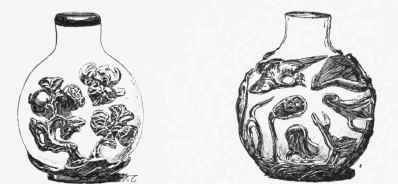
Snuff-bottles of double glass. Chinese workmanship. (Collection of Dr. Piogey.).
Our information is very limited regarding the enamelled glass ware of India. Nevertheless, we have met with one remarkable specimen - a smelling-bottle, showing on one side the familiar subject of young women at a fountain, offering drink to a richly-dressed cavalier. The opposite side is enamelled with bouquets and ornaments in a fine style, which might perhaps lead to the discovery of other works from the same source.
As to China, glass was there known from the remotest times, and was worked with marvellous art under Thai-woo-ti (422-451). It is related that a Scythian came to the court of the emperor, offering to produce the coloured glasses still imported from the West, and commanding very high prices. He made good his promise, and constructed a room large enough to hold a hundred persons, which sparkled with the lustre of the brightest tints, and which, as the annals relate, might have been supposed to have been the work of supernatural beings. Henceforth the industry became general, and the artists allowed themselves to be baffled by no difficulties. We have seen a phial or glass snuff-bottle infinitely more delicate than any that have been given to us to examine from the workshops of Murano. The Chinese excel also in the imitation of stones, such as the agate, jasper, etc. Everyone is familiar with the glass in several layers afterwards cut in the fashion of cameos. Not only do they obtain tones blending one with the other, but in the coloured layers they strew close together varied tints, enabling them, for instance, to raise on a white ground a pink flower with its green leaves.

Glass is found treated in this manner in vases of a tolerably large size, in cups, to flasks of very diversified form and especially snuff bottles.
Continue to:


My Books

