


How To Make A Tree Seat
Description
This section is from the book "Furniture A Girl Can Make", by William W. Klenke. Also available from Amazon: Furniture A Girl Can Make.
How To Make A Tree Seat
People who live in the suburbs or out in the country are aware of the benefits of having an outdoor living room. You too may wish to locate such a place out in the flower garden or in part of an orchard; wherever you decide, be sure to have a good size tree as part of your scheme, not only for the shade which is always so welcome during the hot days of July and August, but because a good size tree is a splendid place around which to build a garden seat.
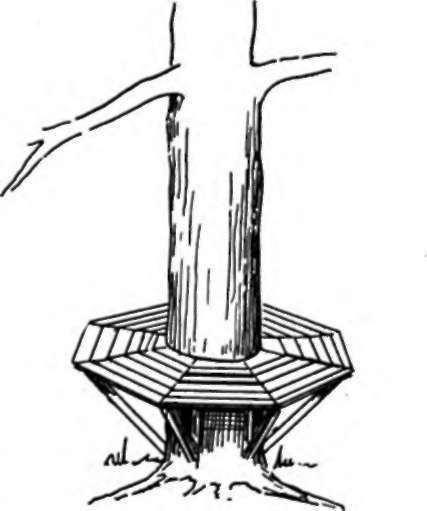
Because of the variation in the size of trees, only two definite dimensions can be given to you—that is, make the seat about 18" wide (out from the tree) and about 17" high, from the ground to the top of the seat.
A simple way to construct a seat around a tree is to make the outside shape octagonal—that is with eight equal sizes.
Method Of Procedure
Construct eight supports out of any soft lumber that stands weather conditions well, such as white pine, cypress, red wood, cedar, chestnut, fir etc., will do very nicely. Use wood that is 13/4"x in size and of the required lengths.
Step No. 2: First lay out where the different supports are to be placed; then securely nail an upright piece to the tree, a horizontal piece (see that this piece is level) and finally the diagonal brace. Use common rough wire nails for this work. As you nail each support in place, be sure to have them all line up and as stated make the horizontal pieces level.
Step No. 3: The seat is made up of pieces about 11/8"x3" and cut to fit half way on each support. Nail these pieces in place with 8 penny finishing nails (nails with small heads, 21/2" long). Leave a space between slats; this prevents water from settling on the seat. The heads of all nails should be sunk below the surface of the wood to allow for puttying.
Step No. 4: Round up the front edges with a few strokes of the plane.
Step No. 5: Paint this seat with three coats of oil paint, following the directions on the can. It is a good idea to paint all seat pieces at least two coats of paint before nailing the pieces in place. The final coat can then be applied after the seat is entirely put together. If you would prefer to mix your own paint rather than purchasing it, you will not find it a difficult task. The first coat should contain about one-half turpentine, one-half raw linseed oil and a little drier; the second coat should contain less turpentine and more oil with a small amount of drier. The third coat contains no turpentine at all, just the linseed oil and a little drier. Of course, color can be added to each coat if you wish to use it
Continue to:


My Books

