


How To Make A Rustic Garden Bench
Description
This section is from the book "Furniture A Girl Can Make", by William W. Klenke. Also available from Amazon: Furniture A Girl Can Make.
How To Make A Rustic Garden Bench
If you live in the country or have a friend who does, the wood for making this garden bench should cost you a trifle more than the labor involved in getting it out.
Oak, hickory, ash, elm and many other varieties of wood found in your own locality will serve satisfactorily for making this bench. Use a fairly hard, tough wood that will stand up well when exposed to all weather conditions; oak is first choice.
The following dimensions are very good to use for this project. Length of seat, 4' 6", width of seat 17", height off ground 18". The back should be about 35" or 36" high from the ground to the top rail. The arm should be about 28" from the ground to the top rail.
Make the seat out of from 2" to 3" thick lumber; get a good sound piece for this. The legs and back supports should be made out of about 2" round stock, arms and top back pieces about 21/2". The spindles for the back about 11/2" round stock, the horizontal pieces for the arm sections, about 1" round.
Method Of Procedure
Step No. 1: Get out the piece for the seat. All edges should be hand-hewn.
Step No. 2: Bore holes in the bottom of the seat to take the end of the legs which you must cut round and to fit the holes. Before putting the legs in place, bore holes for the stretchers and fit them in place first; now force the legs into the seat with a tight fit.
Step No. 3: Make up a back section piece as shown on the drawing.
Step No. 4: Locate where the back section is to be placed and bore correct size holes in the seat along the back edge.
Step No. 5: Make up an arm section as shown on the drawing, and bore the necessary holes in the back pieces to receive the arms and horizontal spindles.
Step No. 6: With a mallet, force the different members in place.
When assembling, it is a good idea to use a little heavy white lead on all joints; this will help hold the job together.
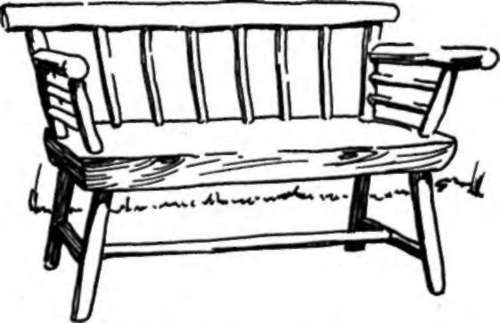
Since this bench is to be rustic in appearance, leave all pieces in the natural form, simply remove the bark where fitting is necessary. Do this to leave a rather rough appearance. It will be well to slightly round up the sharp edges to the ends of the arms and back pieces.
Apply a liberal coat of linseed oil mixed with one-third turpentine to the entire job. Do not paint. Allow at least a week for the oil to thoroughly dry out. It is a good idea to apply a liberal coat of oil to this bench once each season to prevent the wood from checking badly, by drying out too much. This will do much to increase the life of this project.
Continue to:


My Books

