


The Bed. Part 8
Description
This section is from the book "Furniture", by Esther Singleton. Also available from Amazon: Furniture.
The Bed. Part 8
In 1803, Sheraton notes that within the past few years cane has been introduced into the ends of mahogany beds "for the purpose of keeping in the bed clothes. Sometimes the bottom of beds are caned." He also mentions that bed steps are caned.
Sheraton preferred a firm bed to the ancient one of down, or feathers. He recommended a straw mattress, then a flock mattress, then a feather bed, and, last of all, a hair mattress.
England and France exchanged styles; for we read in an English fashion magazine of a novelty "lately imported from Paris, and represents one of those pieces of furniture which are consequent on the reciprocal exchanges of British and French taste: it is an English bed with corner posts decorated agreeably to Parisian fancy. The framework is made of rosewood ornamented with carved foliage, gilt in matt and burnished gold. The drapery is of rose-colored silk lined with azure blue and consists of one curtain, gathered up at the ring in the centre of the canopy being full enough to form the festoons and curtains both of the head and foot. The elegance of this bed greatly depends on the choice, arrangement and modification of the three primitive colors, blue, yellow and red; and in the combination of these, its chasteness or gaiety may be augmented or abridged." The curtain is edged with fringe.
The fashionable English designs of 1816 show that draperies were of more importance than the woodwork. One has curtains of pea-green, poppy red, and canary very gracefully arranged; and one, intended for a young lady of fashion, has hangings of light blue silk and a tender shade of brown, supported by rings and rods of brass, behind which the curtains were drawn up by cords and tassels.
In 1817, a canopy, or sofa-bed, has draperies of silk ornamented with gold lace and fringe; the linings were of lilac and buff. These curtains, which fell from a kind of crown, were dark green. A muslin embroidered drapery was used as a covering in the daytime.
In 1822, an English decorator remarks: "The taste for French furniture is carried to such an extent that most elegantly furnished mansions, particularly the sleeping-rooms, are fitted up in the French style; and we must confess, that, while the antique forms the basis of their decorative and ornamental furniture, it will deservedly continue in repute." He then gives a fine plate representing " a sofa, or French bed, designed and decorated in the French style " and " adapted for apartments of superior elegance." The sofa is highly ornamented with Grecian ornaments in burnished and matt gold. The cushions and inner coverlids are of white satin. The outer covering is of muslin in order to display the ornaments to advantage and bear out the richness of the canopy. The dome is composed of alternate pink and gold fluting, surrounded with ostrich feathers, forming a novel, light and elegant effect; the drapery is green satin with a salmon-colored lining silk and lined with pink taffeta.
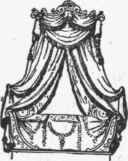
Sofa-Bed, Empire Style
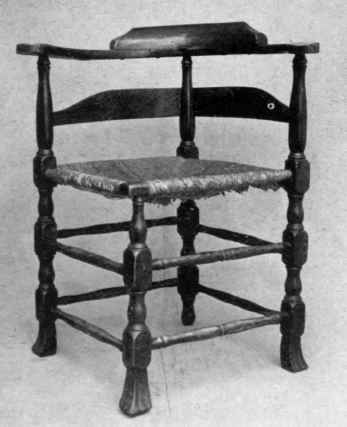
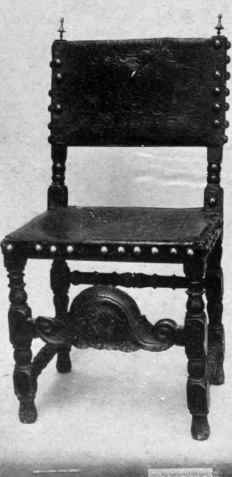
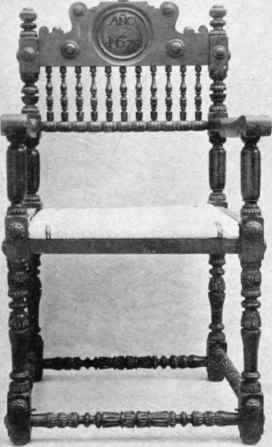
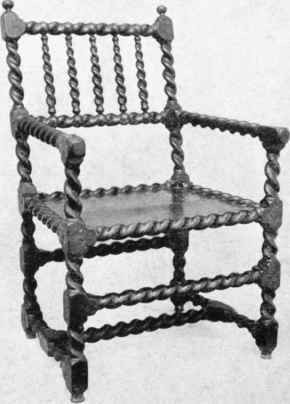
Plate LXXXIII Seventeenth Century Chairs - Corner Chair with Rush Seat and "Spanish Feet" Carved Oak (1670) "Low-leather" Chair,Flemish Turned Chair - Metropolitan Museum
The shape of the sofa was what we should designate as Empire. The ornaments that the decorator speaks of were at one end a big horn of plenty filled with flowers and ending in a bird, the head of which lay upon the floor. The other end also terminated in a bird and curved upwards in the form of a scroll.
Though the French beds and sofa-beds were fashionable in the first quarter of the century, the high-post and field-bed had not gone out of favor. We hear of mahogany carved bedsteads, maple carved bedsteads and down beds with pillows (1822); a bureau bedstead (1823); four-post curled mahogany bedsteads (1823); carved and plain mahogany high-post bedsteads, curled maple do. with screws and improved joints (1823); a "superb mahogany high-post bedstead with elegant cornishes," cost $100 in 1824; mahogany and curled maple and field-bedsteads (1824); rosewood, mahogany, plain and curled maple bedsteads, with a variety of French patterns (1825); French bedsteads, mahogany and field-bedsteads (1825); French bedsteads with curtains (1825); rosewood, mahogany and French and curled maple bedsteads (1826); mahogany high-post and French bedsteads (1826); and maple high-post and field-bedsteads (1826).
Continue to:


My Books

