


Sofas. Continued
Description
This section is from the book "Colonial Furniture In America", by Luke Vincent Lockwood. Also available from Amazon: Colonial Furniture In America.
Sofas. Continued
The Sheraton sofa shown in Figure 660 belongs to Mr. R. T. Haines Halsey, of New York. On the surface of the top rail are carved, in cameo carving, festoons of drapery caught up with bow knots. At the centre is an oval panel within which is carved a bunch of arrows. Extending from the oval panel are streamers of bell flowers. The tops of the arms are reeded as are also the bulb-shaped supports. A carved rosette finishes the block above the legs, which are turned and reeded.

Figure 660. Sofa, Sheraton style, 1790-1800.
Sofa, Sheraton style, 1790-1800.
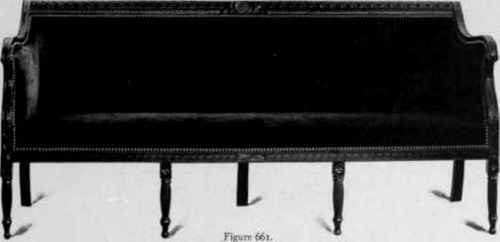
A beautiful Sheraton sofa, the property of Mr. H. W. Erving, is shown in Figure 661. The top is carved in an egg-and-dart design, and at the centre is carved a shell with foliated streamers very similar to the design found on the chamher-table (Figure 111). Just below the egg-and-dart pattern is a finely carved narrow border of acanthus leaves. The top and front of the arms arc carved in a scale design. The front rail is carved in a beautiful upright acanthus-leaf design with a rosette at the centre. The legs are reeded. The carving on this sofa is of a very fine quality. The shell at the centre of the back is very unusual on a Sheraton piece, but the rosettes and legs place it beyond question in that school.
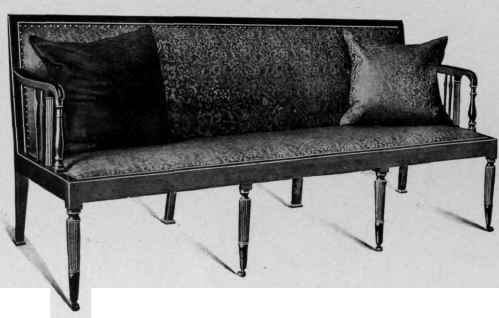
Figure 662. Sheraton Sofa, about 1800.
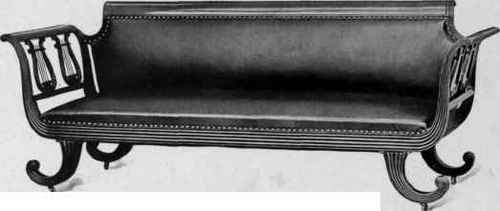
Figure 663. Sofa, Phyfe style, 1800-10.
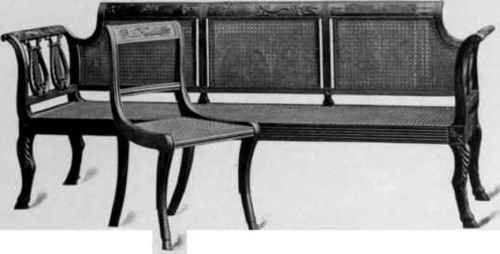
Figure 664. Cane Sofa, Phyfe style, 1800-10.
Figure 662 shows a Sheraton sofa which was purchased in 1799 and is now in the possession of the Misses Andrews. The arms with spindle supports and the slender reeded legs are characteristic. Many sofas of this kind, both plain and inlaid, are still to be found in this country.
Following the foregoing type of sofa came the late Sheraton style, with its classic form, of which Figure 663 is a splendid example. This sofa was made by the New York cabinet-maker, Duncan Phyfe, of whom mention is made in the chapter on chairs. The top rail is panelled and is attached to the arms at a single point, giving the piece somewhat the appearance of a French bedstead with a back. The rolling arms are well proportioned and form a continuous line with the front rail. The whole surface is reeded. Each arm consists of two lyres with brass strings. This was a popular theme in the early nineteenth century. The legs are scroll-shaped and reeded. The sofa is the property of Mr. R. T. Haines Halsey, of New York.
Another very fine specimen of a sofa in similar design is shown in Figure 664. The top of the back is divided into three panels; upon the surface of each of the two outer ones is carved, in cameo carving, fasces, and on the centre panel are carved two cornucopias with ends entwined. A smaller pair of cornucopias are carved on each arm. As in the preceding figure, the arms are each composed of two lyres with metal strings. The surface is carved with acanthus leaves. The three cane panels of the back are separated by reeded stiles. The front rail is also reeded. The piece stands on four goats' legs terminating in goats' hoofs. It is the property of Mrs. Ellings, of New York.
Figure 665 shows a small sofa or seat in the Phyfe style. The front is outlined by a long scroll which terminates in the arms on either side. This scroll is finished with rosettes at the ends and at the centre. The legs are curved in an opposite direction and terminate in animal's claw feet. The seat sets within the large scroll and all of the flat surfaces are reeded in the usual manner of the period. The top rail of the back is carved in panels, at the centre is drapery with tassels, and at each side is a bundle of sticks tied at the centre with a bow knot; and the latter pattern is repeated on the sides above the arms. This piece was the property of the late Mrs. Frank H. Bosworth, of New York.
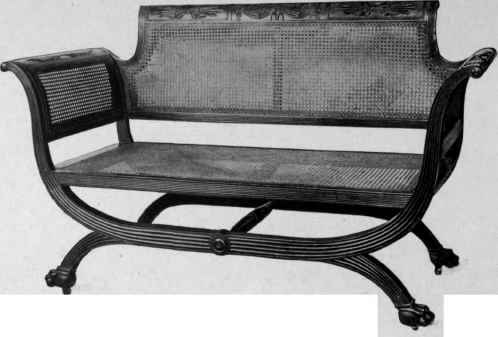
Figure 665. Cane Sofa, Phyfe style, 1800-10.
Figure 666 shows another popular design of a sofa of this period. The surfaces are reeded; the legs are scrolled, terminating in brass claw feet. At the turn of the scrolls on the arms are carved rosettes. This style of foot was very popular for tables as well as sofas, and many examples arc to be found in this country. One end of the sofa is low, to hold the head reclining. This piece is the property of Mr. Francis H. Bigelow, of Cambridge.
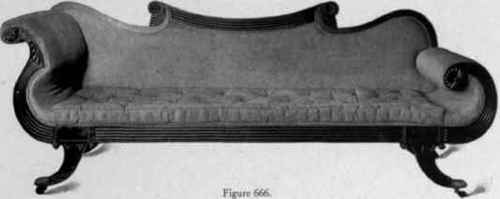
Sofa in Phyfe style, 1800-10.
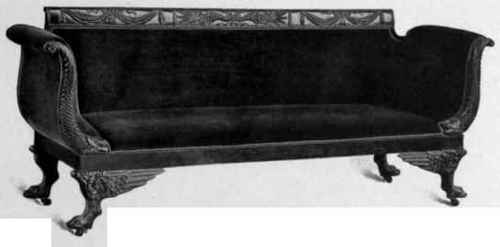
Figure 667. Sofa in late Sheraton style, 1800-10.
Figure 667 shows a sofa which was the property of the late Judge Arthur F. Eggleston, of Hartford, and which is a good example of the transition between the Sheraton and Empire styles. The top rail is divided into three panels carved in cameo carving, after the manner of the Sheraton school. In the centre one are two cornucopias fastened with a bow knot at the centre out of which project heads of wheat Drapery caught at the centre with bow knots and tassels decorates the outer panels. The rest of the sofa is in the earlier Empire style. On the front of each arm is carved a dolphin. The feet are well-carved animal's claws, at the head of which are eagle wings extending under the seat rail.

Figure 668. Empire Sofa, 1810-20.

Empire Sofa, 1810-20.
Figure 668 shown another sofa which belongs to the Misses Brown, of Salem, Massachusetts. The arms are in the form known as swan-neck. The legs are made to represent animal's legs with claws, and above are carved wings in imitation of the Egyptian or Assyrian style.
Figure 669 shows a very ornate example of a sofa in the Empire style. The general shape is the same as that shown in the preceding figures. Across the back is carved an eagle's head with wide, extending wings. The arms are carved to represent dolphins, the tails forming the curves. The legs are also dolphins with heads resting on the floor and the tails twisted and extending to the rails. This sofa is the property of Mr. K. W. Mansfield, of Westport, Connecticut.
Empire Sofa, 1810-20.
Sofa, Empire style, 1810-20.
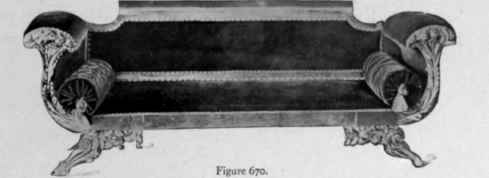
Figure 670 is a sofa dating about 1810 to 1820, commonly called the cornucopia sofa, so named from its shape and the carving of the arms. The round pillows shown at the ends of the sofas are known as squabs. The legs of this piece terminate in claw feet and above them is a slab of wood carved in a design of fruits. This sofa is the property of Mrs. L. A. Lockwood.
A common form of Empire sofa had the back finished with a heavy round rail carved at each end.
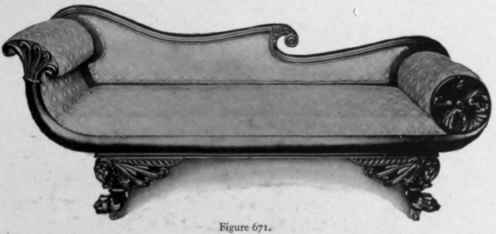
Another example of an Empire sofa very common in the South is shown in Figure 671. At one end is a squab built in with a large carved rosette finishing the end. The other end is high. The legs are in the form of animal's feet with wings.
Empire sofas such as have been described were extremely popular in America during the early part of the nineteenth century. They were followed by the massive clumsy pieces without carving popular as late as 1850.
Continue to:


My Books

