


Chapter X. Folding Screens
Description
This section is from the book "It's Fun To Build Things", by W. T. R. Price. Also available from Amazon: It's Fun To Build Things.
Chapter X. Folding Screens
There's no particular trick about making folding screens, and there are several ways of doing it.
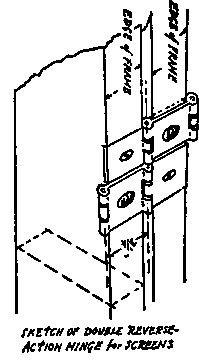
For joining them to open either way, you need to get double-acting hinges, here sketched.
The dimensions may be anything you want, and you may build your screen with three or four panels. The panel may be built as though it were a cupboard door, or you may use 3/4" plywood, with no frame. (In this case you are in for a patient job of sandpapering, to get the edges really smooth.) Framed panels are best made with mill lumber that has a groove in it, though that isn't always so easy to get. The second kind is a little more common, and has the advantage that you use masonite, or a panel of any thickness, whereas with the channel groove you have to find a panel (as you can in plywood) of exactly the thickness of the groove.
Framed screens, as made professionally, are built at the corners with a mortice-and-tenon joint, like a regular door, but unfortunately this requires tools and skills which we found lacking when we wanted to build a cupboard door, and which are still lacking, as far as the amateur is concerned.


To the left, a sketch of the special double-acting hinge which allows the panels to open either way.
Above, sections showing three different ways of constructing the panels of a folding screen. The third method avoids use of special grooved lumber, being made up of thin strips.
So far as building is concerned, the folding screen presents no staggering problems. If weight is a consideration, better to build framed panels of light plywood-the kind with a core of balsa wood. If a maximum surface for decoration is the thing, the ideal screen is made simply of large pieces of 3/4" thick plywood, very diligently sandpapered as to the cut edges. And you need to be, as always in sawing plywood, very careful not to splinter the edges.
Mainly, the screen is a decorative affair which places the burden of our effort on decoration. And decoration is very much a matter of taste. There are so many different decorations for screens that only a few of known effectiveness are going to be suggested here-and even then, there's still the particular, individual thing you may want to do, especially if you are anything of a decorative painter. If you are, far be it from us to guide your inspired hand. Paint anything you fancy-and if you don't like it you have only yourself to blame.
If you are painting directly on the wood, of course you will "ground" it very thoroughly with a filler-coat of shellac, or a thick coat of "flat white." Flat paint often needs smoothing down with powdered pumice in order to give it an ideal surface for any very intricate or detailed piece of painting. Another ground for painting is canvas or sanitas, evenly glued to the panel-but in such a scheme you would need a framed panel and a cover-molding mitered around it to cover the edges. The advantage is a good painting surface, and one with a slight texture.

Decorative painting, very much in the modern manner, is often effectively done by incising the outlines directly in the wood, in this way giving definite areas within which to apply paint or, even better, lacquer, and even gold or silver leaf. The incised line technique (which, after all, is as new as ancient Egypt, where it was very popular) calls for a very fine gouge such as you get among the tools that are sold in art stores for making linoleum cuts or woodcuts. It's a matter of taste whether you want your incised line to be a V-cut or a U-cut. You can get either kind of a gouge, but the line you gouge out in the wood should not be much more than 1/16" wide.
As gold leaf and silver leaf are rather difficult to apply-indeed, necessitating a special and skilled technique-you might substitute some of the new gold, silver, and copper metallic papers, which, carefully cut to shape and glued down, have all the appearance of actual metal, and are non-tarnishing. This suggestion combines painting and "montage," which is the new and more or less professional term for mounting anything on something else.
We might as well think of screen decoration as in two major divisions: "art work" and "montage," even when the art work, as here, may call for montage as a technique. The design would still be original and creative.
Thus, we have all-paint and paint combined with the montage of materials which can't be painted. The second of these had better be confined to decorative designs executed in the incised line technique, because the incised line gives a definite boundary for the mounted material.
"Flexwood" is an intriguing material for decorative screen treatments-a paper-thin wood veneer, coming in a variety of richly figured woods. The design can be cut out with paper patterns (previously designed) for all the world like dress patterns. The pieces are then securely glued to the panel and given an oil-and-wax finish, or simply varnish. The entire panel may be worked out in flexwood, including the background of the design, or a lot of cut-outs. Tricky-looking animals, for instance, may be applied on a background of verimilion lacquer, with touches of gold or silver. (Does this sound decorative, or does it not?)
Yet another technique is one that calls for a jigsaw, but requires no greater skill than used to be expended on the making of jigsaw puzzles, which were so popular in soothing raveled minds during the Great Depression. From thin wood (plywood about the thickness of cigar-box wood) you cut out various units of the design, which, of course, you first fully develop to actual size on paper. These various raised parts of your design are painted or lacquered separately, as also the background. Then the cut-outs are glued on, and the whole given several coats of varnish. The jigsaw cut-outs are likely to look better if the edges are beveled down smooth, in a round bevel, with sandpaper.
Continue to:


My Books

