


Chapter I. An Ideal Bed-Room. - Its Walls
Description
This section is from the book "The Bedroom And Boudoir", by Lady Barker. Also available from Amazon: The Bedroom And The Boudoir.
Chapter I. An Ideal Bed-Room. - Its Walls
IT is only too easy to shock some people, and at the risk of shocking many of my readers at the outset, I must declare that very few bed-rooms are so built and furnished as to remain thoroughly sweet, fresh, and airy all through the night. This is not going so far as others however. Emerson repeats an assertion he once heard made by Thoreau, the American so-called "Stoic,"- whose senses by the way seem to have been preternaturally acute - that "by night every dwelling-house gives out a bad air, like a slaughter-house." As this need not be a necessary consequence of sleeping in a room, it remains to be discovered why one's first impulse on entering a bed-room in the morning should either be to open the windows, or to wish the windows were open. Every one knows how often this is the case, not only in small, low, ill-contrived houses in a town, but even in very spacious dwellings, standing too amid all the fragrant possibilities of the open country. It is a very easy solution of the difficulty to say that we ought always to sleep with our windows wide open. The fact remains that many people cannot do so; it is a risk - nay, a certainty - of illness to some very young children, to many old people, and to nearly all invalids.
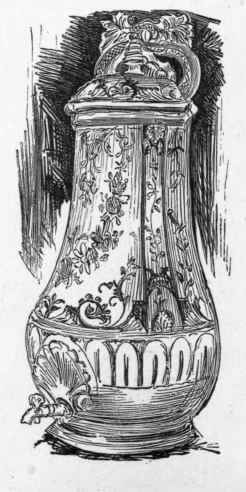

In a large room the risk is diminished, because there would be a greater distance between the bed and window, or a space for a sheltering screen. Now, in a small room, where fresh air is still more essential and precious, the chances are that the window might open directly on the bed, which would probably stand in a draught between door and fireplace as well. I take it for granted that every one understands the enormous importance of having a fireplace in each sleeping-room in an English house, for the sake of the ventilation afforded by the chimney. And even then a sharp watch must be kept on the housemaid, who out of pure "cussedness" (there is no other word for it) generally makes it the serious business of her life to keep the iron flap of the register stove shut down, and so to do away entirely with one of the uses of the chimney. If it be impossible to have a fireplace in the sleeping-room, then a ventilator of some sort should be introduced. There is, I believe, a system in use in some of the wards of St. George's Hospital and in the schools under the control of the London School Board, known as Tobin's Patent. Ventilation is here secured by means of a tube or pipe communicating directly with the outer air, which can thus be brought from that side of the building on which the atmosphere is freshest.
If report can be trusted, this system certainly appears to come nearer to what is wanted than any with which we are yet acquainted, for it introduces fresh air without producing a draught, and the supply of air can be regulated by a lid at the mouth of the pipe. A sort of double-star is often introduced in a pane of glass in the window, but this is somewhat costly, and it would not be difficult to find other simpler and more primitive methods, from a tin shaft or loosened brick in a wall, down to half a dozen large holes bored by an auger in the panel of the door, six or eight inches away from the top, though this is only advisable if the door opens upon a tolerably airy landing or passage. If it does not, then resort to some contrivance, as cheap as you please, in the outer wall leading directly into the fresh air. In most private houses it is generally possible to arrange for those to whom an open window at night is a forbidden luxury, that they should sleep with their door open. A curtain, or screen, or even the open door itself will ensure the privacy in which we all like to do our sleeping, but there should then be some window open on an upper landing, day and night, in all weathers. Believe me, there are few nights, even in our rigorous climate, where this would be an impossibility.
Of course common sense must be the guide in laying down such rules. No one would willingly admit a fog or storm of driving wind and rain into their house, but of a night when the atmosphere is so exceptionally disturbed it is sure to force its way in at every cranny, and keep the rooms fresh and sweet without the necessity of admitting a large body of air by an open window.
Supposing then that the laws of ventilation are understood and acted upon, and that certain other sanitary rules are carried out which need not be insisted upon here, - such as that no soiled clothes shall ever, upon any pretence, be kept in a bedroom, - then we come to the next cause of want of freshness in a sleeping-room: - Old walls. People do not half enough realise, though it must be admitted they understand a great deal more than they once did, how the emanations from the human body are attracted to the sides of the room and stick there. It is not a pretty or poetical idea, but it is unhappily a fact. So the only thing to be done is to provide ourselves with walls which will either wash or clean in some way, or are. made originally of some material which neither attracts nor retains these minute particles. Nothing can be at once cleaner or more wholesome than the beautiful wainscotted walls we sometimes see in the fine old country houses built in Queen Anne's reign. A bedroom of that date, if we except the bed itself, and the probable absence of all bathing conveniences, presented a nearly perfect combination of fresh air, spotless cleanliness, and stately and harmonious beauty to the eyes of an artist or the nose of a sanitary inspector.
The lofty walls of panelled oak, dark and lustrous from age and the rubbing of many generations of strong-armed old-fashioned housemaids, were walls which could neither attract nor retain objectionable atoms, and ventilation was unconsciously secured by means of high narrow windows, three in a row, looking probably due south, and an open chimney-place, innocent of "register stoves" or any other contrivance for blocking up its wide throat. Such a room rises up clearly before the eyes of my mind, and I feel certain that I shall never forget the deliciously quaint and hideous Dutch tiles in the fireplace, nor the expressive tip of Aha-suerus' nose in the tile representing his final interview with Haman. How specially beautiful was the narrow carved ledge, far above one's head, which served as a mantelpiece, over which simpered a faded lady with low, square-cut boddice, her fat chin held well into the throat, and a rose in her pale, wan little hand. A dado ran round this room about five feet from the floor, and I used to be mean enough, constantly, to try if it was a dust-trap, but I never could find a speck.
Continue to:


My Books

