


Furniture. Part 6
Description
This section is from the book "Principles Of Home Decoration With Practical Examples", by Candace Wheeler. Also available from Amazon: Principles of Home Decoration.
Furniture. Part 6
The dining-room shares with the hall a purpose common to the life of the family, and, while it admits of much more variety and elaboration, that which is true of the hall is equally true of the dining-room, that it should be treated with materials which are durable and have surface quality, although its decoration should be preferably with china rather than with pictures. It is important that the colour of a dining-room should be pervading colour - that is, that walls and ceiling should be kept together by the use of one colour only, in different degrees of strength.
For many reasons, but principally because it is the best material to use in a dining-room, the rich yellows of oiled wood make the most desirable colour and surface. The rug, the curtains, the portieres and screen, can then be of any good tint which the exposure of the room and the decoration of the china seem to indicate. If it has a cold, northern exposure, reds or gold browns are indicated; but if it is a sunny and warm-looking room, green or strong India blue will be found more satisfactory in simple houses. The materials used in curtains, portieres, and screens should be of cotton or linen, or some plain woollen goods which are as easily washable. A one-coloured, heavy-threaded cotton canvas, a linen in solid colour, or even indigo-blue domestic, all make extremely effective and appropriate furnishings. The variety of blue domestic which is called denim is the best of all fabrics for this kind of furnishing, if the colour is not too dark.
The prettiest country house dining-room I know is ceiled and wainscoted with wood, the walls above the wainscoting carrying an ingrain paper of the same tone; the line of division between the wainscot and wall being broken by a row of old blue India china plates, arranged in groups of different sizes and running entirely around the room. There is one small mirror set in a broad carved frame of yellow wood hung in the centre of a rather large wall-space, its angles marked by small Dutch plaques; but the whole decoration of the room outside of these pieces consists of draperies of blue denim in which there is a design, in narrow white outline, of leaping fish, and the widening water-circles and showery drops made by their play. The white lines in the design answer to the white spaces in the decorated china, and the two used together in profusion have an unexpectedly decorative effect. The table and chairs are, of course, of the same coloured wood used in the ceiling and wainscot, and the rug is an India cotton of dark and light blues and white. The sideboard is an arrangement of fixed shelves, but covered with a beautiful collection of blue china, which serves to furnish the table as well. If the dining-room had a northern exposure, and it was desirable to use red instead of blue for colouring, as good an effect could be secured by depending for ornament upon the red Kaga porcelain so common at present in Japanese and Chinese shops, and using with it the Eastern cotton known as bez. This is dyed with madder, and exactly repeats the red of the porcelain, while it is extremely durable both in colour and texture. Borders of yellow stitchery, or straggling fringes of silk and beads, add very much to the effect of the drapery and to the character of the room.
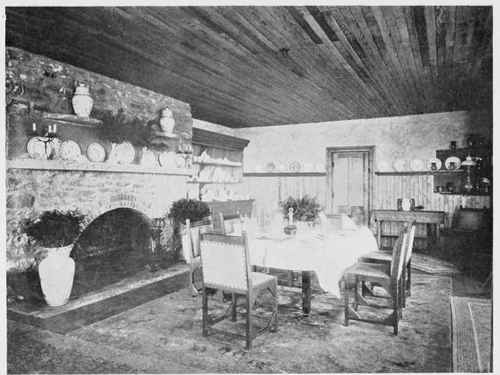
DINING-ROOM IN "STAR ROCK" (COUNTRY HOUSE OK W. E. CONNOR, ESQ., ONTEORA).
A library in ordinary family life has two parts to play. It is not only to hold books, but to make the family at home in a literary atmosphere. Such a room is apt to be a fascinating one by reason of this very variety of use and purpose, and because it is a centre for all the family treasures. Books, pictures, papers, photographs, bits of decorative needlework, all centre here, and all are on most orderly behaviour, like children at a company dinner. The colour of such a room may, and should, be much warmer and stronger than that of a parlour pure and simple, the very constancy and hardness of its use indicating tints of strength and resistance; but, keeping that in mind, the rules for general use of colour and harmony of tints will apply as well to a room used for a double purpose as for a single. Of course the furniture should be more solid and darker, as would be necessary for constant use, but the deepening of tones in general colour provides for that, and for the use of rugs of a different character. In a room of this kind perhaps the best possible effect is produced by the use of some textile as a wall-covering, as in that case the same material with a contrasted colour in the lining can be used for curtains, and to some extent in the furniture. This use of one material has not only an effect of richness which is due to the library of the house, but it softens and brings together all the heterogeneous things which different members of a large family are apt to require in a sitting-room.
To those who prefer to work out and adapt their own surroundings, it is well to illustrate the advice given for colour in different exposures by selecting particular rooms, with their various relations to light, use, and circumstances, and seeing how colour-principles can be applied to them.
We may choose a reception-hall, in either a city or country house, since the treatment would in both cases be guided by the same rules. If in a city house, it may be on the shady or the sunny side of the street, and this at once would differentiate, perhaps the colour, and certainly the depth of colour to be used. If it is the hall of a country house the difference between north or south light will not be as great, since a room opening on the north in a house standing alone, in unobstructed space, would have an effect of coldness, but not necessarily of shadow or darkness. The first condition, then, of coldness of light would have to be considered in both cases, but less positively in the country, than in the city house. If the room is actually dark, a warm or orange tone of yellow will both modify and lighten it.
Continue to:


My Books

