


Metal Work In Italy, Germany, France, And England. Part 3
Description
This section is from the "Historic Ornament - Treatise On Decorative Art And Architectural Ornament" book, by James Ward. Also see Amazon: Historic Ornament - Treatise On Decorative Art And Architectural Ornament.
Metal Work In Italy, Germany, France, And England. Part 3
Some names of Italian goldsmiths about or immediately after Cellini's time are - Luca Agnolo, Valerio Vicentino, Pilote, Piero di Mino, Vincenzo Dati, Girolamo del Prato. The latter was a native of Lombardy. Benedict Ramel, Fran*¡is Desjar-dins, Delahaie, and Fran*¡is Briot are names of French goldsmiths of the sixteenth century. Many models of vases, ewers, plates, cups, and tankards were made by Briot in pewter that are still in existence. These pewter models were usually made by goldsmiths, no doubt, as models for their gold and silver work, or in some cases were casts taken from the finished works, and kept as mementos or as replicas in design of their more costly works, and were also sold to those whose means would not permit them to indulge in the more costly gold and silver plate. Briot's pewter models are among the best examples of design and workmanship in metal of the sixteenth century.
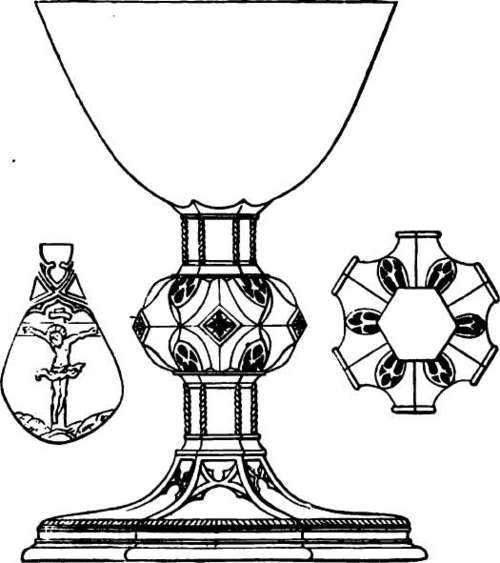
Fig. 164. English Chalice, Corpus Christi College, Oxford; 1507. (C).
Fig. 165. Standing Cup, Corpus Christi College, Cambridge; 1599. (C).
Fig. 166. Enamelled Cup at King's Lynn; 1350. (C).
Fig. 167. Hanap; German. (S. K. M).
Fig. 168. Monstrance; Italian; Fifteenth Century. (S. K. M).
Fig. 169. Pax; Italian; Sixteenth Century. (S. K. M).
Fig. 170. Pendant, attributed to Cellini, in the Library at Paris.
In Germany the art of the metal worker flourished in the sixteenth century in its greatest perfection at Nuremberg and Augsburg.
The German goldsmiths' work, especially at the end of the century, was almost identical with that of the Italian school. The similarity is seen in the details of the ornamentation, the masks and figures; the difference may be noted in the extraordinary development of the cartouche and strap-work of the German work, more especially in that of the Netherlands.
Many German artists of this time, who were chiefly engravers, designed for the goldsmiths and produced engravings from which goldsmiths' work and enamel paintings on metal were executed.
Virgil Solis, of Nuremberg, Theodor de Bry, of Liege, the Collaerts - father and son - of Antwerp, are some of the principal engravers who designed very largely for jewellery and other goldsmiths' work.
These German engravers and designers of ornament went under the designation of the "Little Masters," but in point of fact some of. their work would compare favourably with the compositions of many of the so-called "Great Masters." Generally speaking, they were pupils or followers of Albert D�rer.
As a designer and engraver of figure work, Hans Sebald Beham must be placed first in the rank of the "Little Masters," and for ornament purely the name of Heinrich Aldegrever must head the list.
Albert Drer
Albert Drer, whose great name overshadows all German art, though he tried his gifted hand at ornament, as in the car of the "Triumph" and in the "Book of the Hours," designed for the Emperor Maximilian, was not altogether successful in the matter of ornament, for his work in this line is much too loose and florid, with much unrestrained and naturalistic flourishing.
Hans Burgkmair, Of Nuremberg
Hans Burgkmair, Of Nuremberg, his contemporary, was better at ornament than D�rer, and was the chief artist of that great work, the "Triumph of Maximilian," in which he strove to unite the Gothic and the style of the Renaissance. His work generally takes the form of elaborate heraldry.
Hans Holbein
Hans Holbein, as well as being a great painter, was also a famous designer for goldsmiths' work, and was a master in ornament, especially in the application of the figure to ornamental purposes. He was in some measure a pupil of Hans Burgkmair, and was thoroughly imbued with the spirit of the Renaissance. Holbein the elder his father - was a well-known artist, who worked in the old German Gothic style.
The younger Holbein began his artistic career as a goldsmith, and his designs of sword and dagger handles, in which the figure forms so admirably follow the lines of the composition in a remarkable degree of ornamental fitness, reveal his fine sense and feeling for ornament.
In Italy the sculptor, Luca Signorelli, employed the figure and animal forms with an equal degree of skill, and with the same feeling for ornament. Both artists thoroughly understood the correct laws of ornamental composition, which was not by any means a universal gift with the artists of the Renaissance period.
Holbein designed many cups, one of which was a rich example of a standing cup and cover which was designed for Jane Seymour, one of the wives of Henry VIII, of England. The drawing for this cup is preserved in the British Museum.
During the sixteenth century the art of metal working in Germany, especially at Nuremberg, Swabian Augsburg, and L�beck, reached a high state of perfection under the great patronage of wealthy families, such as the Fugger family, of Augsburg, and others. Holbein, and other German, Dutch, and Flemish artists, worked in England, and besides much German and Flemish Renaissance work found its way into England, and influenced in a great degree the style of the metal work of this country.
In addition to the gold and silver plate of the kings' palaces and of private families, corporations and colleges accumulated great quantities of plate, and before banks were properly established, gold and silver plate and jewellery were the chief store of wealth that could, when necessary, be easily converted into money.
King Henry VII. had a service of plate valued at twenty thousand pounds. This monarch employed the Italian sculptor and goldsmith, Torrigiano, and other foreign artists.
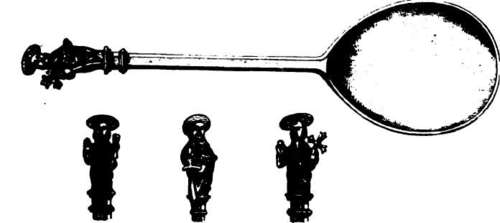
Fig. 171. Apostle Spoons; 1566; at Corpus Christi College, Cambridge. (C).
Henry VIII. also employed many Italian and German artists and goldsmiths, and it is believed that Cellini executed some of his finest jewellery for this king.
Continue to:


My Books

