


How To Use The Scroll-Saw. Part 3
Description
This section is from the book "Our Homes And Their Adornments", by Almon C. Varney. Also available from Amazon: Our Homes and Their Adornments.
How To Use The Scroll-Saw. Part 3
Overlaying
When the amateur has become master of his saw, so that he can saw delicate and intricate work, he should do overlaid work, as this is very neat and a change from other work. Ordinary flat picture-frames can be overlaid with vines and fine tracery. Here is an instance where glue becomes very useful, for one can fasten overlaid work on finished wood, where ordinarily it requires escutcheon pins, but all know it is not pleasant to drive them in light and frail work. Very pretty photograph frames are made by taking a pine board and sawing an oval out of the center and covering the pine with velvet. Fasten the overlaying on velvet. Designs for overlaying, such as vines or clusters of flowers, a head or any other ornament, can be procured of almost any dealer; but a great many. pretty designs for this work can be obtained in such books as the Ladies' Book and Harper's Bazaar.
Silhouettes
Few articles made with the scroll-saw are more ornamental than Silhouettes. Many designs can be found in books for children. They should be cut from material one-sixteenth of an inch thick, or from veneers. Black and white are favorite colors, or ebony and white holly. It requires a tough wood. The finest and best saws should be used. When veneers are used, they should be placed between two pieces of a sixteenth of an inch in thickness each, and fastened firmly. Silhouettes are used in various ways, by overlaying on polished wood or paper placed on a board for a background. If you possess a treadle machine, you can make decorations for your wall, or even make a nice border. Paste a very dark strip around for the border, then procure white holly veneer and saw out a variety of patterns - you can saw one-half dozen or more at one time. Glue them on the dark border, each equal distances apart. If you wish to saw a perfect likeness of one of the family or a friend, place a piece of paper on the wall, and with a strong light throw a shadow on the paper; now with a pencil trace the features, and with a pantagraph reduce to any size you wish. With a little practice you can do excellent work.
You can decorate an easel you wish to give to a friend with his own likeness, by obtaining it in this way and reducing as stated, placing the picture on wood, saw it out and overlay the object to be given away.
Sand-Papering
To sand-paper flat surfaces, alway use a block. Take two pieces of pine, three by four inches, and three-eighths of an inch thick; through one of them put a few slender screws, just long enough to come through about one-eighth of an inch; file these points sharp, take a piece of sand-paper four inches wide and seven and one-half long, lay one end on the screw points, press the paper over them, place another block on this, and fasten the two together with screws; two sets of blocks are best, one for fine, the other for coarse, paper; lay the work on a bench, hold the board with one hand and rub with the other, giving it a circular motion, and move rapidly; begin with No. I, finish with No. oo. Another good way for small work: Lay the whole sheet of paper on a bench or level board, turn the piece to be sandpapered down on it and rub. Small work can be done nicely in this way.
Fret Sawing in Metals, Shell, Pearl, and Ivory.
Brass, gold, silver, shell, ivory, and pearl can also be used by Fret Sawyers, many beautiful and useful ornaments being produced by them. It is not generally known, but is a fact, that brass, tin, zinc, and other composition metals, can be cut with the bracket saw almost as easily as wood.
In sawing out thin metals, or thin and brittle substances, the article to be sawed should be placed between two thin pieces of walnut. The design can be placed on the wood as ordinary work, and the wood and metal sawed through at the same time. By this means very delicate work can be wrought, as the wood forms a support for the thin metal. No matter how fine the lines may be, or how intricate the work, with a steady hand and keen eye the saw will cut hair lines as well as coarse ones.
For metal sawing, only the best blades should be used.
Nos. I, O, and 00 are most desirable. In this manner, earrings and various articles of jewelry and ornament may be produced.
Beautiful ornaments can also be cut from brass, silver, ivory, etc., for inlaying into woods of contrasting colors. Sheet brass, copper, and other metals can be procured of various thicknesses. A silver coin can be hammered quite thin and flat. With the fret-saw this can be worked up into articles of jewelry, or for inlaying purposes. Silver in-layed into ebony is very beautiful.
Hard, vulcanized India-rubber is manufactured in sheets about two feet square, and is sold by the pound. It can be easily cut, and is very attractive and convenient to use for jewelry, card-baskets, etc. Even a handsome clock case can be made from this material. When sawing rubber, frequently place a little oil on the blade, to reduce friction.
In putting nice work together, it is of importance to do it well, as good work can be easily spoiled. Hinges can be had at most stores, but they are usually too plain for fine work, and we propose to show how an ornamental hinge can be made by means of the fret-saw. Sheet brass, copper, or other metals, can easily be procured of various thicknesses. The best suited for this purpose will range from 1/64 to 1/48 of an inch. Upon a piece of metal, the requisite size, trace, with a fine awl point, the design you have selected. Saw out the design, and leave flange sufficient to form a turn or socket, where the two parts of hinge are to be united by a pin. This flange will at first be straight, but by using a pair of small pliers and working it with a light hammer around a steel wire fully as large as the diameter of the pin, it will take a tubular shape. To the other half of the hinge there will be, of course, two more flanges to be made in the same way. The pin should be fitted as true as possible in order that the hinge may open and shut easily.
The hinges should be fastened on with small wire pins, holes of proper size being drilled through the metal and wood.
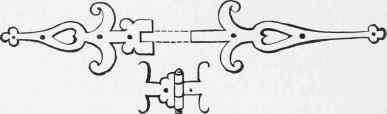
Fig. 85.
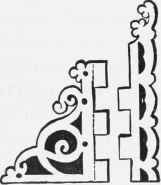
Fig. 86.
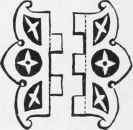
Fig. 87.
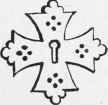
Fig. 88.
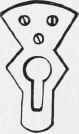
Fig. 89.
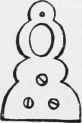
Fig. 90.

Fig. 91.
Escutcheons for key-hole ornaments can also be cut from brass and other metals. A few styles are shown above.
Many other small articles from metals can be cut out with the saw. We illustrate two very useful ones. They are metal loops for suspending clock cases, picture-frames, brackets, etc. For this, sheet brass is used. As nail-heads vary in size, the hole by which the loop is passed over the nail should be sufficiently roomy for the largest-sized picture-nail. Fret-work boxes can be still further ornamented by means of corner braces cut in neat designs from brass. These can be cut in pairs by following the directions already given.
Continue to:


My Books

